Suqaar
Somalia
Understanding : Suqaar
🥘🌍 INTRODUCTION
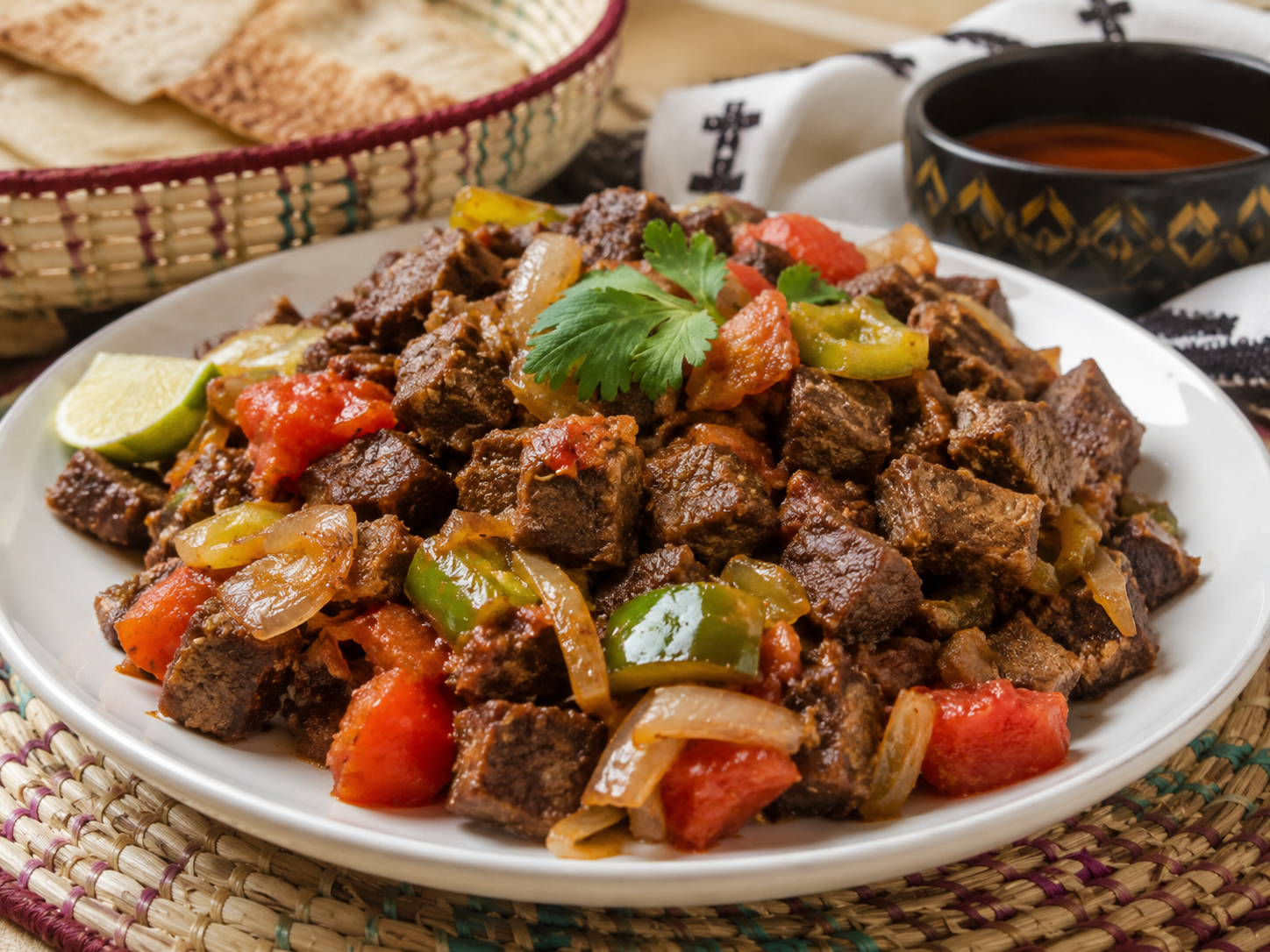
Suqaar is one of the most representative dishes of Somali cuisine and, more broadly, of the culinary identity of the Horn of Africa. Its name refers to the idea of small cut pieces, which well describes its logic: meat cut into fine cubes, seared then sautéed with onions, peppers, tomatoes, garlic, spices, and herbs, until a concentrated, fragrant, and juicy whole is obtained. Often served with fragrant rice, canjeero/laxoox (a type of Somali flatbread) flatbreads, or flatbread, suqaar occupies a central place in family meals, popular restaurants, and convivial settings.
At first glance, the dish may seem similar to other meat stir-fries found around the world. However, suqaar has a distinctly Somali signature: a balance between the warmth of spices and vegetable freshness, quick but controlled cooking, and great flexibility of service depending on the time of day. It can be a hearty breakfast, a quick lunch, or a shared dinner. This versatility explains its lasting success.
Prepare this speciality
Choose a detailed recipe, adjust the portions and prepare your ingredients before starting. Our cooking tips and food safety advice complement the steps described in the recipes.
Explore further: Cooking tips · Food hygiene and safety advice.
History and uses
Its place in African cuisine is important because it embodies several major dynamics: the valorization of meat in small cuts to optimize cooking and sharing, the sophisticated use of spices in short preparations, and the urban anchoring of a cuisine capable of being both quick, nourishing, and expressive. Suqaar demonstrates that contemporary African cuisines are not limited to long festive dishes or traditional rural recipes; they also include efficient urban forms, deeply rooted in local habits.
🔥🧅 A PRECISE PAN TECHNIQUE: CUTTING, SEARING, JUICES, AND AROMATIC BALANCE
The success of suqaar begins with the cut. The pieces of meat must be regular and small, to cook quickly without drying out. Beef, lamb, or sometimes goat are frequently used depending on availability, preferences, and economic context. The size of the cubes allows for homogeneous cooking and promotes coating by spices and vegetable juices.
Cooking is generally done in two stages. First, the meat is seared over a fairly high heat to develop surface aromas. Then, onions, peppers, tomatoes, and aromatics are added, adjusting the heat to obtain a melting but not watery texture. The challenge is to maintain vibrancy: suqaar should not become a long stew. It must remain a cohesive stir-fry, where each ingredient retains an identifiable presence.
Spices play a structuring role. Depending on the household, cumin, coriander, pepper, turmeric, cardamom, and sometimes local blends similar to xawaash (a Somali spice blend) are found. Garlic and ginger can reinforce the aromatic tension. Chili is modulated according to habits. The goal is not to mask the meat, but to build a warm, clear, immediately recognizable depth.
Good suqaar has a slight sheen, tender pieces, cooked but still discernible vegetables, and a short sauce that coats without drowning. This technical precision reveals a cuisine of quick but demanding execution. A few minutes too long and the meat hardens, the vegetables fall apart, the aromas flatten. Suqaar requires a steady hand.
🌊🧭 THE HORN OF AFRICA ON THE PLATE: crossroads, exchanges, and Somali identity Suqaar carries the memory of the historical circulations of the Horn of Africa, a region connected for centuries to the Arabian Peninsula, the Indian Ocean, inland Africa, and maritime trade routes. These exchanges have enriched spice repertoires, cooking techniques, and table habits, without erasing local foundations. The result is a distinct Somali cuisine, at once African, oceanic, and caravaneer in its influences.
In this landscape, suqaar occupies a strategic place. It expresses an effective synthesis: meat, vegetables, spices, short cooking, flexible service. It dialogues with other Somali dishes (spiced rice, sauces, fermented breads) and naturally integrates into modern urban rhythms. It is also an excellent indicator of Somali culinary logic: clarity of tastes, measured generosity, importance of fragrance.
On an African scale, suqaar broadens the understanding of the continent's cuisines by highlighting the specificity of the Horn, sometimes less known than other major African gastronomic ensembles. It reminds us that culinary Africa is an archipelago of connected traditions, and that each region offers its own answers to the same questions: how to nourish quickly, well, with identity.
In my books

Continue exploring the continent’s cuisines with Africa at the Table — 54 countries, 54 iconic dishes, by Alioune FALL. This book is in English.
Explore further
🏙️🤝 EVERYDAY DISH, HOSPITALITY AND DIASPORIC MEMORY
Suqaar is deeply rooted in daily practices. It is appreciated for its speed, intense taste, compatibility with various accompaniments, and its ability to please a variety of guests. In homes, it allows for cooking a complete meal without hours of preparation. In small restaurants, it meets the demand for hot dishes served quickly.
Its social dimension is strong. Suqaar is shared, often in the center of the table, with bread or rice. It promotes direct conviviality: everyone makes their bite, adjusts chili and condiments, and extends the meal with conversation. This relational simplicity is one of the great strengths of African cuisines: dishes designed to create connection as much as to nourish.
In the Somali diasporas in Europe, North America, the Middle East, or elsewhere in Africa, suqaar occupies a major identity place. Easily reproducible with locally available products, it serves as a bridge between generations. It allows for the transmission of a taste memory without depending on complex equipment. Its fragrance becomes a marker of belonging, a reminder of home, a cultural continuity in motion.
🥗⚖️ NUTRITION, ADAPTABILITY AND CULINARY MODERNITY
From a nutritional point of view, suqaar offers an interesting base: animal proteins, vegetables, spices, moderate fat depending on the cooking method. The balance then depends on the accompaniments and portions. With white rice, it provides a significant energy intake. With bread, it promotes flexible and convivial consumption. With more vegetables, it can become lighter without losing its identity.
The dish is also very adaptable to contemporary expectations. One can reduce fat, increase the vegetable portion, choose leaner cuts, modulate salt and chili. Some modern versions even include non-meat alternatives inspired by the structure of suqaar, while retaining the logic of fine cutting, quick searing, and spicy seasoning.
This adaptability explains its longevity. Suqaar remains faithful to its technical core while evolving with time, budget, and public health constraints. It proves that a traditional dish can remain fully current without losing its cultural truth.
✨🍽️ A MAJOR PLACE IN AFRICAN CUISINE: efficiency, character and living heritage Suqaar deserves a central place in African cuisine because it combines culinary efficiency, historical depth, and identity strength. It shows that a quick dish can be rich in meaning, that a stir-fry can carry a memory of regional circulations, and that an everyday recipe can become living heritage.
It also contributes to the recognition of the cuisines of the Horn of Africa in continental and global gastronomic narratives. Too often, these cuisines remain underrepresented despite their sophistication. Suqaar, with its readability and aromatic power, can play an ambassadorial role: accessible to diverse palates, but firmly rooted in a Somali tradition.
🌍 CONCLUSION
Ultimately, suqaar is much more than just sautéed meat. It is a method of composition, a culture of the pan, an art of nourishing quickly without sacrificing taste or social connection. It tells of an urban, mobile Africa, confident in its know-how. It also tells of continuity: that of a cuisine capable of crossing borders, adapting to contexts, and remaining true to its soul.
In the mosaic of African cuisines, suqaar thus occupies a clear and necessary place: that of an everyday dish with high cultural intensity, where technique, history, hospitality, and immediate pleasure meet. It is precisely this alliance that makes its greatness.
In the kitchen : Suqaar
Recipes from the site to put your knowledge into practice:
Discover these cuisines at a restaurant
Explore our restaurant and caterer directories. Choose your destination and check the establishment’s menu to confirm which dishes are offered and available.
Continue exploring
Enjoy discovering ingredients and African cuisines? Join our newsletter. The illustrated PDF 10 sauces africaines incontournables is in French and is offered after confirming a subscription to the French or bilingual edition.