Egusi soup
Nigeria, West Africa
Understanding : Egusi soup
🍲🌍 INTRODUCTION
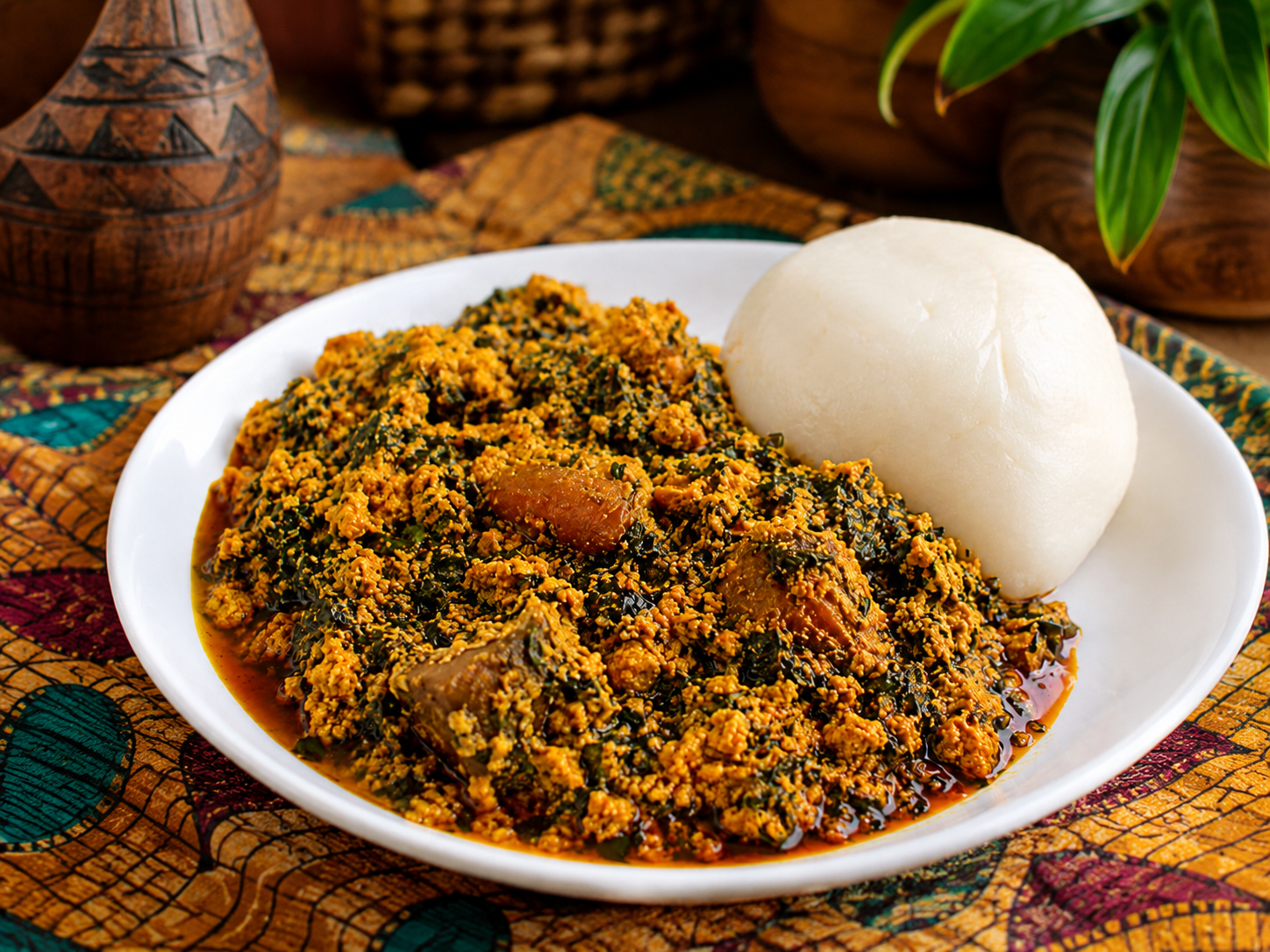
Egusi soup is one of the great culinary monuments of West Africa. Prepared from ground melon seeds (egusi), cooked with oil, chilies, leafy greens, and various protein sources, it holds a central place in Nigeria and neighboring areas where techniques, ingredients, and table habits circulate. Its identity is based on a dense and velvety texture, a deep nutty taste, and a great capacity for regional adaptation. It is a soup in the West African sense of the term, meaning a rich sauce intended to accompany starches like fufu, pounded yam, eba, amala, or other starchy pastes and balls.
To speak of egusi soup is to speak of living cuisine, family memory, agricultural geography, and sociability. It is also to recognize a form of popular excellence. Egusi soup is not a decorative dish: it is a dish of substance, sharing, and cultural continuity. It nourishes intensely, brings diners together around the same bowl or service, and connects generations through gestures passed down at home, in the market, and in celebration kitchens.
Prepare this speciality
Choose a detailed recipe, adjust the portions and prepare your ingredients before starting. Our cooking tips and food safety advice complement the steps described in the recipes.
Explore further: Cooking tips · Food hygiene and safety advice.
History and uses
Its place in African cuisine is fundamental. Firstly, because it represents the gastronomic power of West Africa, a region where sauces structure the architecture of the meal. Secondly, because it illustrates a major culinary intelligence: transforming a local seed into a creamy base capable of absorbing and harmonizing complex flavors. Finally, because it crosses borders, languages, and diasporas while retaining an immediately recognizable identity.
🥜🔥 A SOPHISTICATED TECHNIQUE: ROASTING, GRINDING, BINDING AND TEXTURE CONTROL
The soul of egusi soup lies in the shelled, dried, and then ground melon seed. Depending on practices, the seeds can be used raw ground or lightly toasted to develop deeper notes. This egusi powder is then incorporated in different ways: as a paste, in small lumps, or crumbled into the sauce. Each method produces a particular texture. Some versions seek more visible grains, others a homogeneous creaminess.
Cooking requires precise control of heat and the order of incorporation. Generally, an aromatic base is built with oil (often red palm oil in many traditions), chili, onion according to culinary schools, sometimes tomato in certain variants, then broth and proteins are added. Egusi acts as a body agent: it thickens, flavors, and structures the sauce. It must be stirred carefully to avoid undesirable lumps, control reduction, and prevent sticking to the bottom of the pot.
Leafy greens complete the profile. African spinach leaves, ugu (fluted pumpkin leaves), bitterleaf (prepared bitter leaf), or other greens depending on availability. They bring vegetable freshness, textural contrast, and balance against the lipid richness of the seed and oil. The right balance is delicate: too much reduction makes the sauce heavy, not enough makes it watery. A great egusi soup should coat, not flow like a clear broth.
Proteins also play a role in depth: meat, fresh or smoked fish, dried crustaceans, stockfish, or even multiple combinations depending on the context. This protein stratification, common in West African cuisines, creates powerful aromatic layers. The final result is dense, complex, long on the palate, built to accompany a neutral starch that serves as a taste support.
🧭🌾 TERROIRS, VARIATIONS AND CULTURAL CIRCULATION IN WEST AFRICA
Egusi soup is not a single, fixed recipe. It is a regional constellation. In Nigeria, different traditions (notably Yoruba, Igbo, Edo, and others) offer distinct versions regarding spices, leaves, proteins, egusi texture, and the use of certain fermented condiments. Neighboring countries share similar logics with their own ingredients and terminologies. This variability does not weaken the dish's identity; it confirms it. A great African classic exists precisely because it can thrive in multiple cultural ecosystems.
The dish also reflects agricultural realities. Egusi seeds, products of local systems, are integrated into dynamic markets where seeds, flours, dried fish, oils, and leaves circulate. This vibrant economy connects rural producing areas, urban markets, and domestic kitchens. Egusi soup thus becomes a meeting point between terroir and city, between seasonality and preservation.
In my books

Continue exploring the continent’s cuisines with Africa at the Table — 54 countries, 54 iconic dishes, by Alioune FALL. This book is in English.
Explore further
In the African culinary map, egusi soup is one of the great representatives of the sauce + starchy paste logic, a fundamental meal structure in many regions of the continent. This structure promotes sharing, satiety, and nutritional complementarity. It also offers great flexibility: richness, chili, proteins, and leaves can be adjusted according to budget and context.
🤝🏡 SOCIAL FUNCTIONS: sharing, celebrating, transmitting Egusi soup is deeply social. It appears in ordinary meals, but also on special occasions: family celebrations, community events, religious or civic celebrations depending on the context. Its generous nature makes it a welcoming dish. Serving a good egusi soup signifies the attention paid to guests.
Transmission is mainly through practice. Measurements are not always standardized; one learns by eye, by smell, by the viscosity observed during cooking. Elders teach when to add the leaves, how to “break” the egusi paste, how long to reduce, how to balance salt and chili. This sensory pedagogy is at the heart of African culinary heritage.
In West African diasporas, egusi soup plays a powerful identity role. Even with substitutions (different types of leaves, adapted protein sources), the dish remains a marker of cultural continuity. It allows for recreating a familiar taste space, transmitting a memory to children born far from the country of origin, and maintaining community solidarities around the table.
🥗📊 NUTRITION, ENERGY DENSITY AND MEAL BALANCE
From a nutritional perspective, egusi soup is particularly interesting. Egusi seeds provide lipids, vegetable proteins, minerals, and high energy density. Leaves contribute fiber, vitamins, and micronutrients. Animal or fish proteins enhance the intake of essential amino acids, iron, zinc, and B vitamins depending on the ingredients used.
This richness implies a logic of balance. Egusi soup is generally consumed with neutral starches that structure satiety and temper intensity. Portions and frequency depend on needs, lifestyle, and other meals. In a varied diet, it can hold a solid place due to its nutritional density. Modern adaptations can reduce excess oil, increase the proportion of leaves, or select leaner proteins without altering the dish's identity.
Egusi soup thus illustrates a key principle of African cuisines: nourishing fully with preparation systems adapted to local realities, while maintaining high sensory quality. It does not oppose nutrition and pleasure; it combines them.
✨🍽️ MAJOR PLACE IN AFRICAN CUISINE: heritage, technique and future The place of egusi soup in African cuisine is major and undeniable. It is a pivotal dish that connects technique, agriculture, culture, and social ties. Its strength comes from its ability to be both deeply local and widely shared. It exists in diverse versions but remains immediately identifiable by its core: the ground seed transformed into a creamy and powerful sauce.
It also represents an exemplary African response to contemporary challenges: valorization of local ingredients, intergenerational transmission, modularity according to resources, community anchoring. In a world that is rediscovering the interest of local cuisines and domestic know-how, egusi soup appears not as a curiosity, but as a reference.
🌍 CONCLUSION
Ultimately, egusi soup is much more than a soup. It is a complete culinary architecture, a language of sharing, an edible memory of West Africa. In the great mosaic of African cuisines, it occupies a prominent place: that of a dish that nourishes the body, strengthens the collective, and carries history in every spoonful.
Its longevity, adaptability, and gustatory depth make it a living heritage destined to remain central, both on the continent and in the diasporas. To speak of egusi soup is to recognize the greatness of African sauce cuisines, their technical complexity, and their immense cultural value.
In the kitchen : Egusi soup
Recipes from the site to put your knowledge into practice:
Discover these cuisines at a restaurant
Explore our restaurant and caterer directories. Choose your destination and check the establishment’s menu to confirm which dishes are offered and available.
Continue exploring
Enjoy discovering ingredients and African cuisines? Join our newsletter. The illustrated PDF 10 sauces africaines incontournables is in French and is offered after confirming a subscription to the French or bilingual edition.