Waakye
Ghana
Understanding : Waakye
🍚🫘 INTRODUCTION
Waakye is one of Ghana's most iconic dishes, particularly associated with the south of the country but loved far beyond regional borders. Its basic principle seems simple: cook rice and beans together, often with dried sorghum leaves or stalks which give a characteristic hue and a subtle aromatic nuance. However, reducing waakye to “rice and beans” would be missing its real importance. Waakye is a complete culinary platform, a meal system, a culture of composition, and a strong identity marker of West African cuisine.
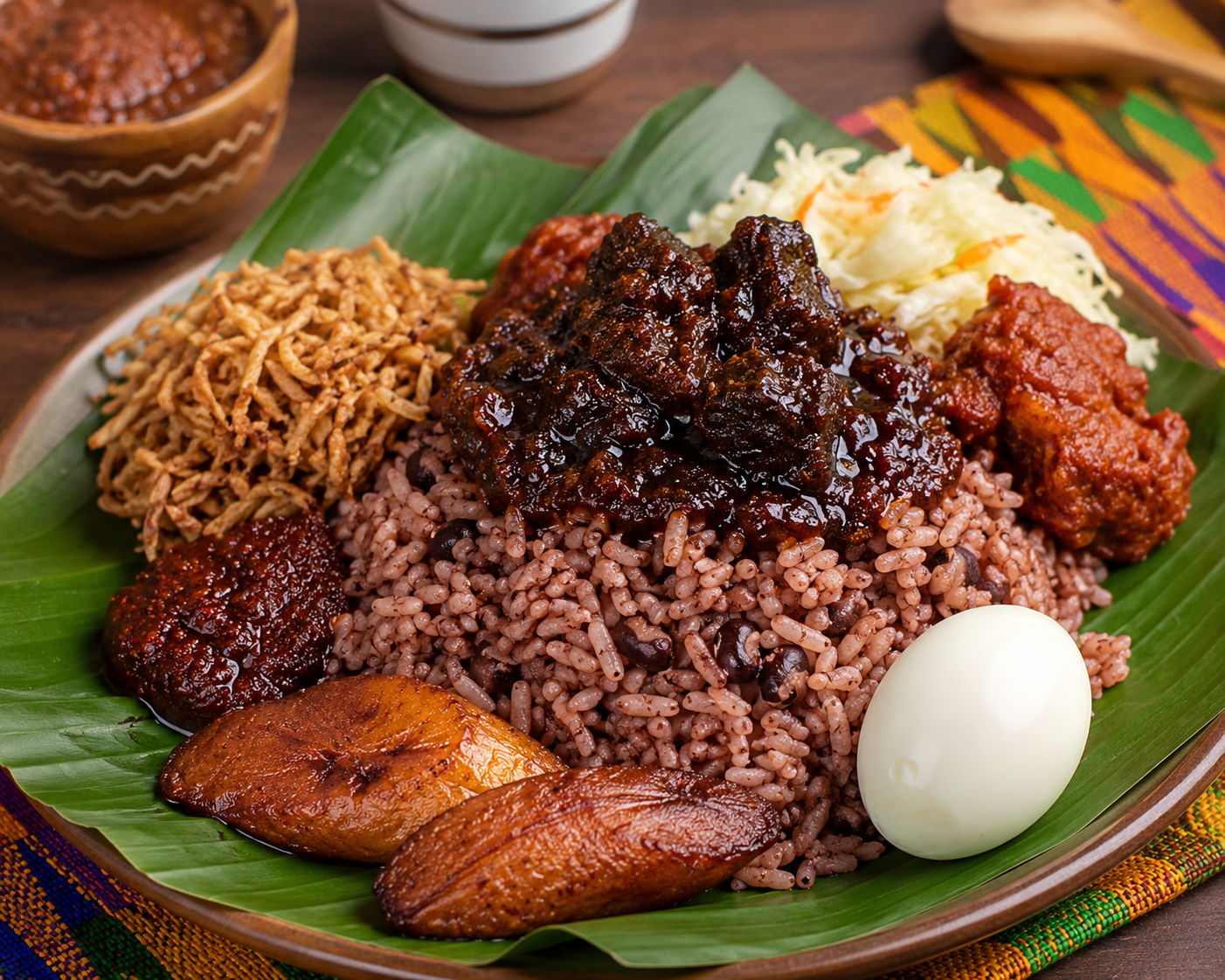
In its most vibrant expression, especially in street food, waakye is served with a constellation of accompaniments: shito (black chili sauce), cooked spaghetti, gari, salad, eggs, meat, fish, kelewele (spicy plantain), or even offal depending on local preferences. Each diner builds their plate according to their taste, budget, and appetite. This modularity explains its immense popularity. Waakye can be modest or very hearty, daily or festive, quick or elaborate.
Prepare this speciality
Choose a detailed recipe, adjust the portions and prepare your ingredients before starting. Our cooking tips and food safety advice complement the steps described in the recipes.
Explore further: Cooking tips · Food hygiene and safety advice.
History and uses
Its place in African cuisine is major because it condenses fundamental principles of the continent: cereal-legume association for satiety and balance, the central role of street food in popular innovation, the ability to structure a plural meal around a common base, and the cultural power of a dish shared transversally by different social classes. Waakye embodies a cuisine that is both accessible and sophisticated, where technique, economy, and pleasure coexist without contradiction.
🔥🍲 A TECHNIQUE FINER THAN IT SEEMS: joint cooking, color, grain texture The preparation of waakye begins with the choice of beans, often cowpeas or red/brown beans depending on habits and availability. Their cooking must be anticipated: too firm, they clash with the rice; too cooked, they mash and blur the texture. Success depends on a precise point of balance. The rice, added at the right time, must cook by absorbing the aromas without becoming pasty.
Using dried sorghum leaves, sometimes called waakye leaves commercially, is an important technical and visual marker. They influence the final color and contribute to the sensory identity of the dish. The dosage is delicate: the desired shade must be obtained without excessive herbaceous taste. Experienced cooks know how to calibrate water quantity, fire intensity, and cooking time to preserve legible grains, slightly linked but not sticky.
This mastery of texture is crucial. A good waakye presents tender rice with discernible grains, melting but whole beans, and controlled moisture. The base must be able to accommodate sauces and accompaniments without turning into a compact mass. This is why cooking is far from trivial: it requires reading the fire, timing, and intuition.
The quality of waakye also depends on managing salinity upstream. As the garnishes (especially shito, meats, fish) already provide an aromatic and saline load, the base must remain balanced to avoid saturation. This intelligence of assembly shows that waakye is a cuisine of composition, not a simple juxtaposition of elements.
🧭🌍 ORIGINS, GHANAIAN ANCHORING AND WEST AFRICAN RESONANCES
Waakye is deeply Ghanaian in its contemporary expression, but it is part of a broader West African culinary horizon where rice-legume associations are ancient and widespread. In many African societies, combining cereals and beans responds to a nutritional and practical logic: local availability, controlled cost, lasting satiety, flexibility of accompaniments.
In Ghana, waakye has established itself as a popular national marker, particularly in urban centers where specialized vendors structure daily eating routines. It is often consumed for late breakfast or lunch, but its use goes beyond fixed times. What matters is its role as a complete and adaptable meal.
Its spread in the Ghanaian diaspora has reinforced its status. In international cities, waakye becomes a culinary ambassador: it makes visible the complexity of West African tables and corrects the reductive idea that African cuisine is monotonous. On the contrary, waakye demonstrates great sophistication in assembly, where each component plays a precise gustatory and social function.
🏙️🤝 STREET FOOD, POPULAR ECONOMY AND CONVIVIALITY
Waakye is inseparable from Ghanaian street culture. Waakye vending points are places of flow, meeting, and loyalty. Customers return for a particular hand, a precise texture, a smokier shito, a better-seasoned meat. The reputation of a waakye vendor can become a neighborhood reference.
In my books

Continue exploring the continent’s cuisines with Africa at the Table — 54 countries, 54 iconic dishes, by Alioune FALL. This book is in English.
Explore further
Economically, this sector supports a large ecosystem: rice and bean producers, sorghum leaf suppliers, sauce preparers, protein vendors, packaging artisans, transporters. The dish is at the heart of an accessible food economy, creating jobs and micro-entrepreneurship, especially for women.
Socially, waakye is a great equalizer. Students, workers, families, visitors, all gather there. Everyone can adapt their portion to their means. This democratization of taste is a central dimension of its place in African cuisine: waakye is popular without being simplistic, affordable without being poor in flavors.
🌶️🍝 THE ART OF ACCOMPANIMENT: SHITO, CONTRASTS AND PLATE ARCHITECTURE
What distinguishes waakye from simple rice-bean preparations is its universe of accompaniments. Shito, a dark and intense chili condiment, brings depth, smokiness, umami, and heat. Gari adds a dry grain and a slight fermentative acidity. Spaghetti introduces a surprising soft texture, which has become classic in many street plates. Eggs, meats, or fish enhance satiety and complexity.
Kelewele, when present, creates a sweet-spicy counterpoint. Fresh salad, even minimal, provides a crunchy contrast and freshness. The whole may seem heterogeneous from the outside, but it obeys a precise logic of balances: hot/cold, soft/crunchy, fatty/spicy, sweet/salty, dense/fresh.
This architecture makes waakye a kind of modular culinary language. One composes according to desires, family habits, local traditions, and the day's budget. This flexibility is one of the great strengths of African cuisines: they offer robust frameworks capable of accommodating variation without losing identity.
🥗📊 NUTRITION, SATIETY AND FOOD MODERNITY
From a nutritional point of view, the waakye base combines complex carbohydrates (rice) and vegetable proteins/fibers (beans), which constitutes a solid foundation for energy and satiety. Accompaniments can enrich the intake of proteins, lipids, and micronutrients, but they can also make the whole heavier depending on the quantities of oil, sauces, and fried foods.
The strength of waakye is precisely its nutritional modularity. One can orient the plate towards more lightness (more vegetables, less fatty proteins, reduced portion of oily condiments) or towards more energy density according to needs. This adaptability explains its lasting relevance in a contemporary urban context.
The dish also addresses current issues: a complete meal at a reasonable cost, preparation in volume, strong cultural acceptability, and the possibility of progressive adjustments without breaking with tradition. It therefore represents an excellent example of food heritage capable of evolving with its time.
✨🇬🇭 A MAJOR PLACE IN AFRICAN CUISINE: identity, resilience and influence Waakye occupies a major place in African cuisine because it is at once a dish, a system, and a social institution. It articulates local agriculture, technical know-how, popular economy, pragmatic nutrition, and collective pleasure. It tells the story of Ghana, but also a certain idea of culinary Africa: inventive, structured, convivial, deeply rooted in daily realities.
Its influence now extends beyond its national cradle. In diasporas as well as in gastronomic scenes curious about African cuisines, waakye attracts with its generosity and complexity. It offers an ideal gateway to understanding that African dishes are not limited to a fixed recipe, but often stem from an intelligent assembly logic, resulting from long social and technical histories.
🌍 CONCLUSION
Ultimately, waakye is one of the great signatures of contemporary West Africa. It unites basic simplicity and compositional sophistication. It nourishes widely, brings people together naturally, and silently transmits a living heritage. In the mosaic of African cuisines, it deserves a prominent place: that of a popular classic that has become a lasting cultural landmark, capable of crossing generations, cities, and borders without losing its soul.
In the kitchen : Waakye
Recipes from the site to put your knowledge into practice:
Discover these cuisines at a restaurant
Explore our restaurant and caterer directories. Choose your destination and check the establishment’s menu to confirm which dishes are offered and available.
Continue exploring
Enjoy discovering ingredients and African cuisines? Join our newsletter. The illustrated PDF 10 sauces africaines incontournables is in French and is offered after confirming a subscription to the French or bilingual edition.