Mutura
Ethiopia
Understanding : Mutura
🌍🔥 INTRODUCTION
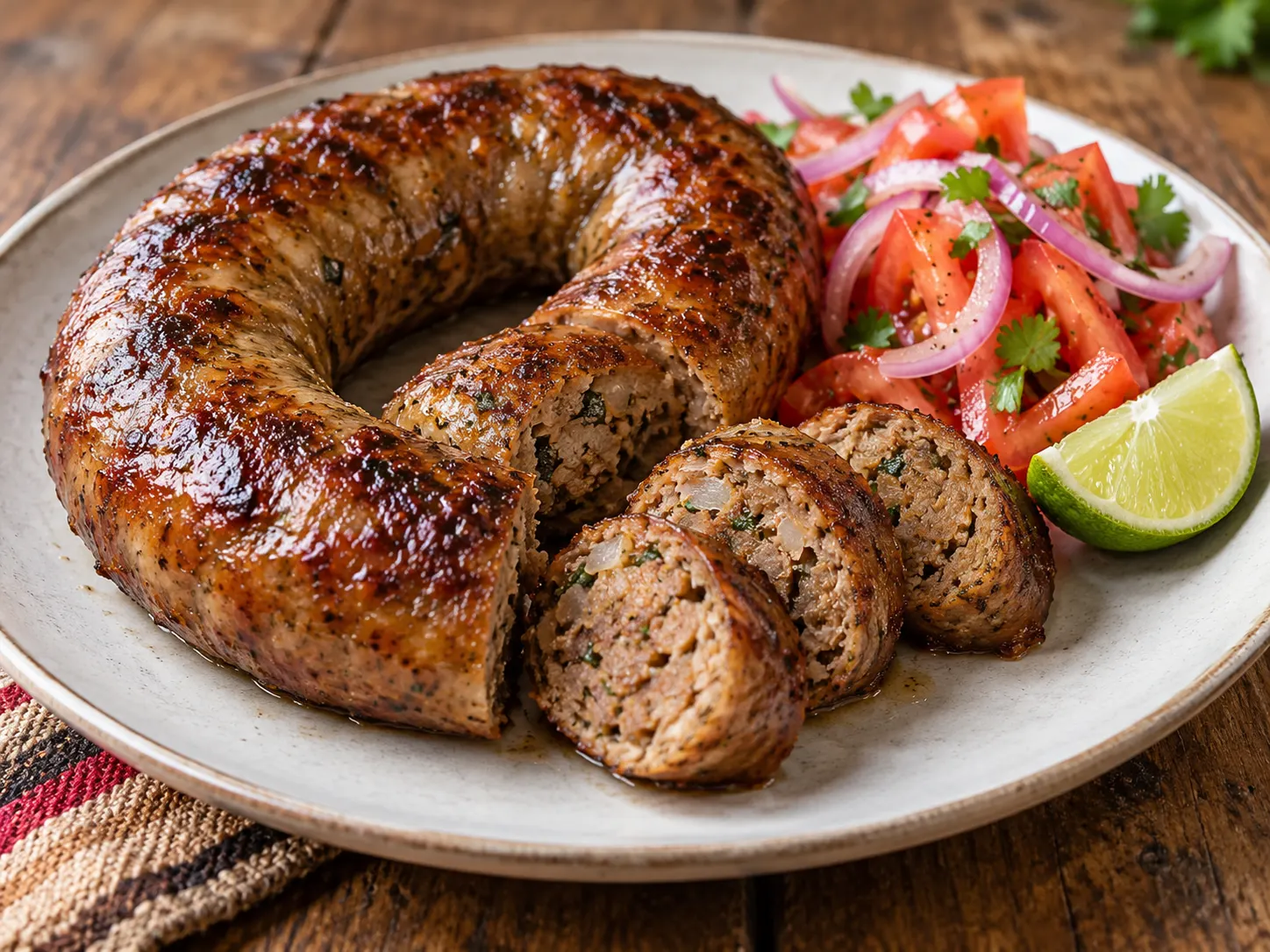
Mutura is one of Kenya's most iconic street foods, often described as a traditional African sausage prepared from cleaned intestines stuffed with a mixture of meat, fat, blood, and spices, then cooked and usually grilled over charcoal fire. Its culinary strength lies in its straightforwardness: powerful flavor, dense texture, smoky aroma, simple and direct service. But behind this apparent rusticity lies a rich technical, social, and cultural preparation.
In many urban neighborhoods, as well as peri-urban and rural contexts, mutura is much more than a snack. It is a marker of belonging, a taste of memory, a ritual of conviviality. People eat it standing near the grill, chatting, sharing, often with kachumbari (tomato-onion-chili salad) or simple accompaniments. Mutura is at the intersection of butchery, popular cuisine, and street culture. It transforms modest ingredients into an intense and communal culinary experience.
Prepare this speciality
Choose a detailed recipe, adjust the portions and prepare your ingredients before starting. Our cooking tips and food safety advice complement the steps described in the recipes.
Explore further: Cooking tips · Food hygiene and safety advice.
History and uses
Its place in African cuisine is major because it embodies fundamental logics present in many traditions across the continent: integral valorization of the animal, mastery of casing and stuffing techniques, live-fire cooking, collective consumption, and anchoring in popular economies. Mutura reminds us that African gastronomy is not limited to domestic "table" dishes; it also includes fast-paced, socially powerful, and technically elaborate urban forms.
🧵🥩 A TECHNIQUE OF PRECISION: cleaning, seasoning, stuffing, and grilling The success of mutura begins long before the fire. It starts with the treatment of the casings, a crucial step for both hygiene and sensory quality. The intestines must be carefully emptied, washed, turned inside out according to practices, and cleaned repeatedly to eliminate undesirable odors and impurities. This phase requires know-how, patience, and rigor.
The stuffing varies according to vendors and culinary heritage, but often relies on a mixture of finely chopped meat, fat, and spices. In some traditions, blood is incorporated for texture, color, and flavor depth. Seasoning can include salt, pepper, coriander, chili, garlic, ginger, onion, and sometimes secret local combinations. The mixture must be homogeneous without becoming pasty, to maintain a pleasant chew after cooking.
Stuffing the casings is another key step. Too tight, the casing risks bursting during cooking; too loose, the texture becomes irregular. The portions are then tied or segmented, then pre-cooked in some processes before going to the grill. This pre-cooking can stabilize the structure, ensure internal cooking, and prepare the product for a quick charcoal finish.
Grilling over wood or charcoal fire gives mutura its signature aroma. Heat control is essential: it must achieve a golden to slightly crispy skin, with a well-cooked, juicy interior, without drying out. The experienced vendor turns, sometimes slightly pierces to regulate pressure, and monitors the coloring by eye. The ideal result combines smoke, spices, and meat juice in a clear balance.
🏙️🤝 MUTURA AS AN URBAN SOCIAL INSTITUTION
In Kenya, mutura is a pillar of street food. It is associated with end-of-day gatherings, markets, informal get-togethers, and moments of relaxation after work. Its consumption mode is deeply social: people order by portion, share, comment on the quality of the batch, the spiciness, the cooking, the freshness. The stand becomes a place of conversation as much as of eating.
This social dimension is central to understanding its place in African cuisine. Many street foods on the continent fulfill a dual function: quick nourishment and bond creation. Mutura excels in this role. It is affordable, filling, expressive in taste, and compatible with intense urban rhythms.
The relationship of trust with the vendor is also important. Loyal customers recognize a "hand," a seasoning style, a grilling quality. As with other popular traditions, reputation is built locally, by word of mouth, rather than by formal labels. This economy of trust is an integral part of living culinary heritage.
In my books

Continue exploring the continent’s cuisines with Africa at the Table — 54 countries, 54 iconic dishes, by Alioune FALL. This book is in English.
Explore further
🐄🌾 INTEGRAL VALORIZATION AND FOOD INTELLIGENCE
Mutura exemplifies a logic of complete animal valorization. Where some food cultures only favor "noble" cuts, sausage traditions in casings show another rationality: reducing waste, transforming various components into a tasty, nutritious, and marketable product. This food intelligence is ancient, sustainable, and deeply relevant.
In many African cuisines, this approach is a historical norm rather than an exception. It responds to economic, ecological, and cultural realities: respecting resources, feeding more people, preserving, and transforming efficiently. Mutura fully aligns with this philosophy.
Its preparation also reveals often underestimated artisanal knowledge. It's not enough to "stuff and grill." One must understand raw materials, thermal reactions, fat/meat balance, casing integrity, and food safety. This level of skill deserves broader gastronomic recognition.
🌍🍽️ MUTURA'S PLACE IN THE AFRICAN CULINARY MOSAIC
On a continental scale, mutura dialogues with other African traditions of processed, grilled, or spiced meats. Each region has its forms: skewers, local sausages, dried meats, street grills. Mutura stands out for its strong relationship to stuffed casings and contemporary Kenyan urban culture, while retaining older pastoral and butchery roots.
It contributes to broadening the representation of East African cuisines in the global gastronomic imagination. Too often, these cuisines are reduced to a few known dishes. Mutura reminds us that there is an extremely rich, dynamic, and technical popular heritage, carried by markets, neighborhoods, and fire artisans.
In diasporas, mutura sometimes becomes more difficult to reproduce identically, particularly for regulatory reasons or access to certain ingredients. But its spirit is maintained through adaptations: adjusted stuffings, locally available casings, modern barbecue cooking. Even transformed, the dish retains its identity as a shared spicy sausage, rooted in conviviality.
🥗📊 NUTRITION, SAFETY, AND CONTEMPORARY ISSUES
Nutritionally, mutura is a dense food, rich in protein and energy, with a variable fat content depending on the recipe. When it includes blood, it can also provide significant iron. This density makes it a filling product, suitable for high energy needs, but calls for balanced consumption according to each individual's profile.
Health issues are essential. Because it involves offal, blood, and casings, the quality of the supply chain, preparation hygiene, temperature control during cooking, and speed of service are crucial. The best mutura artisans are precisely those who combine taste and rigor.
In current contexts, efforts are observed to improve practices: standardization of certain steps, reinforced controls, hygiene awareness, diversification of accompaniments (fresh salads, vegetables). These developments show that tradition can progress without dissolving.
✨🏁 CONCLUSION: A popular grandeur at the heart of African cuisine Mutura holds an essential place in African cuisine because it unites heritage, technique, popular economy, and gustatory intensity. It tells a story of urban and artisanal Africa, capable of transforming complex raw materials into desired, shared, and culturally significant food.
It also reminds us of a fundamental truth: high culinary value does not depend on the social prestige of an ingredient, but on the intelligence of the gesture, the precision of the fire, and the strength of the bond created around the meal. Mutura, in its most successful version, is a cuisine of mastery and community.
Ultimately, talking about mutura is recognizing the depth of Kenyan food cultures and their contribution to the African whole. It is affirming that streets, stalls, and grills are fully part of gastronomic heritage. And it is understanding that a popular food can be, at the same time, a living archive of techniques, tastes, and solidarities.
In the kitchen : Mutura
Recipes from the site to put your knowledge into practice:
Discover these cuisines at a restaurant
Explore our restaurant and caterer directories. Choose your destination and check the establishment’s menu to confirm which dishes are offered and available.
Continue exploring
Enjoy discovering ingredients and African cuisines? Join our newsletter. The illustrated PDF 10 sauces africaines incontournables is in French and is offered after confirming a subscription to the French or bilingual edition.