Irio
Kenya
Understanding : Irio
🥔🌽 INTRODUCTION
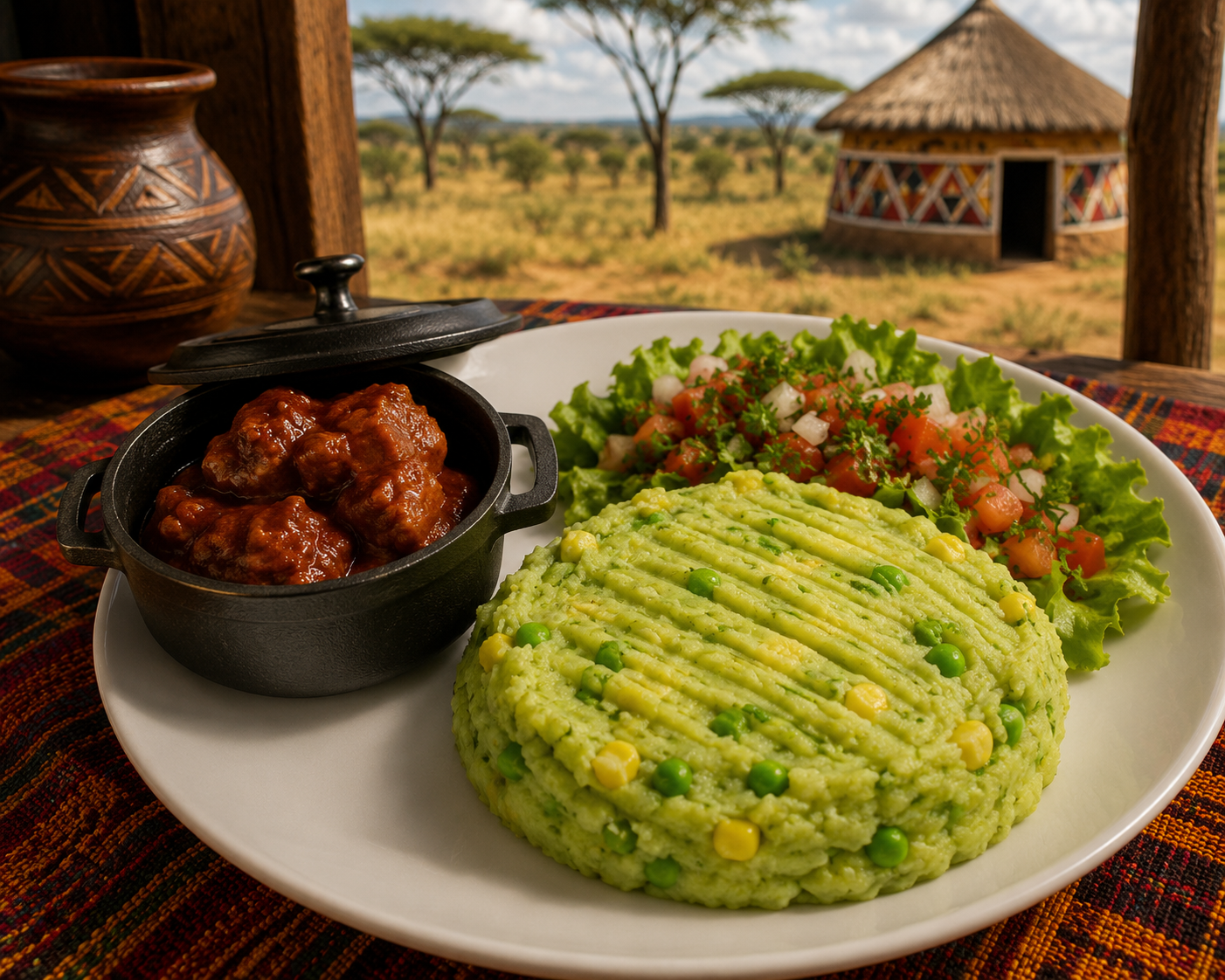
Irio is one of Kenya's most iconic dishes, particularly associated with Kikuyu traditions, but widely enjoyed across the country and increasingly visible in East African diasporas. At its core, irio is a mashed mixture of starches and legumes, most often potatoes, corn, and beans, sometimes enriched with peas or green vegetables depending on the season, region, and family habits. The result is a dense, nourishing, smooth-textured preparation that can be served alone or as an accompaniment to meats, sauces, and vegetables.
What makes irio remarkable is its apparent simplicity which conceals true culinary intelligence. It's not just about mashing ingredients together. It requires managing distinct cooking times, water content, the proportion between starch and vegetable proteins, the final texture, seasoning, and the dish's function within the overall meal. A good irio is moist but not watery, structured but not compact, balanced but never bland.
Prepare this speciality
Choose a detailed recipe, adjust the portions and prepare your ingredients before starting. Our cooking tips and food safety advice complement the steps described in the recipes.
Explore further: Cooking tips · Food hygiene and safety advice.
History and uses
Its place in African cuisine is important because it represents a fundamental principle of the continent: the transformation of local agricultural ingredients into dishes of high nutritional, social, and cultural value. Irio embodies a terroir cuisine, resilient, inclusive, and adaptable. It tells the story of the link between agriculture and the table, between household economy and culinary heritage, between daily life and collective memory.
🌾🧺 A CUISINE ROOTED IN LOCAL AGRICULTURAL SYSTEMS
Irio is inseparable from the agricultural landscapes of the Kenyan highlands, where polyculture has long structured food life: cereals, legumes, tubers, and green vegetables coexist in complementary productive systems. In this context, irio appears as a logical and brilliant culinary response: it brings together several locally available nutritional components in a single dish.
Corn provides energy and a soft granular texture, beans add protein and depth, potatoes bind the whole and give a stable creaminess. Green vegetables, when added, introduce vegetable freshness and color. This composition reflects an ancient food rationality: maximizing satiety, balancing intake, limiting waste, cooking according to the season and household resources.
In many African cuisines, this type of composite preparation exists in different forms: thick purees, enriched cereal pastes, mashed mixtures. Irio stands out for its specific profile and Kenyan roots, but it dialogues with a large continental family of nourishing dishes designed to support daily life while remaining culturally significant.
🔥🥄 TECHNIQUE AND TEXTURE: the art of balanced mashing Preparing a successful irio requires good orchestration of cooking. Beans generally require a longer time; corn can be fresh, pre-cooked dried, or partially replaced depending on availability; potatoes cook faster and must remain dry enough not to drown the texture. Some methods cook the elements separately before assembly, others favor combined cooking in sequence.
The mashing is a crucial step. Too much, it gives a uniform paste without relief. Too little, it produces a disjointed mixture. The ideal texture retains small landmarks: perceptible corn kernels, bean fragments, a binding puree base. It is this architecture that defines the sensory identity of irio. One wants to feel the unity of the dish, but also the personality of each component.
Seasoning generally remains simple: salt, sometimes a little fat, sautéed onion in some versions, pepper or mild chili according to preference. Irio is not meant to be aggressively spicy. Its purpose is to offer a mild base, capable of accompanying more pronounced elements such as grilled meats, stews, or more intense tomato-onion sauces.
Served as a dome, a rustic quenelle, or simply with a spoon, irio can take on a very elegant dimension despite its domestic origins. Its visual simplicity highlights the finesse of its texture and the depth of its role in the meal.
🏡🤝 EVERYDAY DISH, HOSPITALITY AND FAMILY TRANSMISSION
Irio is deeply linked to home cooking. It is a family dish, a routine nourishment, but also a gathering food. It is found in daily meals as well as in community contexts where cooking is done in volume. Its relatively controlled cost and its satiating power make it an ally of household economies.
In my books

Continue exploring the continent’s cuisines with Africa at the Table — 54 countries, 54 iconic dishes, by Alioune FALL. This book is in English.
Explore further
Socially, it carries a strong emotional charge. Many people of Kenyan origin associate irio with childhood, with the cooking of mothers and grandmothers, with meals eaten together after work or school. This taste memory explains its persistence, even as food trends change.
In diasporas, irio plays an important identity role. Easy to reproduce with ingredients available in many countries, it allows for maintaining a concrete link with original culinary practices. It also becomes a bridge dish: accessible to guests unfamiliar with East African cuisines, while remaining authentic for those who carry its heritage.
🌍🍽️ THE PLACE OF IRIO IN CONTEMPORARY AFRICAN CUISINE
On an African scale, irio deserves wider recognition. It illustrates an intelligent composite cuisine, based on the balance between energy, vegetable proteins, and fiber. In a global context where the virtues of legumes and minimally processed foods are being rediscovered, irio appears surprisingly modern.
It also contributes to the visibility of East African cuisines, sometimes less publicized than other African gastronomic centers. By highlighting irio, we shed light on a culinary tradition that values controlled sobriety, the agronomic quality of ingredients, and the conviviality of service.
Irio can dialogue with contemporary dining: presented with roasted vegetables, a spicy sauce, a grilled protein, or in a complete vegetarian version. This ability to integrate into different table styles, without losing its identity, is a sign of heritage vitality.
🥗📊 NUTRITION, BALANCE AND CURRENT RELEVANCE
From a nutritional point of view, irio is particularly interesting. The corn-beans-potatoes combination provides a solid energy profile, vegetable proteins, complex carbohydrates, fiber, and micronutrients. Beans enrich the dish with non-heme iron, magnesium, and folate; potatoes contribute potassium and vitamin C (variable depending on cooking); corn provides energy and certain carotenoids depending on the variety.
The addition of green vegetables enhances micronutrient density (vitamins A, K, folate). Depending on the amount of fat used, irio can remain relatively moderate in lipids. It therefore constitutes a adaptable base for different needs: a very nourishing meal for high energy expenditure, or a lighter version with a vegetable focus.
Its contemporary relevance is obvious: accessible ingredients, often reasonable cost, good satiety, compatibility with omnivorous or predominantly plant-based diets. Irio shows that a heritage dish can meet current challenges of sustainable nutrition without losing its cultural dimension.
✨🧭 A LIVING HERITAGE OF THE AFRICAN TABLE
Irio holds an essential place in African cuisine because it unites terroir, technique, nutrition, and social connection. It expresses a form of culinary wisdom: doing a lot with little, creating comfort without excessive complexity, nourishing the collective from local agricultural products.
It also reminds us that great cuisines are not defined solely by spectacular or festive dishes. They are defined by their daily fundamentals, those preparations that sustain ordinary life, transmit tastes from one generation to the next, and embody the continuity of a culture. Irio fully belongs to this noble category of essential dishes.
In the mosaic of African cuisines, it represents the strength of composite mashed recipes: robust, adaptable, nutritious, and deeply human. Its simplicity is its sophistication. Its humility is its greatness. And its persistent presence, from village to city, from Kenya to the diasporas, confirms its status as an enduring classic.
🌍 CONCLUSION
Ultimately, talking about irio is recognizing the depth of East African culinary knowledge and its major contribution to the continent's gastronomic heritage. It is also affirming that a dish can be both modest and central, local and universal, ancient and perfectly current. Irio, in every spoonful, tells this rare alliance between memory, balance, and future.
In the kitchen : Irio
Recipes from the site to put your knowledge into practice:
Discover these cuisines at a restaurant
Explore our restaurant and caterer directories. Choose your destination and check the establishment’s menu to confirm which dishes are offered and available.
Continue exploring
Enjoy discovering ingredients and African cuisines? Join our newsletter. The illustrated PDF 10 sauces africaines incontournables is in French and is offered after confirming a subscription to the French or bilingual edition.