Boerewors
South Africa
Understanding : Boerewors
🔥🌭 INTRODUCTION
Boerewors is one of South Africa's most emblematic preparations, to the point of becoming a true national cultural marker. Its name, derived from Afrikaans, refers to the idea of a “farmer's sausage,” but this simple translation is not enough to describe its importance. Boerewors is at once a butchery technique, a historical memory, a fire-cooking ritual, and a form of sociability that transcends community boundaries. In markets, butcher shops, family gatherings, and weekend braais, it holds a central place.
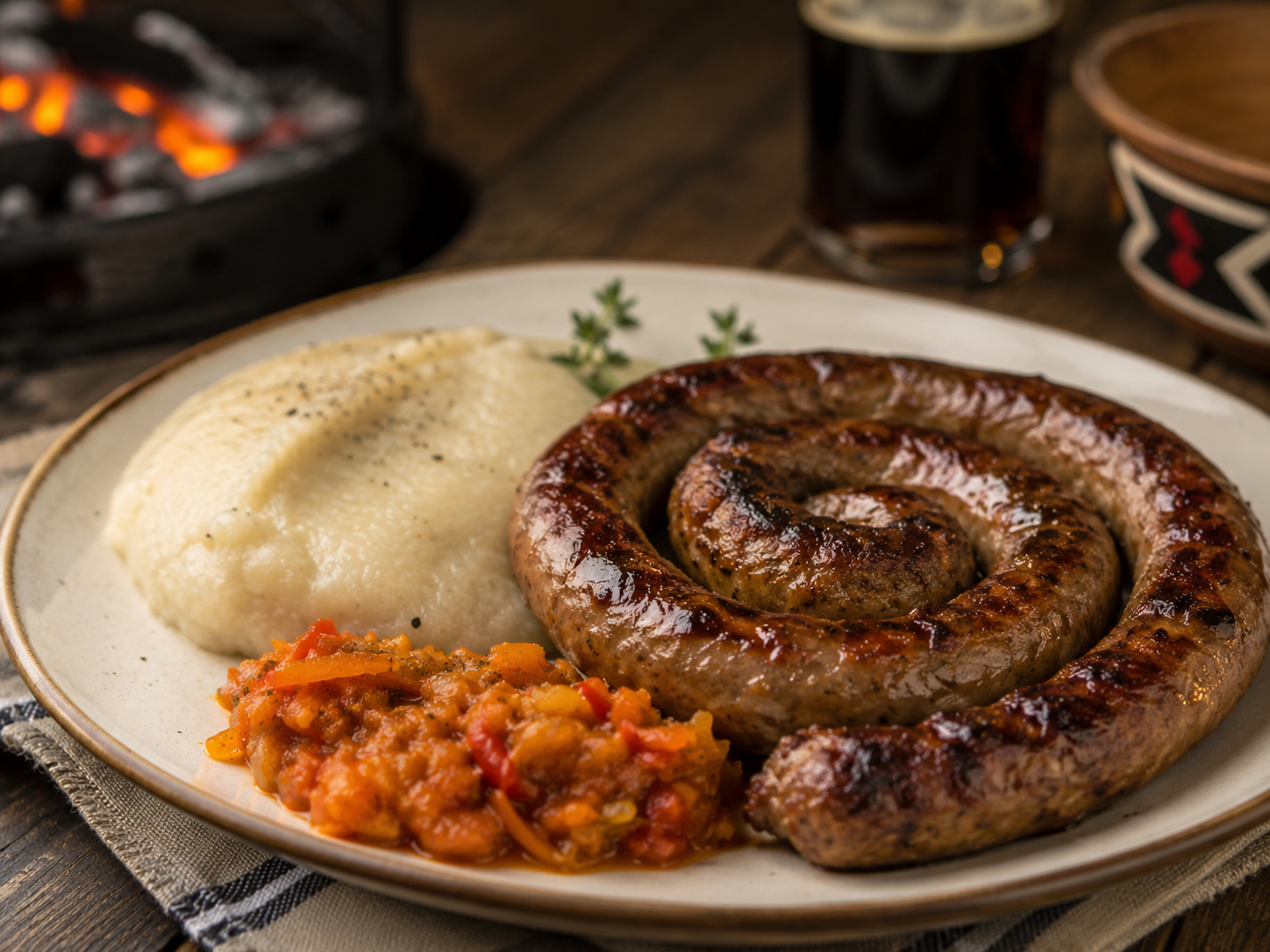
Concretely, boerewors is a fresh sausage usually made of beef, sometimes supplemented with other meats, with a precisely measured proportion of fat and a seasoning often dominated by coriander, pepper, cloves, nutmeg, and vinegar. Its most recognizable form is the long spiral, placed on the grill and then served in sections. This presentation is not just aesthetic: it facilitates progressive and convivial cooking, suitable for sharing.
Prepare this speciality
Choose a detailed recipe, adjust the portions and prepare your ingredients before starting. Our cooking tips and food safety advice complement the steps described in the recipes.
Explore further: Cooking tips · Food hygiene and safety advice.
History and uses
In African cuisine, boerewors holds a major place because it expresses several key dimensions of the continent's culinary heritage: artisanal meat processing, the importance of spices in structuring taste, the social role of collective cooking, and the ability of local traditions to evolve in modern urban contexts. Boerewors is not just “a South African sausage”; it is a culinary language that tells the story and diversity of Southern Africa.
🧭📜 HERITAGES, CIRCULATIONS AND THE CONSTRUCTION OF A SOUTH AFRICAN CLASSIC
The history of boerewors is part of South Africa's agricultural, pastoral, and colonial trajectories. European charcuterie techniques combined with local realities: types of livestock, access to spices via trade routes, climatic constraints, preservation practices, and outdoor cooking habits. Over time, a specific identity emerged, distinct from the original European sausages.
This identity is based on several elements: a relatively coarse but homogeneous texture, the dominance of certain warm spices (especially coriander), the use of vinegar to balance and bind the flavors, and a preference for braai cooking rather than boiling. Boerewors thus becomes a cultural terroir product, associated with butchers' know-how and domestic habits passed down from generation to generation.
With urbanization and food industrialization, boerewors has seen massive diffusion. It can be found in premium artisanal versions as well as more standardized ones. Despite these variations, the reference to “real boerewors” remains strong in the collective imagination, proving that the product retains a heritage dimension. In the South African diaspora, it also plays a role as an emotional link: preparing or finding boerewors means reconnecting with a taste of home.
🥩🧪 BUTCHERY TECHNIQUE AND AROMATIC PROFILE: AN OFTEN UNDERESTIMATED PRECISION
Good boerewors begins with the selection of meats. Beef frequently forms the base, with a fat content essential for juiciness. Depending on the style, lamb or pork may be included, but balance remains crucial. Too lean, the sausage becomes dry. Too fatty, it loses its firmness and finesse.
The grinding and mixing are decisive. The desired texture is neither a smooth paste nor an irregular mince: it requires a structure that retains some bite while remaining coherent after cooking. Classic seasoning highlights coriander (toasted and ground seeds in many recipes), supported by pepper, nutmeg, cloves, and sometimes sweet chili. Vinegar plays a technical and gustatory role: it enhances, balances the fat, and contributes to the product's signature.
Stuffing into natural casing requires real expertise. The tension must be just right to prevent bursting or collapsing. The emblematic spiral shape allows for practical handling on the grill and convivial serving. This detail shows that boerewors is designed for fire and for groups.
The expected result: a juicy sausage, spiced without excess, with a warm depth, a good hold when cut, and a smoky aroma developed by the embers. This level of quality cannot be improvised. It reflects a chain of skills ranging from butchery to cooking.
In my books

Continue exploring the continent’s cuisines with Africa at the Table — 54 countries, 54 iconic dishes, by Alioune FALL. This book is in English.
Explore further
🔥🤝 THE BRAAI: SOCIAL SPACE WHERE BOEREWORS BECOMES SHARED CULTURE
To talk about boerewors without mentioning the braai would be incomplete. In South Africa, the braai is a social institution, a gathering moment that goes beyond simply preparing a meal. People come together to celebrate, discuss, welcome, and transmit. Boerewors plays a central role because it is easy to share, visually convivial, and sensorially powerful.
Over the fire, mastery is essential. Too high heat burns the outside before internal cooking; too low, it dries it out. Experienced cooks seek stable embers, carefully turn the spiral, avoid piercing it to preserve the juices, and let it rest briefly before cutting. This ritual contributes to the culture of gesture and the informal transmission of culinary knowledge.
Serving is flexible: plate with side dishes, or boerewors roll (bread filled with sausage, onions/sauce), very popular at sporting events, markets, and local festivals. This double life, between table dish and street food, reinforces its transversal status.
🌍🍽️ PLACE IN AFRICAN CUISINE: BETWEEN LOCAL IDENTITY AND CONTINENTAL REACH
On an African scale, boerewors dialogues with other traditions of processed meats: spiced skewers, local sausages, street grills, smoked preparations. Its uniqueness lies in its specific spiced structure and its anchoring in South African braai culture. But its general logic, transforming and seasoning meat for sharing over fire, is deeply African in spirit.
It also contributes to the recognition of Southern African cuisines, sometimes less represented in global narratives than other regions of the continent. Boerewors shows that this area possesses robust technical heritages, capable of combining craftsmanship, conviviality, and modern adaptation.
In contemporary contexts, it inspires variations: leaner versions, revisited seasonings, integration into fusion cuisines. Yet, even modernized, it remains identifiable. This identity resilience is a sign of culinary classicism.
🥗📊 NUTRITION, BALANCE AND CURRENT ISSUES
Boerewors is a protein-rich preparation, with a variable lipid content depending on the formulation. It can be very nourishing and filling, especially when accompanied by starches or bread. In terms of micronutrients, it provides iron, zinc, and B vitamins, linked to red meat.
As with any fresh sausage, quality depends heavily on the composition (proportion of lean meat, type of fat, salt level) and cooking method. Controlled cooking, without excessive charring, improves the sensory and sanitary profile. In current uses, many consumers seek versions that are better balanced in fat and salt, without sacrificing traditional taste.
Side dishes play an important role in the overall balance of the meal: fresh salads, grilled vegetables, chakalaka, pap, tomato-onion relishes. They provide fiber, freshness, and contrast, and prevent the experience from being solely focused on fat and salt.
✨🏁 A LIVING, POPULAR AND TECHNICAL HERITAGE
Boerewors deserves its prominent place in African cuisine because it is both popular and demanding. Popular, because it belongs to everyday life, to celebrations, to streets, to stadiums, to families. Demanding, because its quality requires true mastery of meat, spices, casing, and fire. This combination explains its longevity and prestige.
It also represents a form of living heritage: not fixed, continuously reinterpreted, but solidly rooted in collective practices. As long as there are braais, artisanal butcher shops, family recipes, and guests gathered around the embers, boerewors will continue to evolve without losing its soul.
🌍 CONCLUSION
Ultimately, boerewors is much more than a spiral sausage. It is a culture of taste and sharing, a memory of Southern Africa, and a major contribution to the continent's gastronomic diversity. In the grand narrative of African cuisines, it occupies a clear position: that of a unifying classic, intensely local and fully universal in its ability to bring people together around the fire.
In the kitchen : Boerewors
Recipes from the site to put your knowledge into practice:
Discover these cuisines at a restaurant
Explore our restaurant and caterer directories. Choose your destination and check the establishment’s menu to confirm which dishes are offered and available.
Continue exploring
Enjoy discovering ingredients and African cuisines? Join our newsletter. The illustrated PDF 10 sauces africaines incontournables is in French and is offered after confirming a subscription to the French or bilingual edition.