Harira
Morocco, Maghreb
Understanding : Harira
🍲🌙 INTRODUCTION
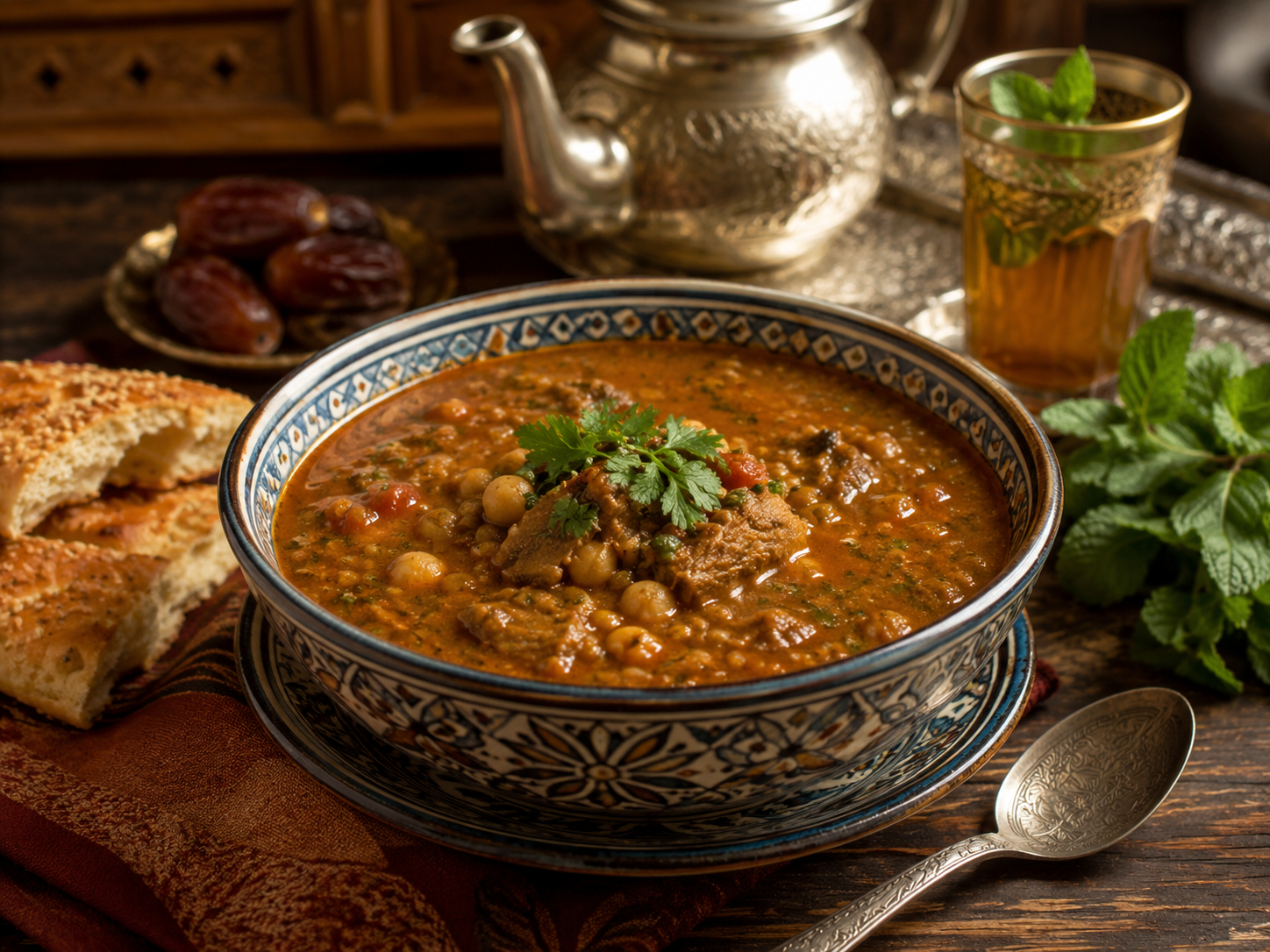
Harira is one of the most emblematic dishes of the Maghreb, particularly Morocco, where it holds a place that is at once daily, festive, and spiritual. A rich, thick, fragrant, and nourishing soup, it is built around a subtle balance of legumes, tomatoes, herbs, spices, sometimes meat, and a thickener that gives it its characteristic texture. It is neither a simple broth nor a heavy stew: it is an intermediate culinary architecture, highly controlled, designed to comfort, satisfy, and bring people together.
In the collective imagination, harira is often linked to the month of Ramadan, at the time of breaking the fast, but its importance extends far beyond this context. It is present in many homes throughout the year, in family meals, hospitality settings, popular restaurants, and intergenerational transmissions. It represents a cuisine of care, patience, and precision, where each ingredient contributes to the coherence of the whole.
Where to find it
Look for the exact food-grade form required by the recipe at markets and specialist shops. Check the product name, ingredients, condition and storage instructions.
Explore further: Cooking tips · Food hygiene and safety advice.
History and uses
Its place in African cuisine is central. Harira demonstrates the strength of North African traditions of composite soups, the mastery of legumes, the intelligence of spices, and the social value of the shared bowl. It also shows that African cuisines know how to build dishes of great aromatic complexity from accessible ingredients, with robust and transmissible domestic techniques.
📜🌍 HISTORICAL HERITAGE, MAGHREBI ROOTS, AND CULTURAL DIFFUSION
Harira is part of a long Maghrebi culinary history made of ingredient circulations, Arab-Berber, Andalusian, and Mediterranean influences, and then the local stabilization of practices. In Morocco, it has acquired an almost institutional status. Each region, each city, sometimes each family has its version, with nuances in the proportion of lentils, chickpeas, meat, celery, coriander, binding flour, eggs, or spices.
This internal diversity does not weaken its identity; it strengthens it. Harira is recognizable by its structure, its fragrance, and its social function, even when the recipe varies. This plasticity is one of the strengths of great African dishes: they remain faithful to a matrix while absorbing local, economic, and seasonal realities.
Its diffusion in diasporas has further expanded its reach. In many cities in Europe, North America, and elsewhere, harira has become a strong identity marker for Maghrebi communities. Preparing harira abroad means recreating continuity: the smell of fresh coriander, the steam of spicy tomato, the velvety texture in the bowl. It acts as a bridge between territories, generations, and memories.
🧅🌿 A PRECISE CULINARY CONSTRUCTION: LAYERS OF FLAVOR AND MASTERED TEXTURE
Successful harira relies on a logic of stratification. It generally begins with an aromatic base of onion, celery, coriander, parsley, sometimes small pieces of meat, then come the spices, tomato, legumes, water or broth, and finally the thickener. Each step has a function.
Legumes, especially chickpeas and lentils, provide the nutritional core and textural depth. They must cook until tender without completely disintegrating. Tomato brings acidity, color, and natural binding. Fresh herbs create a vibrant vegetal signature that distinguishes harira from other more earthy soups.
The thickener, often a flour-water mixture (tadouira in many practices) added gradually, transforms the broth into a coating texture. This step requires attention: poured too quickly or without stirring, the thickener forms lumps; poorly dosed, it makes the soup too fluid or too pasty. Good harira is silky, bound, but still mobile in the spoon.
Spices vary by household, but ginger, turmeric, pepper, and sometimes cinnamon are common. The result should not be burning hot with chili; harira aims instead for a round aromatic warmth. A squeeze of lemon at serving can awaken the whole and refine the finish.
🌙🤝 HARIRA, RITUAL OF BREAKING THE FAST AND ACTIVE HOSPITALITY
The place of harira during Ramadan is particularly significant. It often opens the breaking of the fast with dates, water, milk, or other elements depending on local customs. Its gentle density and nutritional balance make it an ideal food to re-energize the body after long hours without eating. It hydrates, warms, provides progressive energy, and relative digestive comfort when well executed.
But beyond its nutritional function, harira carries a strong symbolic charge: it marks the transition from fasting to sharing. The bowl of harira placed on the table is a signal of community found again each evening. In many homes, its preparation involves several people, and its distribution can extend to neighbors, extended family, and local solidarity actions.
In my books

Continue exploring the continent’s cuisines with Africa at the Table — 54 countries, 54 iconic dishes, by Alioune FALL. This book is in English.
Explore further
This dimension of collective care is essential to understanding its African place. Many cuisines on the continent value dishes that can be prepared in quantity, easily shared, reheated without losing quality, and adapted to community rhythms. Harira perfectly fits this logic.
🌍🍽️ A MAJOR PLACE IN AFRICAN CUISINE
In the African culinary mosaic, harira represents the Maghrebi side of highly structured meal-soups. It dialogues with other African traditions of enriched broths, nourishing sauces, and legume-based preparations, while maintaining its own identity: dominant tomato-herb, careful binding, warm spices, and ritual serving.
It also plays an important role in the international perception of African cuisines. Well presented and well understood, harira shows a gastronomy of domestic precision, where the ordinary can reach a high level of sensory sophistication. It contradicts the idea that culinary complexity is reserved for restaurant cuisines: here, finesse is born from the home, from repeated gestures, from transmitted experience.
In contemporary culinary scenes, harira inspires reinterpretations: accomplished vegetarian versions, variations with ancient grains, textures adjusted for gourmet service. Yet, its strength remains intact in its classic family form.
🥗📊 NUTRITION, BALANCE, AND CURRENT RELEVANCE
Harira is nutritionally interesting because it combines several food families in a single dish: legumes, vegetables, herbs, sometimes animal proteins, moderate lipids, cooking water rich in aromatic compounds. It can provide proteins, fiber, complex carbohydrates, minerals (iron, potassium, magnesium depending on ingredients), and vitamins from herbs and vegetables.
Its satiety effect is generally good, thanks to the combination of fiber + legumes + bound texture. It can be suitable for various contexts: a light main meal, a nourishing appetizer, breaking the fast, an economical and dense family meal. Its flexibility allows for adjusting richness: more or less meat, more vegetables, moderate oil, controlled salt.
In a context where sustainable, accessible, and less dependent on ultra-processed products dishes are sought, harira appears very current. It values basic ingredients, promotes home cooking, and allows for efficient quantity management for several meals.
🏺✨ TRANSMISSION, IDENTITY, AND THE LIVING FUTURE OF HARIRA
Harira is a living heritage. It is transmitted through observation, smell, texture, and corrections during cooking. Written recipes provide a framework, but true mastery comes from practice: recognizing the right moment to add the thickener, sensing the herb-tomato balance, adjusting the water according to reduction, correcting salt and acidity just before serving.
This sensitive transmission is at the heart of many African cuisines. It produces concrete cultural continuity: the gestures of elders pass into the hands of the younger generation, and the dish remains alive because it is remade, tasted, discussed, adjusted. Harira perfectly illustrates this mechanism of dynamic permanence.
Its future is solid, because it meets timeless needs: to nourish well, to gather, to comfort, to respect available means, to celebrate important moments. In cities as in diasporas, it continues to evolve without losing its soul.
🏁🍲 A GREAT VOICE OF AFRICAN CUISINE
Ultimately, harira holds a prominent place in African cuisine. It is both technical and accessible, ancient and current, intimate and collective. It expresses Maghrebi culinary intelligence in its most generous form: transforming simple ingredients into a deeply nourishing, aromatically rich, socially unifying dish.
🌍 CONCLUSION
Through its historical roots, its ritual value, its nutritional density, and its capacity for transmission, harira transcends the status of a “traditional soup”. It becomes a form of cultural language, a symbol of a shared table, proof of the sophistication of African culinary heritages. As long as there are family kitchens, fast-breaking meals, neighbors to welcome, and memories to transmit, harira will maintain its place: central, warm, and enduring.
In the kitchen : Harira
Recipes from the site to put your knowledge into practice:
Discover these cuisines at a restaurant
Explore our restaurant and caterer directories. Choose your destination and check the establishment’s menu to confirm which dishes are offered and available.
Continue exploring
Enjoy discovering ingredients and African cuisines? Join our newsletter. The illustrated PDF 10 sauces africaines incontournables is in French and is offered after confirming a subscription to the French or bilingual edition.