Rfissa
Morocco
Understanding : Rfissa
🍲🫓 INTRODUCTION
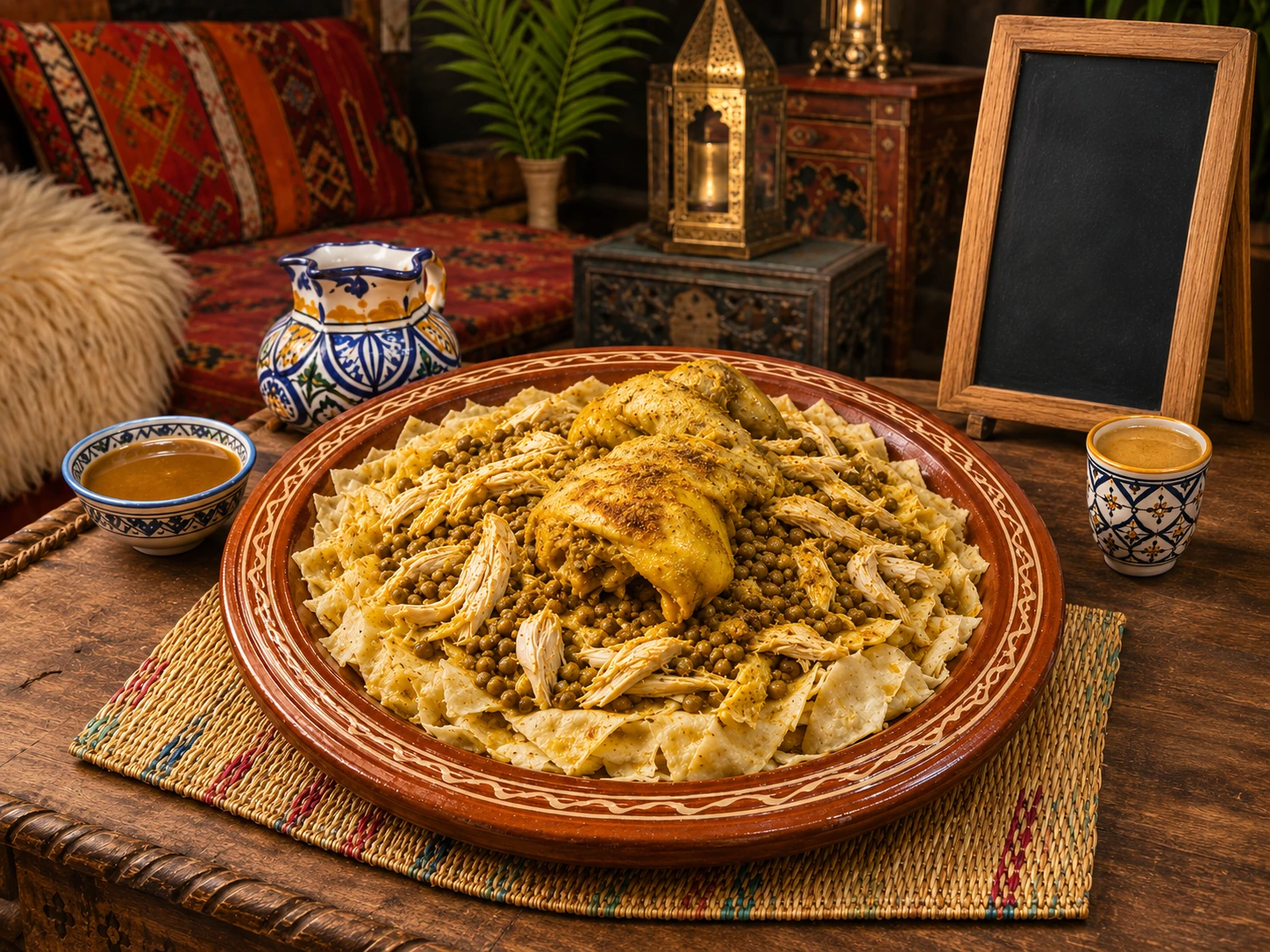
Rfissa is one of the most emblematic dishes of Moroccan cuisine. Deeply rooted in domestic practices, it combines a spiced broth, usually with chicken and lentils, with a base of crumbled or cut flatbreads, most often trid, sometimes msemen depending on the region and family habits. The principle seems simple: pour a rich and fragrant sauce over a bed of fragmented puff pastry. But in reality, rfissa is a very precise culinary construction, where texture, aromatic warmth, nutritional density, and social symbolism come together.
It is a dish of generosity and care. It is often prepared for special occasions, particularly during postpartum periods in some Moroccan traditions, but also for family gatherings, honorary meals, or moments when one wants to offer a nourishing and meaningful dish. Its reputation stems as much from its taste as from its relational function: rfissa is a dish that embraces, comforts, and brings people together.
Prepare this speciality
Choose a detailed recipe, adjust the portions and prepare your ingredients before starting. Our cooking tips and food safety advice complement the steps described in the recipes.
Explore further: Cooking tips · Food hygiene and safety advice.
History and uses
In African cuisine, its place is important because it illustrates the richness of Maghrebi heritage, the sophistication of broth and bread/dough dishes, and the ability of the continent's cuisines to unite technique and symbolism. Rfissa shows that African cuisine is also a cuisine of assembly, superimposed textures, and serving rituals, not just raw cooking or monolithic dishes.
🌾📜 AN ANCIENT CULINARY MATRIX: wheat, legumes, poultry, and spices Rfissa is part of Morocco's historical agricultural and culinary logic: valuing cereals (wheat), legumes (lentils), poultry, onions, and spices. This combination is not accidental. It reflects ancient food intelligence: combining sustainable energy, protein, fiber, aromatic depth, and convivial service.
Trid, a thin crepe or sheet of dough cooked then dried/slightly softened depending on use, plays a central role. It absorbs the broth without immediately disintegrating, creating a unique texture, neither soup nor dry dish. Msemen can replace trid in more accessible everyday versions, giving a richer and flakier result. Each base changes how the sauce spreads and how the bite holds together.
Rfissa broth often relies on a base of stewed onions, warm spices (ginger, turmeric, pepper, sometimes saffron depending on means), and especially fenugreek in many traditional versions, which gives the dish its characteristic aromatic signature. Fenugreek, with its slightly bitter, nutty, and deep profile, clearly distinguishes rfissa from other Moroccan chicken dishes.
This construction refers to a cuisine of patience. It requires cooking, reducing, binding, tenderizing, and flavoring. Rfissa does not like haste. It is a dish that demands time, and this time is part of its cultural value.
🔥🧅 TECHNIQUE AND BALANCE: the art of hydrating without soaking The main difficulty of rfissa lies in managing moisture. The dough base must be sufficiently impregnated to become tender, but not drowned to the point of turning into a compact mass. The broth must be concentrated, just fatty enough, spiced without excess, and poured at the right time.
The chicken must remain tender, the lentils cooked but whole, the onions well candied to provide sweetness and thickness. The sauce is generally richer than a simple table broth, as it must “carry” the dough. The final assembly, often in a large communal dish, is crucial: the trid or msemen are arranged in pieces, gradually moistened, the poultry is placed, lentils and onions are distributed, and then more sauce is adjusted according to the absorption capacity.
Service is immediate or almost immediate, to preserve the right texture. Too early, the dough remains dry at the core. Too late, it disintegrates. This serving window, well known to experienced cooks, shows the level of mastery required.
🤱🏽💛 CARE, MATERNITY, AND TRADITIONAL THERAPEUTIC DIMENSION
Rfissa is particularly famous in Morocco for its link with the postpartum period in many family practices. It is then considered a recovery dish: warm, nourishing, specifically spiced, energetic, easy to share with close relatives. Fenugreek is often valued in popular knowledge for its properties associated with comfort and recovery.
Beyond the objective nutritional dimensions, one must understand the symbolic power of this function. Offering rfissa to a young mother is to express presence, support, and intergenerational continuity. The dish becomes a social gesture of protection. This dimension of culinary care is fundamental in many African cultures, where food accompanies life passages: birth, illness, mourning, celebration, reconciliation.
In my books

Continue exploring the continent’s cuisines with Africa at the Table — 54 countries, 54 iconic dishes, by Alioune FALL. This book is in English.
Explore further
Rfissa is therefore a narrative dish. It tells the story of family, women who transmit, neighbors who help each other, moments when cooking carries more than taste: it carries the relationship.
🌍🍽️ RFISSA'S PLACE IN AFRICAN CUISINE
In the mosaic of African cuisines, rfissa occupies a unique space. It belongs to the family of dishes where a starchy base absorbs a powerful sauce, as found in various forms across the continent (balls, pastes, breads, semolina, flatbreads). But its personality is distinct: use of trid/msemen, marked presence of lentils, a spicy profile dominated by ginger-turmeric-fenugreek, often ceremonial service in a large dish.
It also represents Maghrebi domestic refinement. It is not a visually spectacular dish, but a dish of technical depth and balance. As such, it fully participates in the recognition of African cuisine as a set of demanding, codified, and inventive traditions.
In diasporas, rfissa plays a strong identity role. Even when artisanal trid is difficult to reproduce, families adapt with alternatives while preserving the dish's logic. This ability to adapt without losing its soul is a mark of great classics.
🥗📊 NUTRITIONAL DENSITY AND MODERNITY OF THE DISH
From a nutritional point of view, rfissa is a complete and dense dish. It combines proteins (chicken, lentils), complex carbohydrates (trid or msemen based on wheat), fiber (lentils, onions), lipids (cooking fat), and a palette of spices that enriches the sensory profile. It is designed to provide lasting satiety, which corresponds to its historical function as a strength-giving dish.
In contemporary uses, some adaptations appear: reduction of fat, increase in the proportion of lentils, versions without chicken or with leaner pieces, salt control. These adjustments address health concerns without erasing the culinary identity.
Rfissa is also relevant in current discussions on sustainable food: it values simple, minimally processed, accessible ingredients, and relies on transmissible domestic techniques. Its cost can remain controlled depending on ingredient choices, which strengthens its place in family cooking.
🏺🫶 TRANSMISSION, GESTURES, AND CULINARY MEMORY
What makes rfissa great is the sum of invisible gestures it mobilizes: kneading and cooking the trid sheets, hand-dosing spices, judging the cooking of lentils, balancing the sauce, assembling the dish without breaking the texture. Many of these skills are learned by imitation and repetition, rarely by strict recipes.
Rfissa is therefore a living heritage in the strong sense. It transforms with contexts but remains faithful to a precise culinary grammar. Each family has its nuance, its intensity of fenugreek, its method of cutting trid, its assembly order. This internal diversity makes its richness and guarantees its continuity.
✨🏁 A MAJOR CLASSIC OF AFRICAN HERITAGE
Ultimately, rfissa deserves a prominent place in African cuisine. It embodies the encounter between nutrition, technique, hospitality, and social symbolism. A dish of care and celebration, it goes beyond the simple category of “traditional recipe” to become a profound cultural marker of Morocco and, more broadly, of Maghrebi culinary heritage in Africa.
It reminds us that African cuisines are cuisines of high practical intelligence: managing textures, balancing spices, adapting products, nourishing the collective, transmitting gestures. Rfissa condenses all this into a warm and powerful form.
🌍 CONCLUSION
As long as it is cooked in homes, shared during important moments, adapted in diasporas, and transmitted to new generations, it will retain its strength: that of a dish that nourishes the body, strengthens bonds, and tells, with each serving, a living African memory.
Trid: the dish name and the sheets
Morocco's national tourism office also presents rfissa under the name Trid. In preparation vocabulary, trid may mean the thin pan-cooked dough sheets forming the base: the component and the assembled dish are not interchangeable in every context. Recipe 11759, titled Trid, combines these sheets with chicken, lentils and vegetables; it joins this Rfissa entry rather than generating a duplicate. Recipe 270 uses msemen or thin flatbreads. These two verified versions illustrate different bases, not one compulsory formula. Tear the sheets, add broth gradually and arrange the chicken to adjust absorption at serving time. Cultural associations with particular stages of life are not medical prescriptions.
In the kitchen : Rfissa
Recipes from the site to put your knowledge into practice:
Discover these cuisines at a restaurant
Explore our restaurant and caterer directories. Choose your destination and check the establishment’s menu to confirm which dishes are offered and available.
Continue exploring
Enjoy discovering ingredients and African cuisines? Join our newsletter. The illustrated PDF 10 sauces africaines incontournables is in French and is offered after confirming a subscription to the French or bilingual edition.