Shakshuka
Tunisia, Maghreb, Ethiopia
Understanding : Shakshuka
🍳🌶️ INTRODUCTION
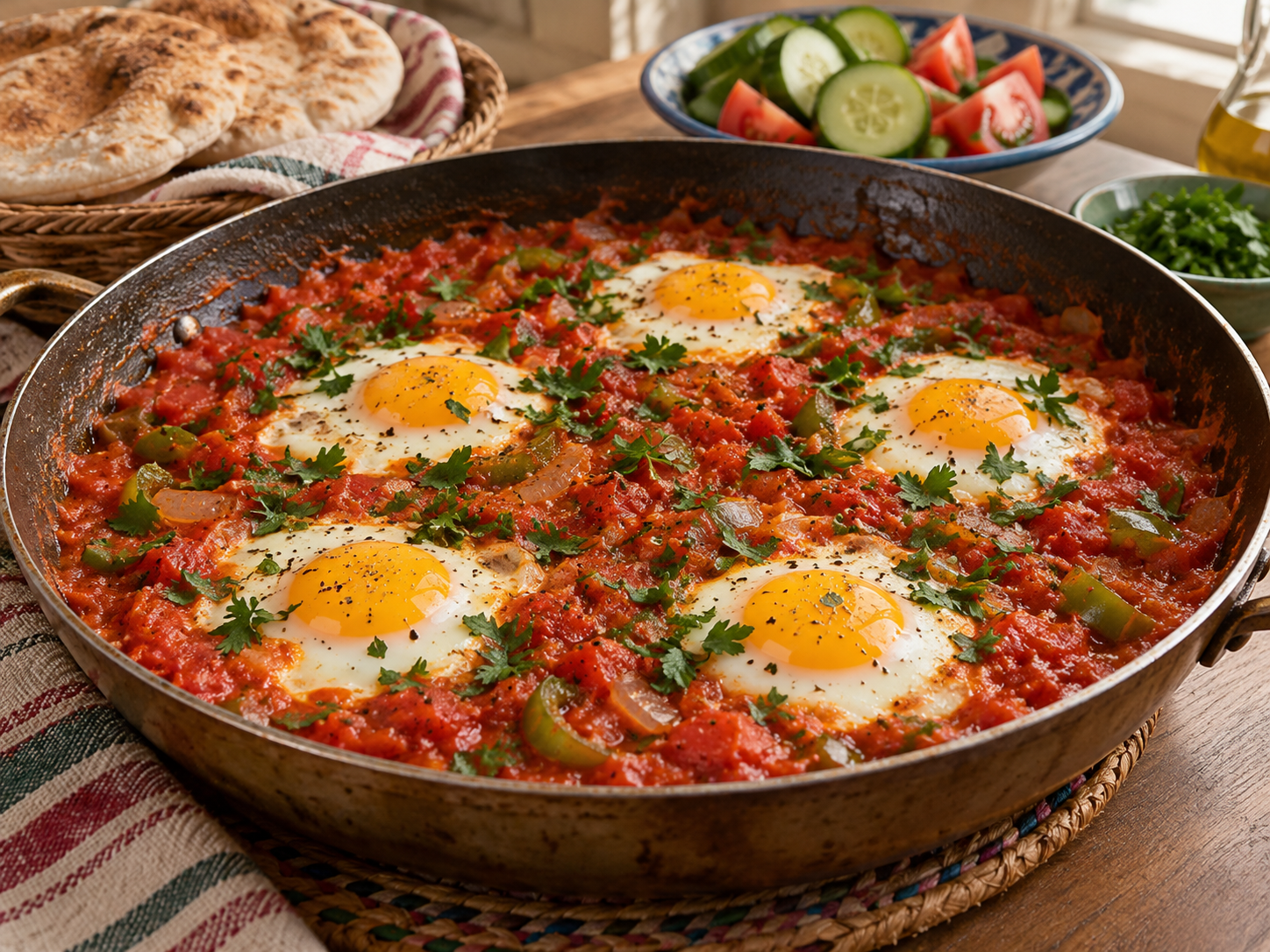
Shakshuka is one of the most famous dishes in North Africa, particularly rooted in the culinary traditions of the central and eastern Maghreb, before being widely disseminated in other regions of the world. In its most known form, it consists of eggs poached or gently cooked in a tomato-pepper sauce seasoned with garlic, onion, olive oil, and spices. But this basic definition is not enough to convey its importance. Shakshuka is a complete culinary model: accessible, technically simple, strongly identity-driven, and capable of accommodating countless variations without losing its soul.
Its strength comes from a remarkable alchemy between modest ingredients and precise execution. A good shakshuka is neither a simple tomato sauce with eggs broken over it, nor a disguised omelet. It is a preparation of texture and timing: the sauce must be concentrated but still supple, the eggs must cook just enough to offer set whites and still creamy yolks (or to the desired doneness), and the whole must remain harmonious whether eaten with a spoon or bread.
Prepare this speciality
Choose a detailed recipe, adjust the portions and prepare your ingredients before starting. Our cooking tips and food safety advice complement the steps described in the recipes.
Explore further: Cooking tips · Food hygiene and safety advice.
History and uses
In African cuisine, shakshuka holds an important place because it illustrates a widespread culinary intelligence on the continent: transforming common products into a highly satisfying dish, shareable and adaptable to seasons, means, and local preferences. It also tells the story of the historical circulation of techniques and tastes between cities, ports, countrysides, and North African diasporas.
🧭📜 MAGHREBI ROOTS AND HISTORICAL TRAJECTORIES
The word shakshuka is generally associated with the idea of mixing, which well describes the spirit of the dish. Its roots are located in the North African space, with strong anchors in Tunisia, Algeria, Libya, and echoes in other nearby cuisines. Over time, the recipe has traveled with human mobility, trade, and community movements, becoming a globally recognized dish today.
However, in its African cradle, shakshuka remains linked to concrete practices: family cooking, quick but nourishing meals, extensive use of tomato and pepper, a taste for spicy condiments, and the role of bread as a tasting tool. It is this cultural base that gives it its coherence, even when it changes form according to context.
Its international dissemination has sometimes simplified its image, but the Maghrebi tradition shows real diversity: very spicy versions, milder versions, additions of merguez (spicy lamb or beef sausage), potatoes, chickpeas, fresh herbs, local cheeses, or preserved chili peppers. This diversity is not a deviation from the norm; it is the living norm of the dish.
🍅🧅 ARCHITECTURE OF TASTE: the sauce as the heart, the egg as punctuation
The technical core of shakshuka is the sauce. One often starts by sweating or browning the onion in oil, then adding garlic and pepper to develop an aromatic base. The tomato then arrives fresh, crushed, or as pulp depending on the season and availability. The cooking must reduce the natural water of the tomato to concentrate the flavor without becoming dry.
Spices build the personality. Paprika, cumin, coriander, caraway, chili, black pepper, sometimes harissa depending on the region and household: each combination modulates the heat, depth, and length on the palate. Salt, of course, must be adjusted after reduction. A touch of acidity can be balanced by the natural sweetness of cooked onion; conversely, an overly sweet tomato may require more spicy relief.
Eggs are added at the end, into hollows made in the sauce. Cooking can be done covered or uncovered, depending on the desired texture. The main challenge is to avoid overcooking the yolks. In many traditions, success is judged by the contrast between the hot, spicy, enveloping sauce and the runny yolk that enriches each bite.
Immediate service is essential. Shakshuka is a pan dish and a dish of the moment: it loses some of its magic if it waits too long. It is often eaten directly from the cooking pan, in the center of the table, with bread for dipping.
🏡🤝 CULINARY SOCIABILITY: simplicity, sharing, and daily life One of the great qualities of shakshuka is its ability to create conviviality with little. It requires relatively affordable ingredients, few utensils, and can be prepared in varying quantities. This makes it an everyday dish as well as an improvised welcoming dish.
In my books

Continue exploring the continent’s cuisines with Africa at the Table — 54 countries, 54 iconic dishes, by Alioune FALL. This book is in English.
Explore further
In many North African homes, it can appear at late breakfast, quick lunch, or light dinner depending on life rhythms. This hourly flexibility is rare for such an identity-driven dish. It shows that shakshuka is not confined to a ceremony; it accompanies ordinary life, which strengthens its cultural roots.
Sharing is at the heart of the experience. A pan placed in the center, bread broken by hand, everyone composing their bite between sauce and egg: the gesture is collective, warm, non-hierarchical. In African cuisine in a broader sense, this mode of consumption is deeply significant, as it prioritizes the table as a relational space.
🌍🍽️ PLACE IN CONTEMPORARY AFRICAN CUISINE
Across the continent, shakshuka represents the genius of "simple-complex" dishes: simple in appearance, complex in balance. It is one of the most recognizable North African recipes internationally, and thus plays an ambassadorial role. But its importance is primarily local and continental: it contributes to the recognition of Maghrebi cuisines as technical, nuanced, and evolving cuisines.
It also dialogues with other African traditions where tomato and chili structure sauces served with bread, semolina, or cereals. Even if the forms differ, a common logic is found: aromatic density, controlled cooking, convivial service, adaptability to available resources.
In modern culinary scenes, shakshuka inspires many reinterpretations, sometimes very creative. Yet, its most enduring version often remains the most sober: good tomato, good pepper, good heat, a good hand with spices, and perfectly cooked eggs. This confirms that it is a fundamental classic, not a passing fad.
🥗📊 NUTRITIONAL INTEREST AND CURRENT ADAPTATIONS
Nutritionally, shakshuka presents an interesting profile: cooked vegetables rich in antioxidant compounds (especially via tomato and pepper), eggs providing high-quality protein and micronutrients, and fat content adjustable according to the amount of oil used. With whole grain bread or a vegetable side dish, it can form a balanced and satisfying meal.
The dish is easily adaptable: more vegetables to increase fiber, less salt, personalized spice level, addition of legumes to strengthen nutritional density, egg-free version for certain diets with plant-based alternatives. This flexibility explains its longevity in changing dietary contexts.
Like many tomato sauce dishes, the quality of ingredients strongly influences the result. Ripe tomatoes, good oil, fresh spices, and patient cooking make the difference between a bland shakshuka and a memorable shakshuka.
🧠🔥 KNOW-HOW, MEMORY, AND TRANSMISSION
Shakshuka is often the first "signature" dish learned in some families, precisely because it seems simple. But in practice, it teaches essential culinary fundamentals: sweating without burning, reducing without drying out, seasoning in stages, managing differentiated cooking in the same pan, and serving at the right time.
This pedagogical dimension makes it an excellent vehicle for intergenerational transmission. One learns the recipe by observing, tasting, and correcting. Proportions vary, but the logic remains. This is exactly how African culinary heritages live: through creative repetition rather than rigid fixation.
✨🏁 AN AFRICAN CLASSIC OF UNIVERSAL REACH
Ultimately, shakshuka fully deserves its place in African culinary heritage. It condenses central values: economy of means, intensity of taste, conviviality, adaptability, transmission. It is deeply Maghrebi in its roots, and fully African in its logic of shared, warm, and living cuisine.
Its global success should not overshadow its continental roots. It was in North Africa that it built its gustatory and social grammar, before traveling. Even today, whether prepared in a family kitchen, a small neighborhood café, or a contemporary table, it continues to tell the same story: a cuisine that knows how to transform simplicity into depth, and a meal that brings people together as much as it nourishes.
🌍 CONCLUSION
Shakshuka is therefore not just a popular recipe. It is a lasting culinary language, a bridge between past and present, and one of the most accessible and powerful expressions of the richness of African cuisines.
In the kitchen : Shakshuka
Recipes from the site to put your knowledge into practice:
Discover these cuisines at a restaurant
Explore our restaurant and caterer directories. Choose your destination and check the establishment’s menu to confirm which dishes are offered and available.
Continue exploring
Enjoy discovering ingredients and African cuisines? Join our newsletter. The illustrated PDF 10 sauces africaines incontournables is in French and is offered after confirming a subscription to the French or bilingual edition.