Mitmita
Ethiopia
Understanding : Mitmita
🌶️🔥 INTRODUCTION
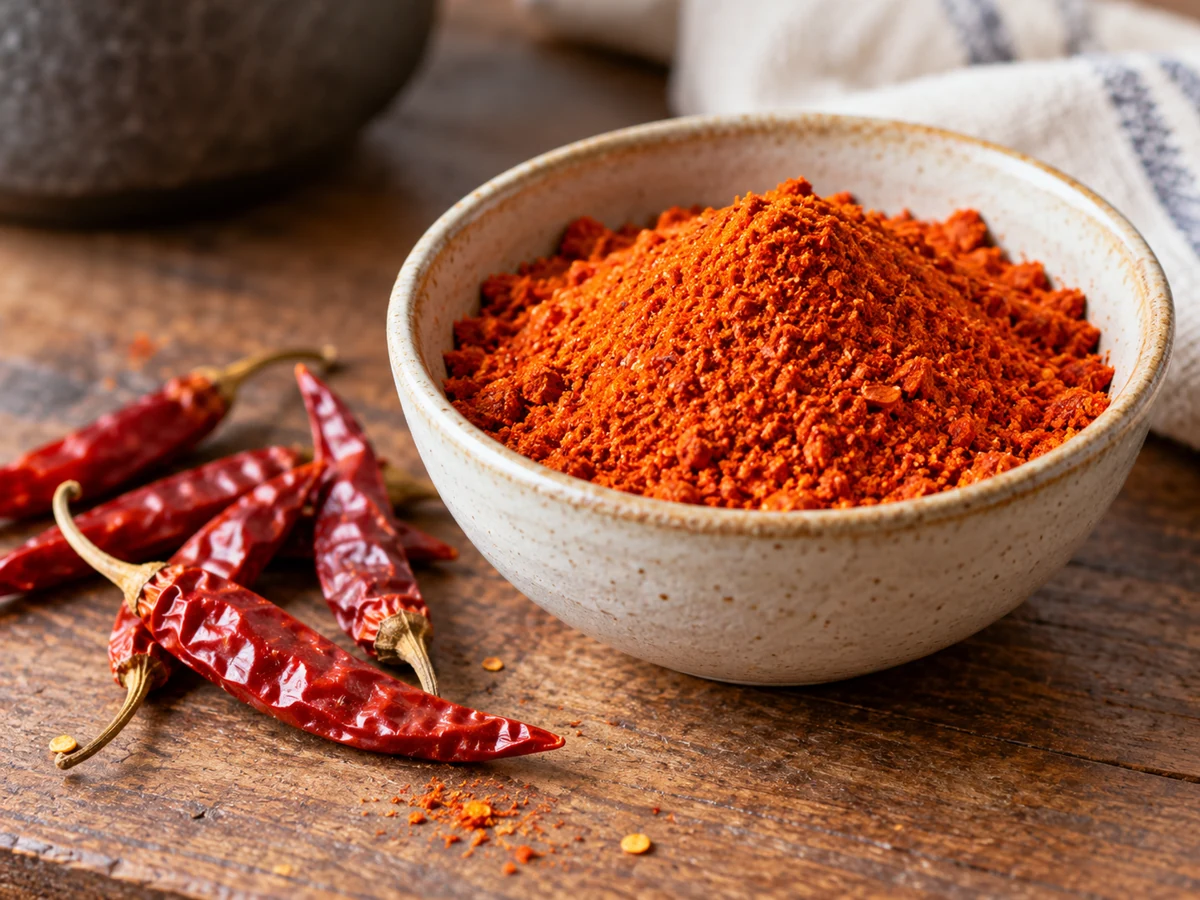
Mitmita is one of the most powerful and distinctive seasonings in Ethiopian cuisine, and more broadly, in the Horn of Africa. It comes as a fine, reddish-orange powder, intensely spicy, built around dried chilies and an assembly of aromatic spices that varies according to family traditions, regions, and uses. Although sometimes compared to other spicy blends worldwide, mitmita has a distinct personality: immediate heat, a frank attack, a warm and slightly earthy aromatic base, sometimes deep notes from seeds, dried herbs, or mild spices in support.
In daily use, mitmita is not simply “chili powder.” It is a tool for structuring flavor. It can season meats, enhance legume-based preparations, accompany dishes served on injera, be incorporated into wet mixtures with clarified butter or oils, or even be used as a finishing touch to boost aromatic perception just before serving. Its strength demands precision: poorly dosed, it overwhelms; well-dosed, it adds depth, length, and an immediately recognizable identity.
Where to find it
Look for the exact food-grade form required by the recipe at markets and specialist shops. Check the product name, ingredients, condition and storage instructions.
Explore further: Cooking tips · Food hygiene and safety advice.
History and uses
Its place in African cuisine is fundamental because it embodies the sophistication of the continent's spice traditions. Mitmita reminds us that African cuisine is not limited to the generic use of chili: it develops complex systems of blending, roasting, drying, grinding, and balancing. In this, it stands at the crossroads of technique, history, and culinary culture.
📜🌍 CULTURAL ROOTS AND ANCHORAGE IN THE CUISINES OF THE HORN
Mitmita is part of a culinary universe where spice blends play a structuring role. In Ethiopia, cuisine relies on deep balances between fermentation (injera), spicy sauces (wats), fragrant fats, and dry or wet condiments that modulate the power of dishes. Mitmita participates in this grammar: it acts as an accent, corrector, and amplifier.
Historically, the Horn of Africa is a region of ancient trade routes, through which spices, aromatics, preservation techniques, and blending practices have passed. Mitmita reflects these dynamics while retaining a very strong local identity. Its exact composition varies, but the logic remains stable: a dominant spicy base, supported by spices that build depth and complexity.
In social practices, mitmita is also linked to specific dishes, particularly certain meat preparations where the desired intensity is part of the experience. It can accompany moments of strong conviviality, where the meal is both gustatory and relational. This cultural dimension goes beyond a simple recipe: it embeds the spice in a way of being together.
🧪🌶️ COMPOSITION, MANUFACTURING, AND THE INTELLIGENCE OF THE BLEND
A quality mitmita begins with the choice of chili. Variety, degree of ripeness, drying method, and fineness of grinding directly influence the final result. The chili provides heat, but also color and part of the aroma. Then come the secondary spices, whose combination varies according to culinary schools: some recipes emphasize aromatic seeds, others warmer notes, and still others herbaceous touches.
Artisanal production often follows a precise sequence: sorting, additional drying if necessary, light roasting of certain components, cooling, then grinding. Roasting is delicate: insufficient, it leaves raw notes; excessive, it brings bitterness. Grinding must aim for a regular particle size for homogeneous flavor diffusion.
The final balance is an art. Mitmita should not be a one-dimensional raw chili. It must combine impact and complexity. The best blends offer a clear rise in heat, then an aromatic persistence that continues after the initial burn. This persistence is the hallmark of well-designed blends.
Preservation also matters. Exposed to air, humidity, or light, the blend quickly loses intensity and freshness. Careful practices favor airtight containers, small quantities, and frequent renewal to preserve its vibrancy.
🍖🍽️ CULINARY USES: from direct seasoning to dish construction Mitmita can be used in several ways. As a direct seasoning, it instantly enhances a bite, grilled meat, a stew, or a legume preparation. Mixed with fat, it becomes a paste or base that more gently coats ingredients. Integrated into cooking, it merges with juices and gains roundness; added as a finish, it retains its sharpness.
In my books

Continue exploring the continent’s cuisines with Africa at the Table — 54 countries, 54 iconic dishes, by Alioune FALL. This book is in English.
Explore further
In some emblematic preparations, its presence is central and assumed: it is not about “mild spice,” but an intense gustatory experience. Yet, even in these contexts, mastery remains essential. Mitmita must interact with acidity, fat, salt, and textures, not dominate blindly.
Its interaction with injera is particularly interesting. The fermentation of injera, with its characteristic acidity, can balance the heat of mitmita and prolong the aromas. This complementarity shows how traditional cuisines are conceived as systems: a condiment fully exists only in relation to the other elements of the meal.
🤝🏺 SOCIAL VALUE AND TRANSMISSION OF KNOW-HOW
Like many major condiments in Africa, mitmita is also a vehicle for cultural transmission. Proportions, spice choices, roasting and grinding techniques are often passed down within family or community settings. There are house styles, local preferences, and recognized flavor signatures.
Preparing a spice blend is not just cooking: it is affirming a collective gustatory memory. In the Ethiopian and Eritrean diasporas, mitmita plays a strong identity role. Finding it, preparing it, or offering it helps maintain a concrete link with the original flavors.
This living transmission is essential to mitmita's place in African cuisine. It reminds us that the continent's heritage includes refined formulation knowledge, comparable to the great global spice traditions, but with its own unique logics.
🌍📚 PLACE IN AFRICAN CUISINE: INTENSITY, PRECISION, IDENTITY
Across the continent, mitmita represents controlled power. It shows that culinary Africa possesses advanced condiment traditions, capable of articulating fire, aroma, and texture in precise proportions. It complements other great African seasoning systems, whether wet, dry, fermented, or smoked.
It also contributes to the visibility of the Horn of Africa in gastronomic narratives. Too often, African cuisines are presented uniformly. Mitmita, by its singularity, helps to recall the continent's internal diversity: here, a culture of fine spice, associated fermentation, complex sauces, and powerful blends.
In contemporary cuisines, it inspires new uses: fusion marinades, seasonings for roasted vegetables, incorporation into compound butters, chef creations. These innovations can be relevant if they respect the logic of the blend and do not reduce it to a simple spicy effect.
🥗⚖️ NUTRITION, PERCEPTION OF SPICINESS, AND RESPONSIBLE USES
Mitmita, used in small quantities, primarily brings a sensory dimension, with the compounds of chili and spices. Capsaicin, responsible for spiciness, influences thermal perception and can stimulate appetite in some diners. Associated spices can also contribute to the digestive complexity of the meal, depending on individual sensitivities.
However, its intensity requires a responsible approach: progressive dosing, adaptation to audiences, special attention for those sensitive to chili. In professional and domestic kitchens alike, mastering the level of heat is a skill in itself.
✨🏁 A MAJOR MARKER OF AFRICAN CULINARY HERITAGE
Ultimately, mitmita holds an essential place in African cuisine because it unites a strong regional identity with broad gastronomic reach. It is deeply rooted in the traditions of the Horn of Africa, while offering the continent a showcase of its spicy intelligence: precision of blends, mastery of processes, and the social role of condiments.
🌍 CONCLUSION
More than a chili powder, mitmita is a grammar of taste. It teaches that power can be refined, that heat can carry complexity, and that African cuisines possess arts of blending of great depth. As long as it is prepared, transmitted, and respected in its uses, it will continue to embody a strong culinary truth: Africa knows how to compose fire with elegance.
In the kitchen : Mitmita
Recipes from the site to put your knowledge into practice:
Discover these cuisines at a restaurant
Explore our restaurant and caterer directories. Choose your destination and check the establishment’s menu to confirm which dishes are offered and available.
Continue exploring
Enjoy discovering ingredients and African cuisines? Join our newsletter. The illustrated PDF 10 sauces africaines incontournables is in French and is offered after confirming a subscription to the French or bilingual edition.