Charmoula
Maghreb
Understanding : Charmoula
🌿 DEFINITION AND CULINARY IDENTITY
Charmoula, also known as chermoula, chermila, or sermoula depending on the country, language, and family usage, is one of the great aromatic preparations of the Maghreb. It can be defined as a marinade, a seasoning sauce, or a paste of herbs and spices intended to flavor food before, during, or after cooking. Its composition varies from one household to another, but it generally relies on a base of fresh herbs, garlic, olive oil, lemon juice or preserved lemon, cumin, paprika, coriander, salt, and sometimes chili. It is best known for accompanying fish and seafood, but it is also used with meats, poultry, vegetables, legumes, and certain stews. This versatility explains its central place in Moroccan, Algerian, Tunisian, and Libyan cuisines. ([LinsFood | by Azlin Bloor][1])
Where to find it
Look for the exact food-grade form required by the recipe at markets and specialist shops. Check the product name, ingredients, condition and storage instructions.
Explore further: Cooking tips · Food hygiene and safety advice.
History and uses
🐟 A MARINADE BORN FROM THE CONNECTION TO THE SEA
Charmoula is intimately associated with the coastal cuisines of North Africa. Along the Atlantic and Mediterranean shores, it has long been used to enhance fish, sometimes to mask the strong flavor of certain meats, but above all to exalt the freshness of seafood. In ports, markets, and homes, it transforms grilled, fried, stuffed, or baked fish into a deeply flavorful dish. Fish coated in charmoula absorbs the aromas of garlic, cumin, lemon, and herbs, while the oil helps to fix the flavors and protect the flesh during cooking. This culinary function is important: charmoula is not just a sauce added at the end; it acts as a binding preparation between the raw food, the fire, the spices, and the table.
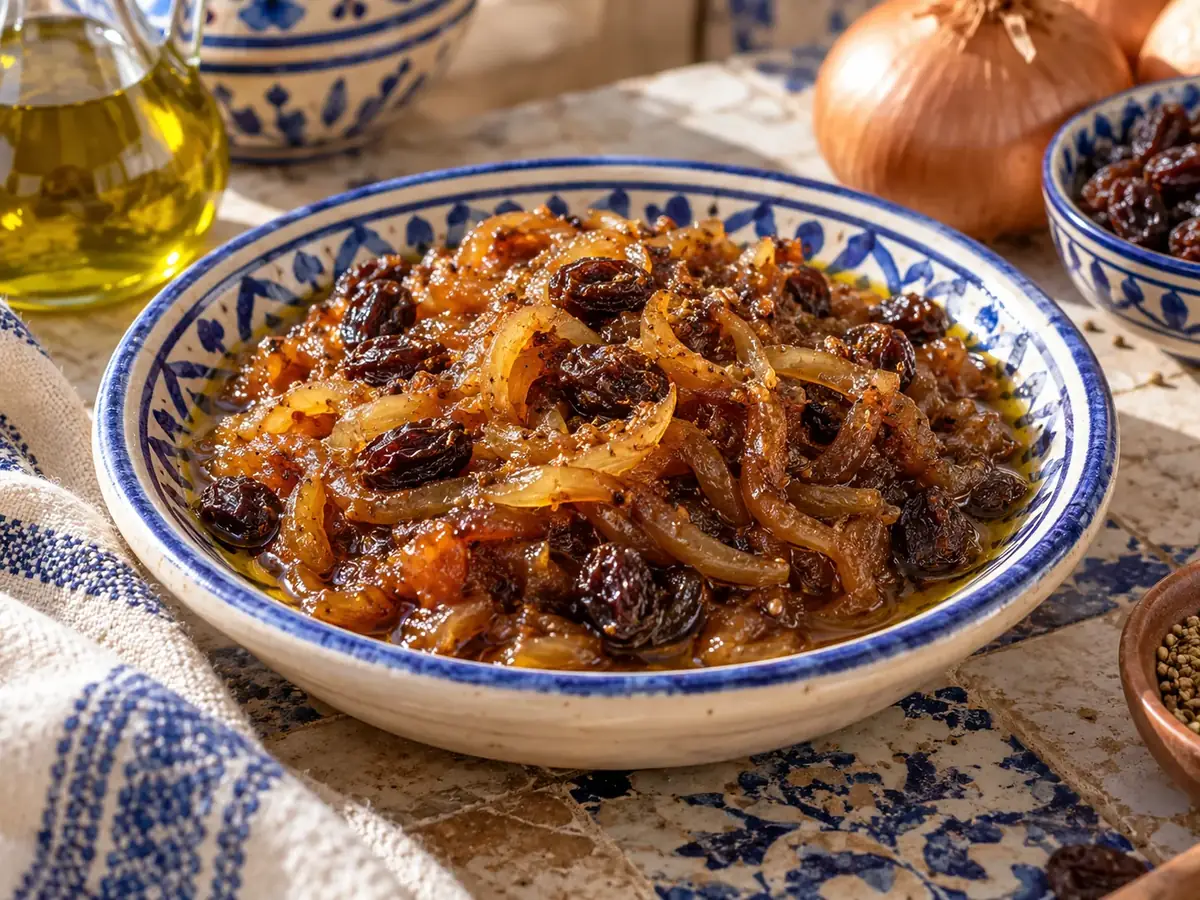
In Morocco, it is very present in fish tagines, stuffed sardines, grilled dishes, marinated vegetable dishes, and certain cooked salads. In Algeria, it also accompanies fried fish, vegetables, baked dishes, and various family recipes where garlic, cumin, and lemon play an important role. In Tunisia, it can take on spicier, sometimes more concentrated forms, and certain regional variations, particularly around Sfax, deviate from the classic green version to incorporate sweet-savory notes, raisins, onions, and warm spices. In Libya, similar preparations are also found, sometimes associated with onion, vinegar, tomatoes, or chili, especially with fried fish and summer meals. ([Wikipedia][2])
🧄 AN ARCHITECTURE OF FLAVORS
The strength of charmoula comes from its balance. Fresh herbs provide color, freshness, and vegetal vibrancy. Garlic gives depth and an immediately recognizable intensity. Cumin, very present in Maghrebi cuisines, brings an earthy and slightly bitter warmth. Paprika colors the preparation and gives it a smoky or fruity sweetness depending on the variety. Lemon, whether fresh or preserved, provides the necessary acidity to awaken the whole. Olive oil binds the ingredients, rounds out the flavors, and allows the marinade to adhere to the food. Chili, when used, provides a more or less lively heat, without necessarily dominating the preparation.
In a well-balanced charmoula, no flavor should overpower the others. It should be at once lively, herbaceous, spicy, lemony, and slightly piquant. This accessible complexity is what makes it so successful. It does not require rare ingredients, but it does demand a good understanding of proportions. Too much garlic can harden the taste; too much lemon can make the marinade aggressive; too much oil can make it heavy; too much cumin can mask the freshness of the herbs. Charmoula is therefore a seemingly simple preparation, but subtle in its execution.
🍋 A FAMILY AND REGIONAL PREPARATION
Like many African preparations, charmoula is not limited to a single recipe. It belongs first and foremost to families, to transmitted gestures, to local habits, and to available products. Some households prepare it very green, rich in coriander and parsley. Others prefer it redder, with more paprika, chili, or tomato paste. Some versions are very lemony, others oilier, drier, or almost pasty. Preserved lemon, common in Moroccan cuisine, gives a particular depth to charmoula: it provides an acidity that is less sharp than fresh lemon, but more complex, almost saline and fermented. ([Serious Eats][3])
Charmoula can be pounded in a mortar, chopped with a knife, or blended. The mortar gives a more rustic texture and gradually releases the essential oils from the herbs, garlic, and spices. The blender yields a more homogeneous, quicker sauce, but sometimes less nuanced if over-processed. In home kitchens, these choices are not just technical: they reflect the relationship to time, culinary memory, and the way of cooking. A charmoula prepared in a mortar often carries the idea of an ancient, patient, almost ritualistic gesture.
In my books

Continue exploring the continent’s cuisines with Africa at the Table — 54 countries, 54 iconic dishes, by Alioune FALL. This book is in English.
Explore further
🌍 ITS PLACE IN AFRICAN CUISINE
Charmoula holds an important place in African cuisine because it perfectly illustrates the richness of the cuisines of the northern part of the continent. It shows that culinary Africa is not limited to grain dishes, long sauces, grilled meats, or stews; it also has a great tradition of condiments, marinades, and aromatic preparations. In this sense, charmoula can be compared to other great African preparations that structure taste: Senegalese nokoss, Ethiopian spice blends like berbere, West African chili pastes, Sahelian grilled marinades, or herb-based sauces found in several regions of the continent.
It also expresses the Mediterranean, Amazigh, Arab, and African dimensions of Maghrebi cuisine. Through its herbs, olive oil, and lemon, it dialogues with the Mediterranean world. Through its cumin, chili, spices, and popular uses, it fully belongs to North Africa. Through its function as a fish marinade, it recalls the role of African coasts, fishing markets, and local cuisines. It is therefore at once local, regional, and continental.
🔥 A BRIDGE BETWEEN HOME COOKING AND FESTIVE CUISINE
Charmoula is present in everyday cooking, but it can also accompany festive dishes. In a simple meal, it transforms sardines, vegetables, or chicken into a flavorful dish. On a more elaborate table, it can be used to stuff fish, flavor a tagine, accompany skewers, or enhance a starter. This ability to transition from everyday to festive is one of the strong characteristics of great African culinary preparations. They are not just recipes; they are cooking tools.
Charmoula is also an economical preparation. It allows for a lot of flavor with few ingredients. It enhances simple products, especially popular fish, potatoes, carrots, zucchini, eggplants, or legumes. In this sense, it belongs to a cuisine of domestic intelligence: a cuisine that knows how to transform, enhance, preserve, and transmit.
🍽️ A MAGHREBI SIGNATURE IN THE WORLD
Today, charmoula extends far beyond the Maghrebi family context. It is present in restaurants, cookbooks, culinary blogs, and diaspora kitchens. It is sometimes compared to South American chimichurri, as both preparations combine herbs, garlic, oil, and acidity. But charmoula retains a very different personality thanks to its North African spices, notably cumin, paprika, coriander, sometimes saffron, or preserved lemon. (The Mediterranean Dish)
Its international spread helps to promote a more precise and refined image of African cuisine. It showcases an Africa of condiments, aromatic balances, marinating techniques, and bold flavors. For a reader or cook discovering the continent's cuisines, charmoula is an ideal gateway: it is easy to understand, easy to prepare, yet deeply rooted in a culinary history.
🌶️ AN AFRICAN AROMATIC MEMORY
Charmoula can finally be understood as an aromatic memory. It carries within it the gestures of markets, seaside kitchens, family meals, grilled fish, fragrant tagines, shared dishes, and variations passed down from generation to generation. It is not fixed: every cook, every region adds its own accent. It is precisely this flexibility that makes it strong. It does not impose a norm; it offers a base, a common language, a North African way of speaking to food.
In African cuisine, charmoula thus occupies a place that is both modest and essential. Modest, because it is not always served as a main dish. Essential, because it gives the soul, the fragrance, and the direction of the dish. It reminds us that in the continent's cuisines, taste comes not only from the main ingredient, but from the art of accompanying it, preparing it, flavoring it, and embedding it in a culture. Through it, the Maghreb asserts a major contribution to the great African table: that of luminous marinades, fresh herbs, warm spices, and lemon that awakens the taste.
In the kitchen : Charmoula
Recipes from the site to put your knowledge into practice:
Discover these cuisines at a restaurant
Explore our restaurant and caterer directories. Choose your destination and check the establishment’s menu to confirm which dishes are offered and available.
Continue exploring
Enjoy discovering ingredients and African cuisines? Join our newsletter. The illustrated PDF 10 sauces africaines incontournables is in French and is offered after confirming a subscription to the French or bilingual edition.