Smen
Maghreb
Understanding : Smen
🧈 DEFINITION AND CULINARY IDENTITY
Smen is a fermented, salted, and long-aged butter, emblematic of North African cuisines, particularly Morocco, Algeria, and some neighboring North African regions. It is also known as sman, s’men, smin, smen beldi, or dhan, depending on the country, region, and family usage. It is not merely preserved butter, but a true fatty condiment that is powerful, fragrant, and distinctive. Its function extends far beyond that of a cooking fat: smen gives character to dishes, signifies culinary belonging, and evokes an ancient memory of domestic preservation.
In its traditional form, smen is prepared from butter made from cow's, goat's, or sheep's milk. It is salted, sometimes clarified, then left to ferment and mature in a closed container, often away from light. Studies on fermented butters from North Africa describe smen as a traditional butter obtained from raw milk, salted, matured in cool, low-oxygen conditions for several months, sometimes much longer. ([MDPI][1])
Where to find it
Look for the exact food-grade form required by the recipe at markets and specialist shops. Check the product name, ingredients, condition and storage instructions.
Explore further: Cooking tips · Food hygiene and safety advice.
History and uses
🌍 A STRONG PLACE IN NORTH AFRICAN CUISINES
Smen's place in African cuisine is primarily as a marker of the Maghreb. It belongs to that large family of African preparations that are not always visible on the plate but profoundly build the taste. Like nokoss in West Africa, berbere in Ethiopia, or certain chili pastes in Sahelian cuisines, smen acts as an aromatic base. A small amount is enough to transform a dish. It brings a milky depth, a fermented note, an almost cheesy power, and a persistent warmth.
In Morocco, smen is associated with couscous, tagines, soups, legume dishes, breads, and certain festive preparations. In Algeria, where it is also known as dhan in some regions, it is part of an ancient food heritage, linked to the rural world, milk preservation, and family culinary practices. Research on Algerian smen highlights its importance as a traditional dairy product and as an element of gastronomic heritage to be preserved. ([CCSE][2])
🐄 A PRODUCT OF PRESERVATION AND DOMESTIC INTELLIGENCE
Smen tells a very African story: that of transforming available products to make them last, enrich them, and pass them on. In societies where milk, butter, and fats were precious, ways had to be found to preserve them that were adapted to the climate, seasons, and rhythms of domestic life. Salting, fermentation, and maturation extended the shelf life of butter while developing new aromas.
This logic is essential to understanding smen. It was not born from a search for abstract refinement, but from a concrete necessity: to preserve a fragile fat. Over time, this necessity became an art. What was initially a preservation method became a culinary signature. Smen thus illustrates how African cuisines transform constraint into gustatory richness. Where fresh butter would simply be mild, smen becomes intense, deep, almost mysterious.
👃 A POWERFUL, FERMENTED, AND DEEP TASTE
Smen has a very distinct aromatic personality. Its aroma can surprise those who discover it for the first time. It can evoke aged butter, ripe cheese, a cellar, hazelnut, fermented milk, sometimes even a slight animal note. This intensity explains why it is rarely used in large quantities. A few grams are enough to flavor an entire couscous, soup, or tagine.
Its taste depends on many factors: the origin of the milk, the type of butter used, the amount of salt, the aging period, the container, the temperature, any added herbs, and local traditions. Some families prepare a relatively mild smen for daily use. Others seek a very old, more full-bodied smen, reserved for grand dishes or special occasions. In some Moroccan traditions, herbs like thyme or oregano can be included in the preparation, giving smen a vegetal and medicinal note. Culinary sources also describe its aging in a sealed jar, sometimes for months or years. ([Kitchn][3])
🍲 SMEN IN EVERYDAY DISHES
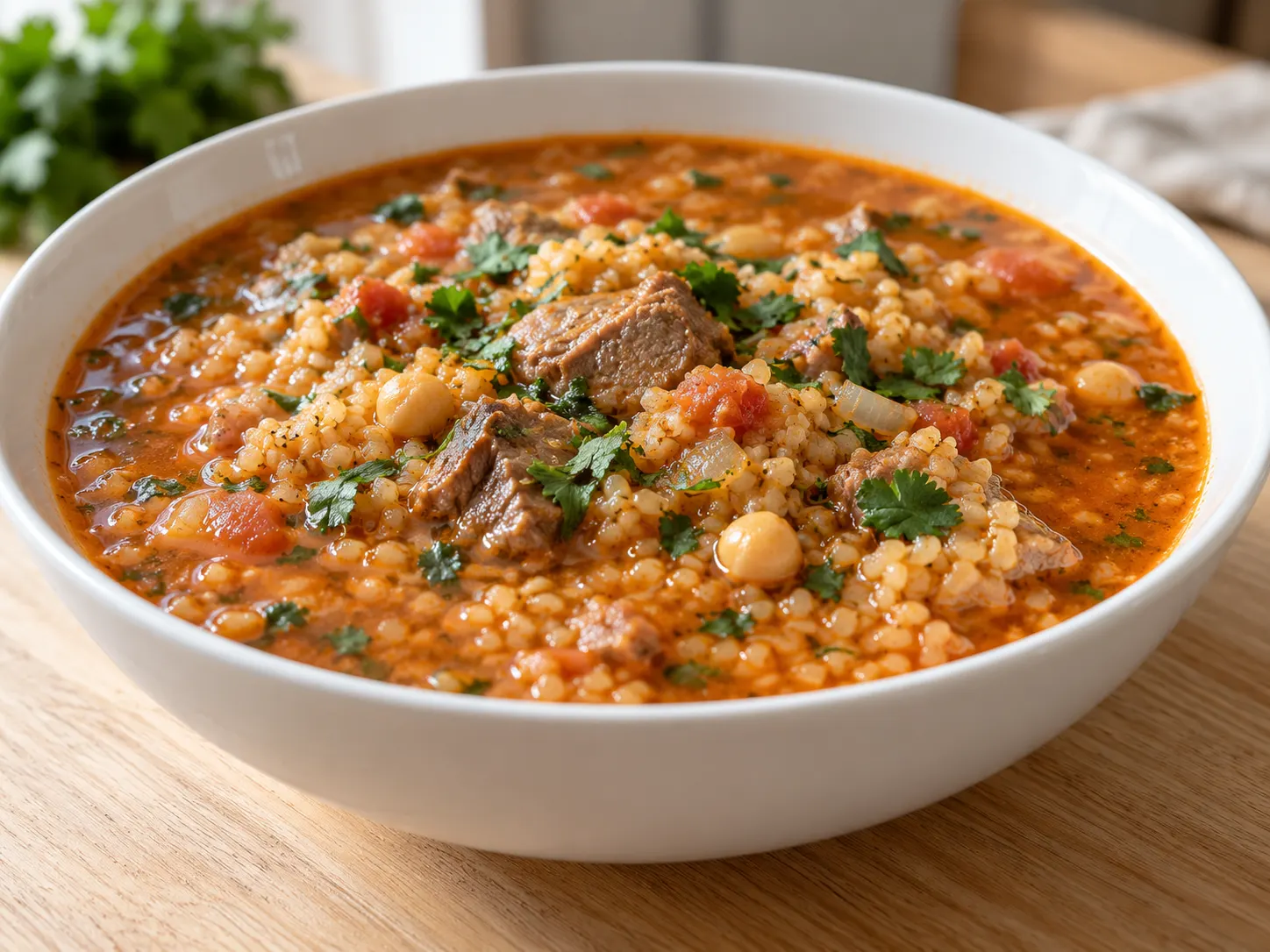
In everyday cooking, smen functions as a traditional flavor enhancer. It can be added to couscous to flavor the semolina and broth. It can enrich a soup, enhance a legume purée, give depth to a vegetable tagine, or accompany warm bread. It doesn't need to be dominant: its role is often discreet but decisive.
In couscous, smen brings a richness that oil alone does not provide. It blends with the steam of the semolina, vegetables, spices, and broth. In a tagine, it supports the spices and provides a long finish. In a split pea, fava bean, or lentil soup, it adds a fermented note that makes the dish denser and more nourishing. Some Moroccan culinary sources mention its use in couscous, tagines, on bread, and even in some more specific consumption habits. ([KPBS Public Media][4])
In my books

Continue exploring the continent’s cuisines with Africa at the Table — 54 countries, 54 iconic dishes, by Alioune FALL. This book is in English.
Explore further
🎉 AN INGREDIENT OF MEMORY AND CEREMONY
Smen is not just a food product. It also has a symbolic dimension. In many North African families, good smen is passed down, kept, and respected. The older it gets, the more precious it can be considered. It can accompany festive meals, special occasions, dishes prepared for guests, or moments when one wants to give a dish a particular depth.
This symbolic value comes from its longevity. Ancient smen carries time within it. It recalls the gestures of mothers and grandmothers, jars kept in a cool corner, rural kitchens, domestic reserves, and know-how that cannot be measured solely by written recipes. Like many fermented products, it is the result of a relationship between food, time, place, and the human hand.
🌿 BETWEEN AFRICA, THE MEDITERRANEAN, AND THE PASTORAL WORLD
Smen occupies an interesting position in African culinary geography. It belongs to North Africa, but it dialogues with several worlds: the pastoral world of milk, the Mediterranean world of oil and herbs, the Saharan world of preservation, and the domestic world of slow-cooked dishes. It shows that African cuisine is not limited to cereals, sauces, and grilled foods. It also includes aged products, fatty condiments, complex fermentations, and ancient preservation techniques.
From this perspective, smen can be compared to other cultural fats on the continent: red palm oils in Central and West Africa, clarified or flavored butter in some pastoral cuisines, peanut oils, preserved animal fats, or local fermented butters. Each of these fats does not just serve to cook; it gives identity to the dish. Smen is one of the strongest expressions of this African intelligence of fat as a vector of taste, memory, and territory.
🥣 A DISCREET BUT ESSENTIAL PRODUCT
What makes smen fascinating is its paradox. It is rarely the main element of a dish, but it can entirely change its personality. It is not always seen, but it is felt. It does not occupy the center of the plate, but it inhabits the taste. In couscous or tagine, it acts as an invisible signature. It connects the ingredients, deepens the spices, provides warmth, and places the dish within a tradition.
This discretion is important for understanding African cuisine. Many of its most decisive elements are not always spectacular: an aromatic paste, a red oil, a broth, a fermentation, a pounded spice, an ancient condiment. Smen belongs to this category. It is a foundational ingredient, a product that does not seek attention but gives the dish its accent, depth, and memory.
📚 A FERMENTED MEMORY OF NORTH AFRICA
Smen can therefore be defined as a fermented memory of North Africa. It condenses ancient knowledge: transforming milk, salting, preserving, aging, dosing, transmitting. It also embodies a taste aesthetic specific to North African cuisines: generous, long-fragrant dishes where spice, fat, acidity, cereal, and time work together.
Its place in African cuisine is that of a noble, popular, and heritage condiment all at once. Noble due to its antiquity and aromatic power. Popular because it comes from home kitchens and everyday gestures. Heritage because it tells a way of life, of preserving and flavoring foods. Through smen, North Africa reminds us that African cuisine is also a civilization of fermentation, aging, and gustatory memory.
In the kitchen : Smen
Recipes from the site to put your knowledge into practice:
Discover these cuisines at a restaurant
Explore our restaurant and caterer directories. Choose your destination and check the establishment’s menu to confirm which dishes are offered and available.
Continue exploring
Enjoy discovering ingredients and African cuisines? Join our newsletter. The illustrated PDF 10 sauces africaines incontournables is in French and is offered after confirming a subscription to the French or bilingual edition.