Banku
Ghana
Understanding : Banku
🇬🇭 THE ORIGIN AND HISTORY OF BANKU IN WEST AFRICA
Banku is an iconic staple food of West African gastronomy, particularly rooted in Ghana's culinary identity. This unique preparation, which comes in the form of a cooked, dense, and slightly elastic dough, is consumed daily by millions of people. Historically, banku has its roots among the Ga, Adangbe, and Ewe peoples, who inhabit the coastal and southern regions of Ghana and neighboring Togo. Over the centuries, this specialty has become popular beyond its original homes to become a national treasure shared by all Ghanaian ethnic groups and appreciated throughout the sub-region. The invention of banku testifies to the ingenious adaptation of local populations to available agricultural resources. By combining corn, introduced to Africa via transatlantic trade routes, and cassava, a resilient tuber, traditional cooks developed a highly nutritious food capable of sustainably satisfying workers. Banku thus embodies the cross-cultural blend of agricultural practices and the genius of fermentation preservation techniques, which form the foundation of food security in tropical environments.
🥣 KEY INGREDIENTS AND THE ART OF FERMENTATION
Banku's magic lies in the extreme simplicity of its ingredients, contrasting with the complexity of its preparation. It essentially consists of two elements: fermented corn dough and fermented cassava dough. These two basic ingredients are mixed in varying proportions depending on regions and family preferences, with corn generally representing the larger portion, often two-thirds corn to one-third cassava. The crucial first step is making the fermented corn dough, locally known as corn dough. Dry white corn kernels are soaked in water for several days to initiate natural lactic fermentation. They are then finely ground to obtain a moist, dense dough that is left to ferment at room temperature for another two to three days. Simultaneously, cassava is peeled, washed, grated, then pressed to extract excess water and starch, before undergoing fermentation itself. This double biological process profoundly alters the carbohydrate structure and gives banku its characteristic tangy and sour flavor, while improving its digestibility and increasing its essential nutrient content.
🔥 THE COOKING TECHNIQUE AND THE COOK'S PHYSICAL EFFORT
Cooking banku is a demanding process that requires considerable physical strength and perfectly mastered technique. To begin, the fermented corn and cassava doughs are mixed with warm water in a thick-bottomed aluminum pot or traditional cooking pot. This mixture is vigorously stirred by hand to eliminate all lumps and obtain a fluid, homogeneous consistency, similar to a thick pancake batter. The pot is then placed over medium heat. As soon as the mixture begins to heat up, the cook uses a flat, robust wooden spatula, called banku ta in the local language, to work the dough. This involves a rhythmic, circular kneading and turning motion, requiring continuous pressing of the dough against the sides of the pot to prevent it from burning or forming hard nodules. As the water evaporates, the dough thickens, becomes translucent, elastic, and takes on a whitish or grayish color. The cook regularly adds small amounts of hot water to adjust the texture and ensure uniform cooking of the starch. After about thirty to forty-five minutes of this sustained effort, the banku is cooked. It is then scooped out with a wet bowl and shaped into smooth, hot balls, ready to be served.
🐠 TRADITIONAL ACCOMPANIMENTS AND THE TASTE EXPERIENCE
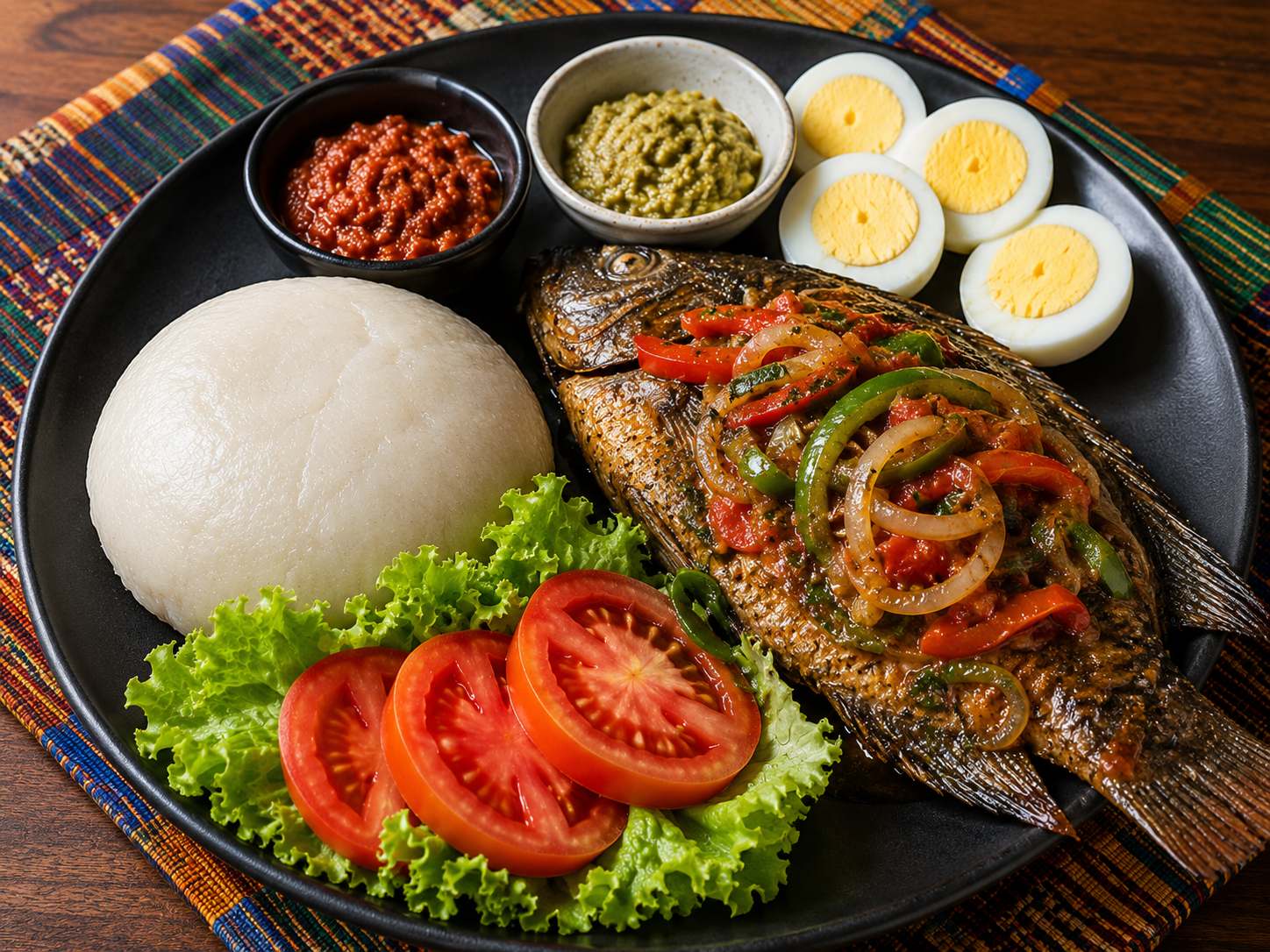
Banku is never eaten alone; its tangy flavor and firm texture make it the perfect vessel for a multitude of rich sauces, stews, and soups in African cuisine. The most famous and beloved pairing is undoubtedly banku with grilled tilapia. In this iconic dish, the hot banku ball is accompanied by a whole seasoned and charcoal-grilled fish, served with a spicy sauce of crushed green or red chilies, sliced onions, and fresh tomatoes. A drizzle of oil or a spoonful of shito, a sauce of fried black chilies with dried shrimp and fish, completes this festive plate. Banku also pairs wonderfully with okra stew, a slimy and fragrant sauce made with meat, crab, fish, and fresh okra. The sticky texture of the okra sauce facilitates the absorption of the corn dough with the fingers. Clear and spicy soups, such as fish soup or goat soup, as well as peanut butter or palm nut-based sauces, are other excellent accompaniments that transform banku into a comforting and nourishing meal.
🏷️ SYNONYMS AND REGIONAL VARIATIONS OF THE DOUGH
Although the term banku is universally understood and used throughout Ghana, there are several synonyms and regional variations that attest to the cultural diversity of the region. Among the Ewe people, inhabiting the Volta region and southern Togo, a very similar variant is called akple. Akple differs from banku in its composition, as it is traditionally prepared almost exclusively with corn flour, without the addition of cassava, which gives it a firmer texture and a slightly grayer color. Furthermore, the fermentation of akple is often less prolonged, which reduces its acidity compared to banku. In some Dangme communities, the word komi is sometimes used, although this term more often refers to steamed fermented corn dumplings cooked in leaves, similar to kenkey. Beyond Ghanaian borders, banku shares great similarities with other West African doughs, such as Nigerian eba, although the latter is made from dry cassava semolina called garri and is generally not fermented in the same way. These nuances in names and textures highlight the richness of culinary traditions that intersect and influence each other along the West African coast.
🌍 BANKU'S CENTRAL PLACE IN AFRICAN SOCIETY
Banku goes far beyond simple food to establish itself as a true social and cultural pillar in West Africa. It is a deeply democratic dish, accessible to all budgets, that brings together individuals from all social classes. In Ghanaian cities, chop bars, these small, traditional, and welcoming street restaurants, are the scene of a daily ballet where workers, students, and businessmen sit side by side to enjoy their steaming banku. It is a convivial food traditionally eaten with the hands, the right hand exclusively, according to a strict code of politeness. Diners often share the same dish, thus strengthening family and community ties. Moreover, the preparation of banku is an integral part of the intangible heritage passed down from mothers to their daughters, constituting a major culinary apprenticeship that marks the entry into adulthood. On festive days, during weddings, funerals, or traditional festivals like the Ga Homowo, banku holds a place of honor on tables, symbolizing abundance, sharing, and attachment to ancestral traditions.
🌱 NUTRITIONAL AND DIGESTIVE BENEFITS OF FERMENTATION
From a health perspective, banku is a food of great nutritional value, particularly suited to the energy needs of active populations. Corn and cassava provide a significant amount of complex carbohydrates that supply sustained energy throughout the day. The natural fermentation process that characterizes banku preparation is a major asset for digestive health. Indeed, lactic fermentation significantly reduces the antinutritional factors in corn and cassava, such as phytic acids, which ordinarily limit the absorption of essential minerals by the human body. Thanks to this biological transformation, the iron, calcium, magnesium, and zinc contained in the cereals become highly bioavailable to the body. Furthermore, fermentation somewhat pre-digests starches, which makes banku extremely gentle on the stomach and prevents bloating. Finally, the natural acidity developed during the process helps maintain a healthy intestinal environment by promoting the growth of good bacteria, thereby indirectly strengthening the immune defenses of regular consumers.
🚀 MODERNIZATION AND FUTURE PROSPECTS OF THIS TRADITIONAL DISH
In the era of globalization and the fast pace of urban life, banku successfully meets the challenge of modernization. As the traditional preparation of fermented doughs is long and laborious, technological and commercial innovations have emerged to simplify household life. Today, it is increasingly common to find dehydrated and ready-to-use banku flours in Ghanaian and diaspora markets and supermarkets. These industrial or artisanal powders allow banku dough to be reconstituted in just a few minutes, while preserving the tangy flavor and elastic texture of the original dish. Moreover, modern restaurants and chefs of the new African cuisine are appropriating banku to present it in revisited gastronomic forms, associating it with contemporary sauces or refined aesthetic presentations. This transition to modernity not only preserves this culinary heritage for young urban generations but also paves the way for international recognition of banku as a healthy, gluten-free, and entirely plant-based alternative, capable of seducing palates worldwide.
Its synonyms: akple, fermented corn and cassava dough, corn and cassava dough dumpling, traditional komi.
Keywords:
Ghana Cassava Fermentation Tilapia Cereal Send message
Where to find it
Look for the exact food-grade form required by the recipe at markets and specialist shops. Check the product name, ingredients, condition and storage instructions.
Explore further: Cooking tips · Food hygiene and safety advice.
In my books

Continue exploring the continent’s cuisines with Africa at the Table — 54 countries, 54 iconic dishes, by Alioune FALL. This book is in English.
In the kitchen : Banku
Recipes from the site to put your knowledge into practice:
Discover these cuisines at a restaurant
Explore our restaurant and caterer directories. Choose your destination and check the establishment’s menu to confirm which dishes are offered and available.
Continue exploring
Enjoy discovering ingredients and African cuisines? Join our newsletter. The illustrated PDF 10 sauces africaines incontournables is in French and is offered after confirming a subscription to the French or bilingual edition.