Eba
Nigeria
Understanding : Eba
🌴 THE ESSENCE AND HISTORY OF EBA IN WEST AFRICA
Eba is one of the most iconic and widely consumed staple foods in West Africa, particularly in Nigeria, where it is considered a national culinary treasure. This preparation, which resembles a firm, dense, and slightly granular dough, is the pivot around which the daily meals of millions of families are organized. Originating from the southern regions of Nigeria, especially among the Yoruba people, eba quickly spread throughout the country and beyond its borders, conquering Benin, Togo, Ghana, and other nations in the sub-region. The history of eba is intimately linked to the cultivation of cassava, a tuber native to South America introduced to Africa by the Portuguese in the sixteenth century. Faced with droughts and the need to feed a growing population, West African farmers and cooks learned to tame this hardy tuber by developing complex processing methods. Eba is the ultimate result of this ingenuity, representing much more than just a meal: it is a symbol of resilience, survival, and cultural identity.
🌾 THE TRANSFORMATION OF CASSAVA INTO GARRI
To understand eba, one must first understand garri, which is its sole solid ingredient. Garri is a dry semolina obtained by the meticulous processing of freshly harvested cassava roots. The process begins with peeling the tubers, which must be rid of their thick brown skin. Once washed, the white cassava pieces are grated to obtain a moist pulp. This pulp is then enclosed in jute or woven plastic bags and subjected to high pressure under heavy weights or hydraulic presses for several days. This step is crucial because it allows the toxic juice of the cassava, rich in hydrocyanic acid, to be expressed, while initiating natural fermentation. This spontaneous fermentation gives garri its sought-after slightly sour and tangy flavor. After pressing, the dried cassava mass is crumbled and sieved to remove coarse fibers. Finally, the resulting semolina is dry-roasted in large cast iron or clay pans over a wood fire. This roasting stabilizes the product, eliminates residual moisture, and gives garri its crispy texture and long shelf life, ready to be transformed into eba at any time.
🍲 THE SIMPLICITY OF PREPARATION AND THE CHEMISTRY OF THE GESTURE
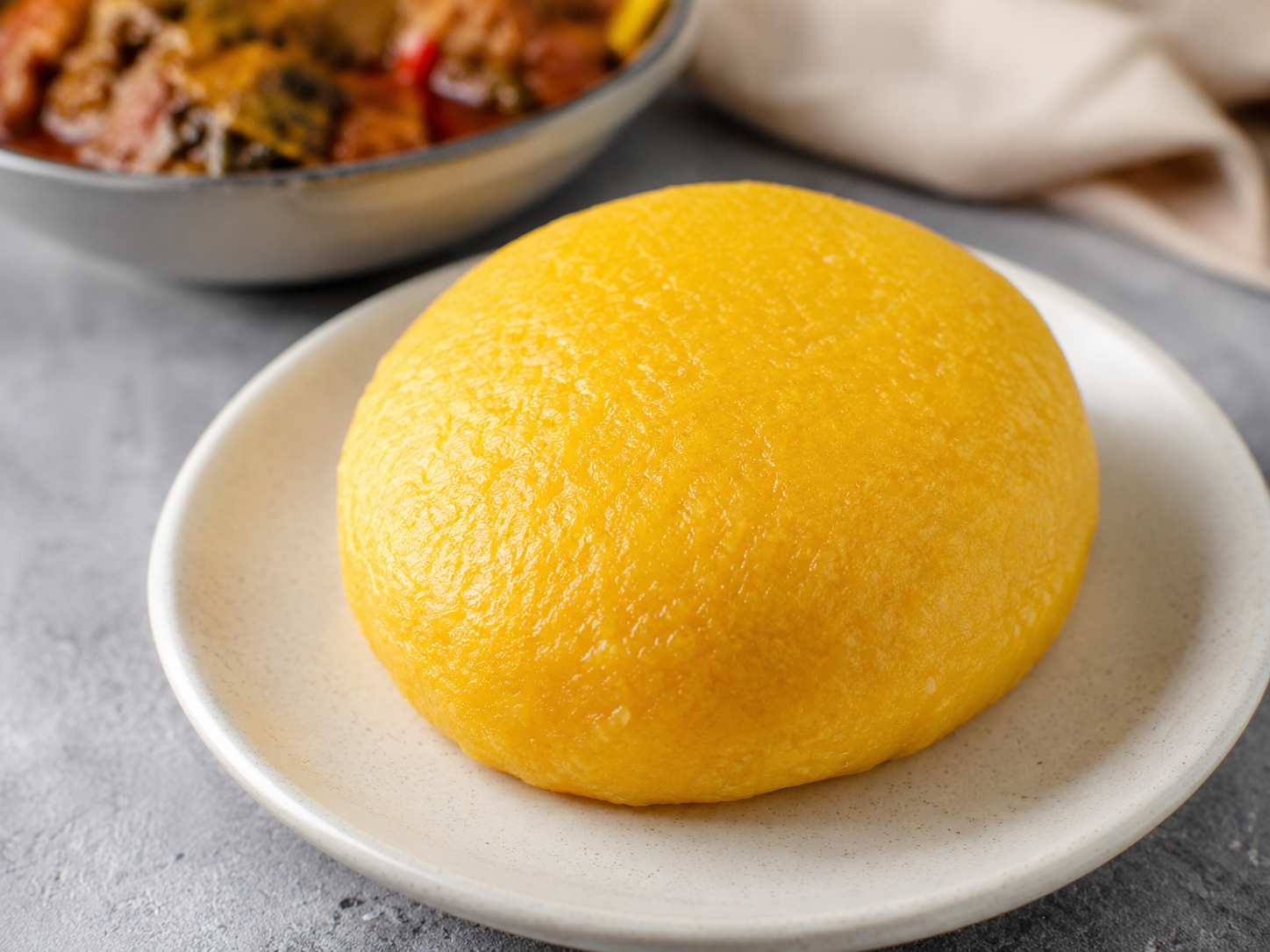
The preparation of eba is a model of simplicity and efficiency, which largely explains its popularity. Unlike other African doughs like fufu or pounded yam, which require intense physical pounding, eba is prepared in a few minutes without excessive effort. The secret lies in the use of boiling water. To make eba, water is brought to a boil in a pot. Once the water is boiling, the pot is removed from the heat or left on very low heat, and garri is gradually poured in a fine stream into the water. Under the effect of heat, the starch contained in the garri grains instantly gelatinizes, absorbing water and swelling to form a compact dough. The cook then uses a flat wooden spatula to vigorously stir and knead the mixture against the sides of the container. This action homogenizes the dough, eliminates air bubbles, and results in a smooth, firm, and malleable texture, without any lumps. Eba is then shaped into balls or domes and served immediately, still steaming, as it hardens slightly as it cools.
🌶️ ACCOMPANIMENTS AND THE ART OF FLAVOR PAIRING
Eba is a neutral food that is never consumed alone. Its firm and slightly elastic texture is specially designed to absorb and enhance the richest sauces and stews of West African cuisine. In Nigeria, the classic pairing par excellence is with egusi soup, prepared from ground melon seeds, green vegetables, palm oil, meat, and dried fish. Another legendary pairing is eba with ogbono soup, a slimy sauce made from wild mango seeds, which coats the dough and facilitates swallowing. Ewedu, a sauce of blended jute leaves, and efo riro, a rich stew of local spinach and peppers, are also traditional companions to eba. When eating, the diner takes a small portion of eba with the fingers of their right hand, shapes a small ball, makes a slight depression with their thumb to collect the sauce, and then swallows it whole without excessive chewing. It is a complete sensory experience, combining the warmth of the dough, the texture of the sauce, and the richness of local spices.
🏷️ SYNONYMS AND VARIATIONS OF THIS CASSAVA DOUGH
Depending on geographical regions and local languages, eba is known by different names that reflect the linguistic richness of West Africa. In Yoruba land, where the original term comes from, it is simply called eba. In French-speaking areas like Benin and Togo, this preparation is most often called pâte de gari or gari fufu. People there see it as a practical variation of traditional fufu. In Ghana, the terms gari fufu or gari paste are also used to refer to this quick dish. There are also variations in color and taste depending on the type of garri used. We mainly distinguish between white eba, made from classic white garri, and yellow eba, very popular in the Niger Delta, prepared with garri to which palm oil has been added during the roasting phase. Palm oil not only provides a beautiful golden color but also a unique sweet and fruity flavor. In Beninese and Togolese cuisine, a seasoned version of gari paste, cooked directly in a meat or fish broth with tomato and spices, is called pinon or pinion, constituting a festive and flavorful variant of classic eba.
👥 SOCIAL REACH AND COMMUNITY SHARING
In West African society, eba transcends the simple role of food to become a major social glue. It is the quintessential family meal, often referred to as the people's dish due to its very affordable cost and the wide accessibility of garri. From the most modest homes to the tables of the urban middle class, eba brings all generations together. Its consumption is imbued with conviviality and sharing. Traditionally, eba is served in a large common dish placed in the center of the table, around which family members gather. Eating eba together strengthens bonds of solidarity and mutual respect, with elders ensuring that younger ones receive their fair share of meat or fish hidden under the sauce. In chop bars, these informal popular restaurants that proliferate in the streets of Lagos, Cotonou, or Lomé, eba is the comforting meal ordered after a long day of work, allowing customers to recharge in a warm and lively atmosphere.
💪 NUTRITIONAL CONTRIBUTIONS AND HEALTH QUALITIES
Nutritionally, eba is a highly energetic food, ideal for people engaged in physical jobs or requiring sustained caloric intake. Its richness in complex carbohydrates, derived from cassava, ensures a gradual release of energy and provides a lasting feeling of satiety. The fermentation undergone by cassava during garri production offers significant health benefits. It breaks down starch into simpler molecules, thus facilitating the work of the digestive system and avoiding feelings of abdominal heaviness. Moreover, the drying and roasting process eliminates virtually all free water, which makes garri and consequently eba extremely healthy, free from the proliferation of molds or pathogenic bacteria during raw material storage. Using no chemical additives, eba is an entirely natural and gluten-free product, making it a choice alternative for people suffering from celiac disease or various digestive sensitivities.
🚀 MODERNIZATION AND INTERNATIONAL EXPANSION
Today, eba successfully adapts to the demands of modern life and globalization. For the African diaspora settled in Europe, America, or Asia, garri is a vital link to their homeland. Thanks to its ease of transport and exceptional preservation, it travels easily and is sold in exotic grocery stores worldwide. Manufacturers strive to modernize garri packaging, offering high-quality airtight bags and individual portions. Furthermore, eba is beginning to make its way onto the tables of gourmet African restaurants around the world, where creative chefs present it aesthetically, molded with cookie cutters and accompanied by revisited sauces. By asserting itself as a plant-based, economical, and gluten-free alternative to Western starches, eba demonstrates that traditional African cuisine possesses universal assets capable of attracting a global audience increasingly concerned about their health and curious to discover new culinary cultures.
Its synonyms: pâte de gari, gari fufu, gari paste, pinon, fufu de gari.
Keywords:
Cassava Garri Nigeria Egusi Sauce
Where to find it
Look for the exact food-grade form required by the recipe at markets and specialist shops. Check the product name, ingredients, condition and storage instructions.
Explore further: Cooking tips · Food hygiene and safety advice.
In my books

Continue exploring the continent’s cuisines with Africa at the Table — 54 countries, 54 iconic dishes, by Alioune FALL. This book is in English.
In the kitchen : Eba
Recipes from the site to put your knowledge into practice:
Discover these cuisines at a restaurant
Explore our restaurant and caterer directories. Choose your destination and check the establishment’s menu to confirm which dishes are offered and available.
Continue exploring
Enjoy discovering ingredients and African cuisines? Join our newsletter. The illustrated PDF 10 sauces africaines incontournables is in French and is offered after confirming a subscription to the French or bilingual edition.