Foutou
Côte d'Ivoire
Understanding : Foutou
🇨🇮 THE HISTORY AND SIGNIFICANCE OF THIS IVORIAN MASTERPIECE
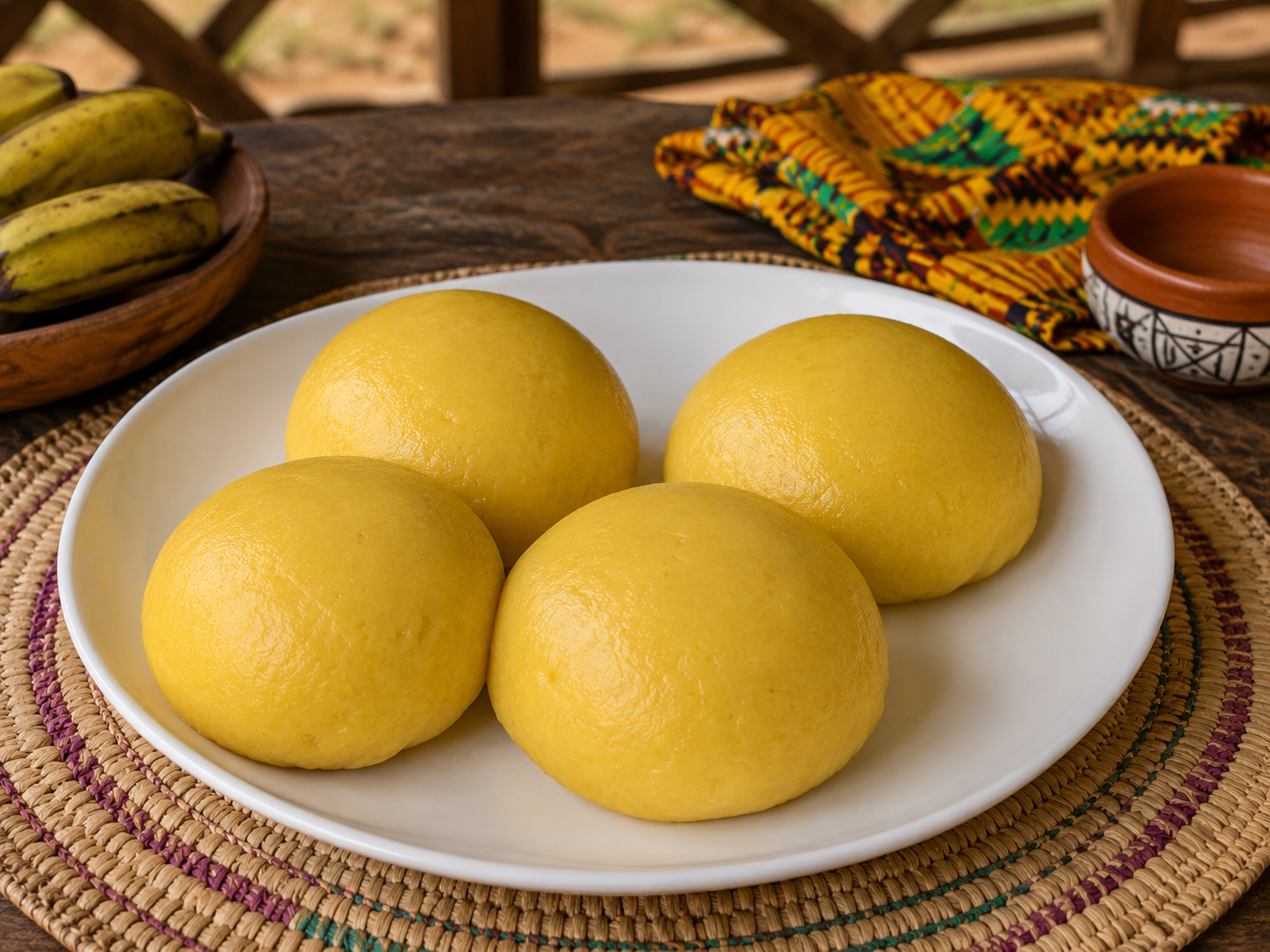
Foutou is the central and unshakeable pillar of Côte d'Ivoire's culinary identity. This ancestral preparation, which takes the form of a smooth, compact, and slightly elastic ball of dough, is much more than just food: it embodies the heart of Ivorian hospitality and conviviality. Present on the tables of families from all social classes, foutou originates from the forest regions of Côte d'Ivoire, particularly among the Akan people, before becoming a national culinary heritage shared and celebrated by all ethnic groups in the country. The preparation of this traditional dish is a direct tribute to the riches of Ivorian land, highlighting fundamental ingredients such as plantain, yam, and cassava. In the popular African imagination, foutou immediately evokes the warmth of home, the hypnotic rhythm of the pestle in the mortar, and communal sharing. It is the highlight of festive meals, Sunday family gatherings, and major celebrations, testifying to a culture of generosity and respect for guests.
🍌 THE VARIATIONS OF THE MAIN INGREDIENT
The versatility of foutou is expressed through its different variations, each possessing its own distinct flavor profile and specific texture depending on the ingredients used. The most famous and appreciated version is foutou banane (plantain foutou). It is prepared by combining ripe or semi-ripe plantains with cassava. The addition of cassava is essential to provide the necessary elasticity and cohesion to the dough, while plantain gives it its golden yellow color and subtly sweet flavor. Another noble variant is foutou igname (yam foutou), particularly revered in the eastern and northern regions of Côte d'Ivoire. Yam, a sacred tuber celebrated during harvest festivals, yields a white, firm, and very refined dough. Less common but equally traditional, foutou manioc (cassava foutou) offers an extremely elastic texture and a more neutral taste. In some households, subtle mixtures are also practiced, for example, combining plantain and yam to balance sweet and savory flavors. Whatever the chosen variant, the quality of the raw product is paramount: tubers must be fresh, firm, and rich in starch to guarantee the success of the final dough.
🔨 THE PHYSICAL AND ARTISTIC RITUAL OF TRADITIONAL POUNDING
The making of foutou is a physical art akin to a true choreography. Traditional pounding requires the use of two fundamental tools: the heavy wooden mortar, carved from a tree trunk, and the hard wooden pestle. The process begins with cooking the ingredients. Pieces of plantains and cassava, or yams, are peeled, washed, then boiled in water until perfectly tender. Once cooked, they are removed from the water, and the pounding begins. It is a remarkable exercise in coordination, often requiring two people: one wields the pestle with strength and regularity, while the other, crouched beside the mortar, turns the hot dough with bare hands between each pestle stroke, lightly moistening it with water to prevent it from sticking. The dull, rhythmic sound of the pestle hitting the wood resonates in African compounds like a heartbeat, signaling to neighbors that a meal is being prepared. This work continues until the fibrous pieces completely disappear, leaving a homogeneous, shiny, and supple dough. The dough is then skillfully shaped into perfect oval balls using a wooden cup or a wet bowl.
🌶️ THE SACRED MARRIAGE WITH MYTHICAL SAUCES
Foutou is by nature a textural food that cannot be conceived without its liquid accompaniment. Its dense consistency and neutral taste are designed to be enhanced by rich, creamy, and highly spiced sauces. In Côte d'Ivoire, the most prestigious pairing is foutou banane with sauce graine (palm nut sauce). This sauce is made from the juice extracted from the pulp of cooked palm nuts, simmered for a long time with bushmeat, fresh fish, crab, or chicken, all seasoned with local spices. The creaminess and natural fat richness of sauce graine deliciously contrast with the sweetness of the plantain. Foutou also pairs exceptionally well with sauce arachide (peanut sauce), prepared with roasted peanut paste and tomatoes, or with sauce claire (clear sauce), a light but very spicy broth with fresh chili and local aromatic herbs. Sauce feuille (leaf sauce), made from cassava leaves, spinach, or okra, is another traditional alliance appreciated for its slippery quality, which facilitates the swallowing of the foutou dough. Eating foutou is an art: one dips fingers to detach a piece, which is then deliciously rolled in the sauce before being swallowed.
🏷️ SYNONYMS AND REGIONAL TERMINOLOGY
Although the word foutou is the established term in Côte d'Ivoire, this dish belongs to a vast West African culinary family that uses different names depending on the country and colonial influences. The most universal synonym in West Africa is foufou or fufu. In English-speaking countries like Ghana or Nigeria, fufu is commonly written to refer to this same preparation made from pounded cassava, yam, or plantain. In neighboring Ghana, the pounded yam paste version is called pounded yam, while the cassava and plantain version retains the name fufu. In French-speaking Central African regions, the word foufou sometimes refers to a paste prepared from dry cassava or corn flour mixed with boiling water, which differs from the Ivorian method of pounding fresh boiled tubers. In Côte d'Ivoire itself, popular expressions describe this specialty, and it is sometimes referred to as boule nationale (national ball) or nourriture des braves (food of the brave) to designate foutou. These terminological nuances show how the same concept of pounded starch-based paste connects Central and West African cultures under various names.
👥 THE SOCIAL ROLE AND THE TRANSMISSION OF KNOW-HOW
Foutou is an essential social cement in West Africa. It embodies values of respect, family, and intergenerational transmission. Knowing how to pound foutou and achieve its lump-free texture has long been considered, in traditional societies, a major skill indispensable for married and family life. This transmission occurs mainly from mother to daughter, from a very young age, through observation and progressive practice with small, adapted pestles. Beyond the family circle, foutou is the dish of hospitality par excellence. Offering a foutou meal to a passing visitor is a mark of deep esteem and respect, showing that the host has spared no effort to honor their guest. Nowadays, in maquis, these popular and lively restaurants in Côte d'Ivoire, foutou brings together customers from diverse backgrounds who share a table with simplicity. The meal is generally eaten communally from a large dish, where everyone respects each other's portion, reinforcing the spirit of social cohesion and fraternity characteristic of African cultures.
💪 THE NUTRITIONAL QUALITIES OF THIS TRADITIONAL DISH
Nutritionally, foutou is an exceptional source of energy, perfectly suited to the needs of workers and active individuals. The combination of plantain, yam, and cassava provides a significant amount of slow-digesting complex carbohydrates. This characteristic allows energy to be released gradually into the bloodstream, avoiding blood sugar spikes and offering lasting satiety. Unlike highly processed cereal products, foutou retains a good portion of the tubers' fiber, which is beneficial for intestinal transit. Furthermore, yam and plantain provide valuable minerals like potassium, essential for blood pressure regulation and proper muscle function, as well as vitamins, notably vitamin C and vitamin B6. Prepared without any added fats during its manufacturing phase, foutou is a healthy food, low in sodium, and naturally gluten-free, making it accessible to people with food sensitivities or intolerances.
🚀 MODERNIZATION AND NEW PREPARATION TECHNIQUES
With rapid urbanization and the modern pace of life, the traditional pounding of foutou, which is noisy and tiring, is sometimes difficult to reconcile with urban apartment living. Faced with this challenge, foutou preparation is undergoing a remarkable technological transition. Many urban families now use food processors, blenders, or special electric foutou machines that replicate the kneading and pounding motion of the traditional mortar. These appliances allow for a smooth dough to be obtained in minutes and without physical effort. Moreover, the food industry has seized this market by offering ready-to-use dehydrated foutou flours. These plantain or yam flours are prepared instantly by mixing with boiling water, offering valuable time savings for busy consumers and for the diaspora living abroad. These innovations contribute to perpetuating foutou consumption among younger generations and to exporting this African specialty worldwide, asserting its place in tomorrow's international gastronomy.
Its synonyms: foufou, fufu, pounded yam, boule nationale.
Keywords:
Plantain Yam Côte d'Ivoire Mortar Sauce
Where to find it
Look for the exact food-grade form required by the recipe at markets and specialist shops. Check the product name, ingredients, condition and storage instructions.
Explore further: Cooking tips · Food hygiene and safety advice.
In my books

Continue exploring the continent’s cuisines with Africa at the Table — 54 countries, 54 iconic dishes, by Alioune FALL. This book is in English.
In the kitchen : Foutou
Recipes from the site to put your knowledge into practice:
Discover these cuisines at a restaurant
Explore our restaurant and caterer directories. Choose your destination and check the establishment’s menu to confirm which dishes are offered and available.
Continue exploring
Enjoy discovering ingredients and African cuisines? Join our newsletter. The illustrated PDF 10 sauces africaines incontournables is in French and is offered after confirming a subscription to the French or bilingual edition.