Tuwo masara
Nigeria
Understanding : Tuwo masara
🌽 THE HISTORY AND SOVEREIGNTY OF THIS SAHELIAN FOOD
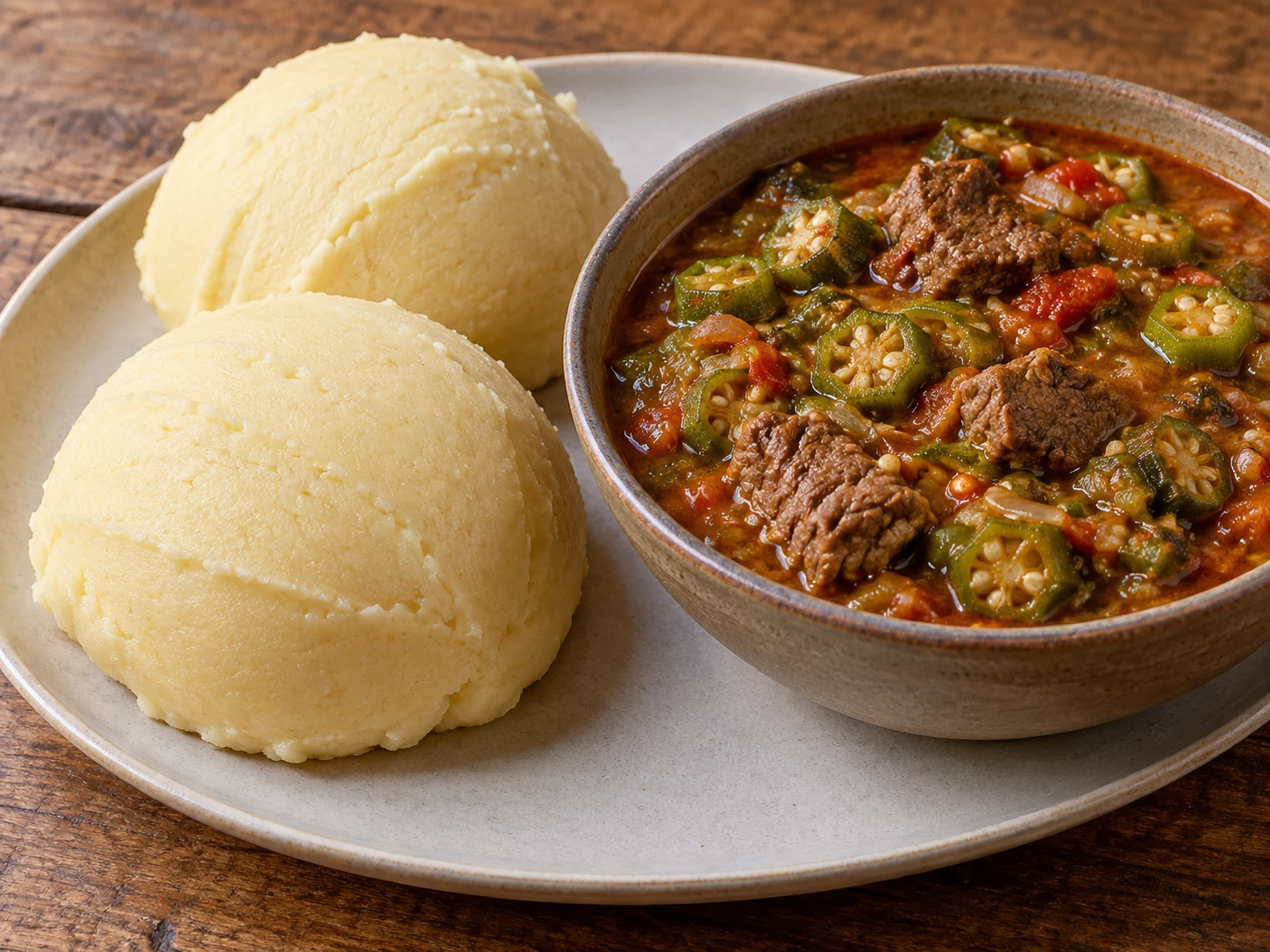
Tuwo masara is a major traditional culinary specialty of West Africa, deeply rooted in the gastronomic identity of Northern Nigeria, Niger, Chad, and the Sahelian regions. This preparation, in the form of a dense paste, yellow or white depending on the variety of corn used, is an essential nutritional pillar for millions of households. Within the Hausa culture, from which it derives its linguistic origins, the term tuwo generally refers to any thick paste made from cooked cereals, while masara specifically means corn. Corn is a hardy cereal that found an ideal home in the soils and climates of the Sahel, quickly becoming the basis of local food security. Tuwo masara alone embodies the simplicity, resilience, and conviviality of the people of this vast region. More than just a staple starch, it is a strong cultural symbol of gathering, generosity, and mutual respect, present in ordinary daily meals as well as during major family celebrations and community gatherings.
🌾 THE RIGOROUS PROCESS OF TRANSFORMING GRAIN INTO FLOUR
The quality of tuwo masara first depends on the meticulous selection of corn and its milling method. Traditional cooks prefer to use dry, locally produced corn, white or yellow depending on the habits of each community. The corn kernels first undergo thorough cleaning to remove impurities, then are sometimes slightly moistened to facilitate hulling. In rural areas, corn is pounded in large wooden mortars to remove the fibrous outer skin, before being ground in local disc mills. To obtain tuwo masara of incomparable fineness, the flour must be sieved several times to retain only the starch-rich part, discarding the coarse bran. This dry corn flour, with a velvety texture, is stored under optimal airtight conditions to preserve its freshness and its gelatinous properties essential for the cohesion of the paste during the final cooking phase.
🔥 THE PHYSICAL AND PRECISE GESTURE FOR PERFECT COOKING
Cooking tuwo masara is a quick thermal and gestural art that requires precision to avoid the formation of lumps. It all begins with heating a large quantity of water in a deep saucepan or cast-iron pot over a wood or gas fire. While the water heats, the cook prepares a small liquid suspension of corn flour diluted in cold water. This suspension, called talia or cooking base, is poured into the boiling water while stirring. This creates a light, simmering porridge that will serve as a thermal binder. Then, the dry corn flour is gradually incorporated in a fine stream into this boiling porridge. Using a large flat wooden spatula called omorogun or banku ta, the cook begins an intense and rhythmic kneading. The paste must be vigorously crushed against the sides of the pot to ensure uniform hydration and gelatinization of the corn starch. When the paste becomes firm and compact, the heat is reduced, the pot is covered, and it is left to steam for a few minutes before a final spatula stroke to make the paste shiny, smooth, and perfectly elastic.
🌶️ PRESTIGIOUS ACCOMPANIMENTS AND AROMATIC SYNERGIES
Tuwo masara has a mild and neutral flavor that makes it the ideal complement for the extremely fragrant stews and soups of Hausa and Sahelian cuisine. The most traditional pairing is with miyan kuka, a dark green soup prepared from dried baobab leaf powder, enriched with smoked fish, crayfish, and local spices. The slightly viscous consistency of the kuka sauce is particularly appreciated because it perfectly coats the firm corn paste, thus facilitating swallowing. Another excellent pairing is tuwo masara with miyan taushe, a creamy and rich stew made from mashed pumpkin or squash, roasted peanut paste, palm oil, and various meats. For lovers of spicy flavors, miyan geda, a peanut-based soup, or miyan karkashi provide exceptional aromatic complexity that transforms this simple corn ball into a truly comforting feast.
🏷️ SYNONYMS AND EQUIVALENTS IN SUB-SAHARAN AFRICA
Due to the presence of corn across almost the entire African continent, tuwo masara belongs to an immense culinary family and has many synonyms and functional equivalents depending on the region. In the Hausa language, its official name clearly distinguishes it from its rice or millet-based counterparts. In French-speaking countries of the sub-region, such as Niger, Benin, Togo, or Burkina Faso, it is commonly referred to as corn paste or corn ball. In Central Africa, particularly in Cameroon or Congo, it is often called corn ball or corn fufu. If we broaden the horizon to East and Southern Africa, tuwo masara shares immense similarities in texture and preparation with ugali from Kenya and Tanzania, sadza from Zimbabwe, nshima from Zambia, or pap from South Africa. Although the accompanying sauces differ according to local cultures, the fundamental concept of corn flour cooked in boiling water and kneaded into a firm mass unites African peoples through the same eating habit.
👥 SOCIAL ANCHORING AND CONSUMPTION RITUALS
Tuwo masara is at the heart of social and family life in Sahelian communities. Its consumption is a highly symbolic ritual of sharing. The meal is generally served hot, arranged in large communal dishes placed in the center of a mat or low table. Guests gather around, settling in a spirit of fraternity and respect. Tuwo masara is eaten exclusively with the fingers of the right hand, according to a strict rule of politeness shared by all cultures in the region. Each person takes a piece of paste, gently rolls it between their fingers to form a compact ball, makes a slight hollow in it to collect the sauce, then swallows it. Children learn this gesture from a young age from their parents, thus integrating the codes of etiquette and the sense of community sharing. Offering hot tuwo masara generously drizzled with sauce to a visitor is a sign that the house is open to them and that they are considered a full member of the family.
🌱 NUTRITIONAL VIRTUES AND THE ENERGY CONTRIBUTION OF CORN
In terms of nutrition and health, tuwo masara is a food of great energy value. Composed mainly of corn starch, it provides a significant amount of complex carbohydrates that supply sustainable energy, ideal for supporting the physical efforts of farmers and workers in the region. Yellow corn, when used, provides valuable carotenoids, precursors of vitamin A essential for vision and the immune system. Tuwo masara also contains dietary fiber that contributes to the proper functioning of the digestive system and provides lasting satiety, preventing cravings throughout the day. Entirely gluten-free, tuwo masara is a food of choice for people suffering from food intolerances or celiac disease. Furthermore, its simple preparation without any added fat during cooking makes it a healthy and pure food, whose overall nutritional value is beautifully complemented by the vitamins, proteins, and minerals contained in traditional accompanying sauces.
🚀 MODERNIZATION AND FUTURE PROSPECTS OF THIS CORN BALL
In the current context of rapid urbanization and globalization, tuwo masara successfully meets the challenge of modernity while preserving its authenticity. While artisanal preparation remains the rule in rural areas, many local agri-food companies now offer high-quality pre-cooked and sieved corn flours, packaged in modern packaging available in supermarkets in large cities such as Niamey, Kano, or N'Djamena. These innovations allow urban households to save valuable time during preparation, while retaining the taste and texture of the traditional dish. For the West African diaspora living abroad, these packaged flours are a valuable way to maintain a connection with their original culinary culture. By asserting itself as a natural, nutritious, economical, and gluten-free food, tuwo masara demonstrates that local African cereals have immense potential capable of meeting the challenges of tomorrow's modern diet.
Its synonyms: corn paste, corn fufu, West African ugali, corn ball, Nigerian polenta.
Keywords:
Corn Nigeria Hausa Miyan kuka Cereal
Where to find it
Look for the exact food-grade form required by the recipe at markets and specialist shops. Check the product name, ingredients, condition and storage instructions.
Explore further: Cooking tips · Food hygiene and safety advice.
In my books

Continue exploring the continent’s cuisines with Africa at the Table — 54 countries, 54 iconic dishes, by Alioune FALL. This book is in English.
In the kitchen : Tuwo masara
Recipes from the site to put your knowledge into practice:
Discover these cuisines at a restaurant
Explore our restaurant and caterer directories. Choose your destination and check the establishment’s menu to confirm which dishes are offered and available.
Continue exploring
Enjoy discovering ingredients and African cuisines? Join our newsletter. The illustrated PDF 10 sauces africaines incontournables is in French and is offered after confirming a subscription to the French or bilingual edition.