Tuwo dawa
Nigeria
Understanding : Tuwo dawa
🌾 AN ANCESTRAL GASTRONOMIC HERITAGE AND ITS HISTORICAL ORIGINS
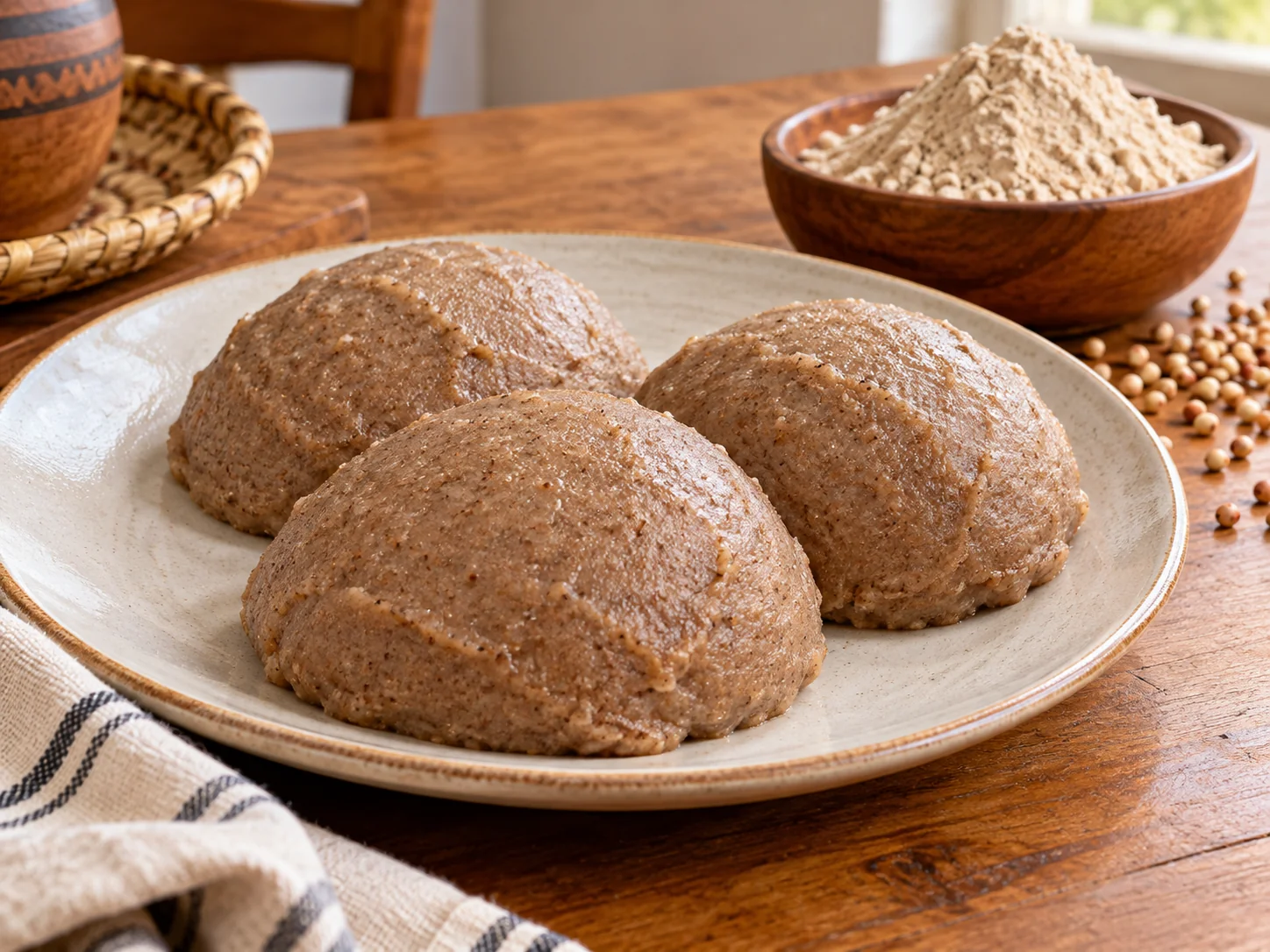
Tuwo dawa is one of the oldest and most respected culinary pillars of West Africa, particularly within the Hausa communities of northern Nigeria, Niger, and adjacent Sahelian regions. To understand the essence of this dish, it is worth examining the etymological meaning of its name in the Hausa language. The word Tuwo generally refers to a thick, compact, and moldable paste, obtained by cooking cereal flours in boiling water. It is the equivalent of what is commonly called a swallow in Anglophone Africa, or a foufou in other parts of Central and West Africa. The term dawa, meanwhile, specifically refers to sorghum, also known as great millet or Guinea corn. Unlike Tuwo gero made from millet, Tuwo masara made from corn, or the famous Tuwo shinkafa made from broken rice, Tuwo dawa highlights sorghum, an indigenous cereal of the African continent cultivated for millennia.
The cultivation of sorghum dates back to the prehistory of the Sahelian region, a semi-arid zone where climatic conditions require crops extremely resistant to drought and heat. Sorghum has a deep root system and a unique ability to go dormant during periods of water stress, which has made it the staple cereal par excellence for the peoples of the Sahel. By elevating Tuwo dawa to the status of a staple food, the ancestors of West African populations were able to leverage this robust cereal to create a highly nutritious dish, capable of sustaining agricultural workers during long days of labor under the scorching sun. Thus, this dish embodies not only a feat of agricultural adaptation but also a gastronomic heritage passed down from generation to generation, preserving the identity and food sovereignty of the Sahelian peoples.
🥣 INGREDIENTS, NUTRITIONAL VALUE, AND THE ART OF PREPARATION
The fundamental recipe for Tuwo dawa is characterized by disarming simplicity, as it generally requires only two basic ingredients: high-quality sorghum flour and water. In some regional or family variations, a tiny amount of traditional potash, called kanwa in Hausa, or a few drops of lemon juice may be added to the cooking water to adjust acidity, stabilize the characteristic dark color of red or white sorghum, or soften the final texture of the paste. Nevertheless, the integrity of the recipe relies on the absence of artificial additives or preservatives, making this dish a healthy and natural food.
Nutritionally, Tuwo dawa is a true treasure. Sorghum is a naturally gluten-free cereal, making it an ideal alternative for people with gluten intolerance or celiac disease. It is particularly rich in complex dietary fibers, which promote slow digestion and a gradual release of energy into the body, thus avoiding blood sugar spikes. Furthermore, sorghum is an excellent source of essential minerals such as iron, magnesium, phosphorus, and copper, as well as B vitamins, including niacin and thiamine. The powerful antioxidants present in the sorghum grain hull, notably polyphenols, also help protect cells against oxidative stress.
The preparation of Tuwo dawa is an art that requires physical strength, patience, and precise skill. The process begins by boiling a large quantity of water in a cast iron or clay pot. A portion of the sorghum flour is first mixed with cold water to form a fluid slurry, which is then poured into the boiling water to create a thickened base. Then, the cook gradually adds the rest of the dry flour while vigorously stirring with a large, sturdy wooden spatula, called larki or matuki. This crucial step of energetic mixing, known as tuka in Hausa, aims to eliminate all lumps to obtain a perfectly homogeneous, smooth, and elastic consistency. The pot is then covered to allow the paste to steam in its own moisture for several minutes. Once cooked, the paste is vigorously worked one last time, then portioned to be shaped into regular spherical balls, ready to be served hot.
🌍 A MOSAIC OF SYNONYMS AND EQUIVALENTS ACROSS THE CONTINENT
Although the term Tuwo dawa is of Hausa origin, this dish is not confined to the linguistic or geographical boundaries of this single community. In reality, there are a multitude of synonyms and variations of this recipe across Africa, testifying to the historical and cultural importance of this sorghum flour preparation.
The most direct and well-known synonym in Francophone West Africa is Tô (sometimes spelled to or toh). In countries like Mali, Burkina Faso, Guinea, Niger, or Ivory Coast, sorghum tô refers to exactly the same thick paste obtained from flour cooked in boiling water. It constitutes the staple food for millions of Sahelian households.
Across the continent, other linguistic synonyms and equivalents reflect this same culinary tradition:
Sorghum foufou or sorghum fufu: this term is used primarily in Central Africa and in West African coastal areas where the word fufu serves as a generic name for all consistent pastes intended to be accompanied by sauces.
Ugali wa mtama: in East Africa, particularly in Kenya, Tanzania, and Uganda, ugali refers to the national paste generally made from corn. However, when prepared with sorghum (named mtama in Swahili), it is called ugali wa mtama.
Sadza re mapfunde: in Zimbabwe and several Southern African countries, sadza is the basic cereal ball. Its ancestral version made from sorghum, called sadza re mapfunde in the Shona language, is the direct equivalent of Tuwo dawa.
Nsima ya mapira: in Malawi and Zambia, the national paste is called nsima. When cooked from sorghum flour (mapira), it becomes nsima ya mapira in the driest areas.
Sorghum amala or amala kano: among the Yoruba people of southwestern Nigeria, a similar paste made from sorghum is called amala dawa or amala kano, appreciated for its elastic consistency and characteristic dark hue.
🍲 TRADITIONAL SOUPS AND THE RITUAL OF TASTING
Tuwo dawa has a delicate, slightly nutty, and subtly tangy flavor due to the intrinsic properties of sorghum, but it remains relatively neutral on the palate. It is precisely this neutrality that makes it an ideal companion for the complex, spicy, and fragrant traditional sauces and soups of African cuisine.
The most famous and inseparable sauce from Tuwo dawa is undoubtedly Miyan kuka. This iconic complementary soup of Hausa culture is prepared from dried baobab leaves reduced to a fine forest-green powder. Miyan kuka is distinguished by its viscous and slimy texture, highly appreciated in the Sahel, as it allows the sauce to perfectly envelop the Tuwo dawa. It is seasoned with dried fish, meat, red sea pepper, onions, and daddawa, a fermented condiment made from locust bean seeds that gives the dish a rich and pronounced umami flavor.
Another highly prized accompanying soup is Miyan taushe, a creamy preparation based on pumpkin or squash simmered with peanut paste, onions, palm oil, chili, and meat. Its slightly sweet taste harmonizes divinely with the neutral sweetness of Tuwo dawa.
Miyan kubewa, made from fresh or dried okra reduced to powder, is another classic slimy sauce that facilitates the passage of Tuwo dawa during tasting. Finally, Miyan karkashi, made from wild sesame leaves, also offers a very appreciated binding texture to accompany this dish.
The way of consuming Tuwo dawa is a deeply rooted ritual. Guests wash their hands before gathering around the communal dish. With the fingers of the right hand, a small ball of Tuwo is taken, lightly shaped in the palm of the hand, a small depression is made with the thumb to collect the sauce, then it is generously dipped in the soup before being swallowed without chewing, thus allowing one to appreciate the fluidity of the sauce and the melting softness of the sorghum paste.
🤝 THE SOCIAL, CULTURAL, AND SYMBOLIC DIMENSION IN THE SAHEL
Beyond its nourishing function, Tuwo dawa plays a central sociological and cultural role in Sahelian communities. It embodies the very symbol of solidarity, hospitality, and social cohesion. Sharing the same dish of Tuwo dawa seals friendships between families and expresses a warm welcome reserved for passing strangers.
This dish also reflects ancestral agricultural traditions. During sorghum harvests, the preparation of festive Tuwo dawa celebrates renewed abundance and pays homage to the nourishing land. In wedding ceremonies, rites of passage, or religious celebrations, its presence on the table symbolizes prosperity, strength, and the continuity of lineage.
Nowadays, faced with the increasing consumption of imported products, the valorization of Tuwo dawa also constitutes a means of asserting local culinary identity and supporting sustainable agriculture in West Africa. Promoting this traditional dish helps to highlight local cereals like sorghum, while ensuring healthy, balanced, and deeply rooted food for the populations in the history of their land.
🔑 KEYWORDS OF CULINARY TRADITION
Sorghum Tô Miyan kuka Hausa cuisine West Africa Synonyms: Sorghum Tô, Sorghum Fufu, Sorghum fufu, Ugali wa mtama, Sadza re mapfunde, Nsima ya mapira, Amala dawa, Amala kano.
Where to find it
Look for the exact food-grade form required by the recipe at markets and specialist shops. Check the product name, ingredients, condition and storage instructions.
Explore further: Cooking tips · Food hygiene and safety advice.
In my books

Continue exploring the continent’s cuisines with Africa at the Table — 54 countries, 54 iconic dishes, by Alioune FALL. This book is in English.
In the kitchen : Tuwo dawa
Recipes from the site to put your knowledge into practice:
Discover these cuisines at a restaurant
Explore our restaurant and caterer directories. Choose your destination and check the establishment’s menu to confirm which dishes are offered and available.
Continue exploring
Enjoy discovering ingredients and African cuisines? Join our newsletter. The illustrated PDF 10 sauces africaines incontournables is in French and is offered after confirming a subscription to the French or bilingual edition.