Kalo
Uganda
Understanding : Kalo
🌾 INTRODUCTION AND ORIGINS OF KALO 🌍
Kalo, also spelled kaalo, is an iconic and essential staple food in East African cuisine, particularly in Uganda, where it has been consumed for centuries by many populations. It is a dense, consistent, and very homogeneous paste, prepared mainly from red millet flour (also called finger millet or Eleusine coracana), often mixed with cassava flour. In other tropical culinary contexts and in some African or Creole diasporas, the word kalo also refers to taro (Colocasia esculenta), a nutritious tuber that holds a major historical place in subsistence agriculture in Sub-Saharan Africa. However, at the heart of East African gastronomy, kalo is synonymous par excellence with this traditional millet bread. Millet, a cereal originating from arid regions of Africa, was one of the first plants domesticated on the continent thousands of years ago. Its remarkable drought resistance and ability to thrive in poor soils made it a sacred crop and an indispensable bulwark against famine. Kalo represents the culmination of the transformation of this cereal, offering a concentrated source of energy and embodying a strong culinary identity. In African societies, particularly among the Luo, Banyankole, Bakiga, Batooro, and Basoga peoples, kalo is not just a daily food, but a true cultural landmark that connects generations, symbolizing the fertility of the land and the resilience of the peoples who cultivate it.
🥣 TRADITIONAL PREPARATION PROCESS 👩🍳
The preparation of kalo is a demanding culinary ritual that requires significant physical strength, skill, and extensive experience. Traditionally, this highly respected task is entrusted to women, who pass this knowledge from mother to daughter. The process begins with harvesting, drying, and threshing the red millet ears. Once the grains are released and carefully winnowed to remove impurities, they are ground to obtain a very fine flour. In many rural areas, this step is still done using traditional stone mills, although the use of mechanical mills is becoming widespread today.
To prepare kalo, millet flour is almost always combined with cassava flour in well-defined proportions, generally two parts millet to one part cassava. This mixture is essential: pure millet flour would result in a paste that is too soft and crumbly, while the starch from the cassava provides the elasticity, cohesion, and slightly sticky and stretchable texture that characterize successful kalo.
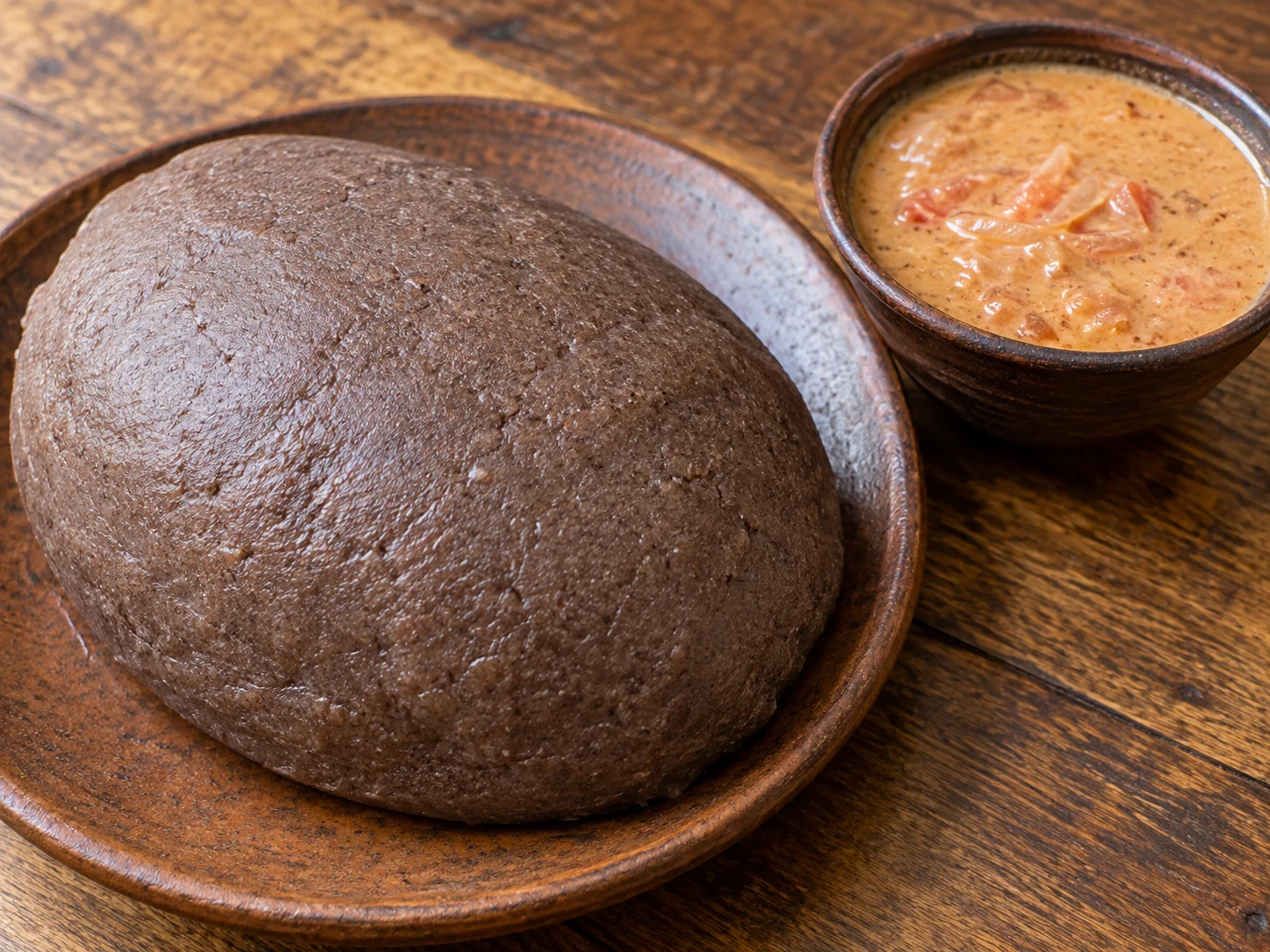
Cooking begins by bringing a large quantity of water to a boil in a traditional pot, often placed over a three-stone hearth or a wood fire. When the water is boiling vigorously, the cook gradually adds the flour mixture while stirring vigorously with a large flat wooden spatula, called ekitara or miko. This movement must be quick and continuous to prevent lumps from forming. As the paste thickens, it becomes extremely heavy and difficult to work with. The cook must then stabilize the pot, sometimes using her feet to hold it to the ground, and use both hands to knead and energetically press the paste against the sides of the pot. Small amounts of hot water can be added to adjust the consistency. Kalo is cooked when the paste turns a deep chocolate brown color, becomes perfectly smooth, and detaches in one piece from the sides of the pot. It is then poured onto a woven table mat or a carved wooden platter, then shaped into a regular ball or dome before being presented hot to guests.
🥗 NUTRITIONAL ROLE OF KALO 💪
From a nutritional perspective, kalo is an exceptionally rich food, far superior to most modern refined starches. Made from whole millet, it retains all its natural nutrients. Red millet is a remarkable source of essential minerals, particularly calcium, iron, and phosphorus. In reality, millet has one of the highest calcium contents among all cereals, making kalo a prime food for children's growth, supporting breastfeeding women, and preserving the bone health of the elderly.
Furthermore, kalo is distinguished by its richness in insoluble dietary fiber. These fibers slow down the digestion process and allow for a gradual release of glucose into the blood, giving this dish a low glycemic index. Kalo thus provides sustained and diffused energy, avoiding insulin spikes and keeping agricultural workers and artisans satiated during long hours of intense physical effort. It also plays a protective role against metabolic diseases like type two diabetes.
The addition of cassava flour provides complex carbohydrates that increase the caloric density of the dish, providing the necessary strength for daily work. Kalo is also naturally gluten-free, making it an ideal alternative for people with gluten intolerance or celiac disease. In a context where food security can be threatened by climatic hazards, the nutritional value of kalo makes it a crucial public health tool to combat micronutrient deficiencies in Sub-Saharan Africa.
🎉 SOCIAL USES AND CULTURAL SYMBOLISM 🤝
Kalo is deeply rooted in the social structures and family customs of East Africa. It embodies values of sharing, mutual respect, and community cohesion. Sharing a dish of kalo is a sacred collective experience: the kalo ball is placed in the center of the table in a woven basket, and guests sit all around. It is traditionally eaten by hand, taking a small piece of hot paste with the fingers of the right hand, shaping it into a small hollow ball with the thumb to collect the sauce, then bringing it to the mouth.
In many local cultures, kalo is a mandatory part of major life ceremonies, such as traditional weddings, initiation rites, and funerals. Among the Banyankole of southwestern Uganda, for example, no dowry or wedding ceremony is valid without the preparation and tasting of kalo. It is also a test of skill for the young bride: her ability to prepare perfect, smooth, and elastic kalo is scrutinized by her in-laws and celebrated as a sign of her maturity and her ability to run a household.
Moreover, kalo is historically linked to the virility and physical endurance of warriors. It was believed that consuming kalo before a battle or a long hunting expedition conferred exceptional physical strength and spiritual protection. Serving kalo to a passing visitor is a mark of great respect and warm hospitality. Refusing to eat it would be perceived as a serious offense to the host. Offering this dish is sharing what the earth has produced most precious.
🗺️ SYNONYMS AND REGIONAL NAMES 🗣️
Africa being a continent of immense linguistic diversity, kalo has many different names depending on the countries, ethnic groups, and local languages. These different synonyms attest to its deep integration into the regional cultural heritage.
In western Uganda, among the Banyankole, Bakiga, Batooro, and Banyoro communities, this millet dish is called akaro or karo.
In the northern regions, among the Luo-speaking peoples such as the Acholi, Lango, and Alur, it is referred to as kwon kal or simply kwon, a term that directly emphasizes the main ingredient, millet (kal).
In the east of the country, among the Iteso, it is known as atapa, a variant that sometimes includes sorghum flour in addition to cassava and millet.
In central Uganda, the Baganda use the term oburo or oburo kalo to refer to both the cereal and the cooked paste.
In neighboring Kenya and Tanzania, similar preparations of dense millet paste are called ugali wa wimbi in Swahili, to differentiate them from classic ugali made from white corn.
Internationally and in gastronomy books, it is commonly called Ugandan millet bread or millet bread.
Furthermore, if we refer to the other culinary meaning of the word kalo, namely taro, we find synonyms such as colocase, coco, cocoyam, macabo, madoumba, or eddoe. This profusion of names shows how much the same food concept can travel and take on multiple identities across borders.
🍛 CULINARY TECHNIQUES AND ACCOMPANIMENTS 🐟
Kalo is rarely eaten alone. Its neutral, slightly woody and mild flavor makes it an ideal accompaniment to enhance the flavors of rich, stewed, and spicy sauces in African cuisine. The choice of sauce depends heavily on the region and available local resources.
One of the most classic and appreciated culinary pairings is kalo with peanut sauce (sauce arachide). Prepared from roasted and ground peanut paste, simmered with onions, tomatoes, and local spices, this creamy sauce provides a richness in protein and fat that ideally complements the carbohydrate intake of millet.
In western Uganda, akaro is traditionally accompanied by eshabwe, an exceptional sauce made from clarified cow's butter (ghee), water, and rock salt, cold emulsified until it obtains a white, creamy, and frothy texture similar to a light mayonnaise. This dish is considered a royal delicacy reserved for special occasions.
Kalo also goes wonderfully with fresh or dried fish broths, very spicy beef, goat, or free-range chicken stews. Traditional leafy vegetables, such as dodo (amaranth leaves), pumpkin leaves, or cowpea leaves, sautéed with onions and tomato, are systematically served to bring a touch of freshness and vitality to the meal.
The tasting technique is an art in itself: each guest takes a small portion of hot kalo, gently rolls it between their fingers to form a homogeneous ball, presses their thumb into it to shape a small receptacle, then dips this edible spoon into the hot sauce to capture pieces of meat, fish, or vegetables before savoring the whole. The unique consistency of kalo allows it to perfectly absorb the cooking juices without falling apart, offering a perfect textural harmony in the mouth.
Synonyms for kalo: akaro, karo, kwon kal, atapa, ugali wa wimbi, Ugandan millet bread, taro, colocase, cocoyam, macabo, madoumba, eddoe.
Where to find it
Look for the exact food-grade form required by the recipe at markets and specialist shops. Check the product name, ingredients, condition and storage instructions.
Explore further: Cooking tips · Food hygiene and safety advice.
In my books

Continue exploring the continent’s cuisines with Africa at the Table — 54 countries, 54 iconic dishes, by Alioune FALL. This book is in English.
In the kitchen : Kalo
Recipes from the site to put your knowledge into practice:
Discover these cuisines at a restaurant
Explore our restaurant and caterer directories. Choose your destination and check the establishment’s menu to confirm which dishes are offered and available.
Continue exploring
Enjoy discovering ingredients and African cuisines? Join our newsletter. The illustrated PDF 10 sauces africaines incontournables is in French and is offered after confirming a subscription to the French or bilingual edition.