Aish baladi
Egypt
Understanding : Aish baladi
🌾 ORIGINS AND HISTORY OF AISH BALADI 🇪🇬
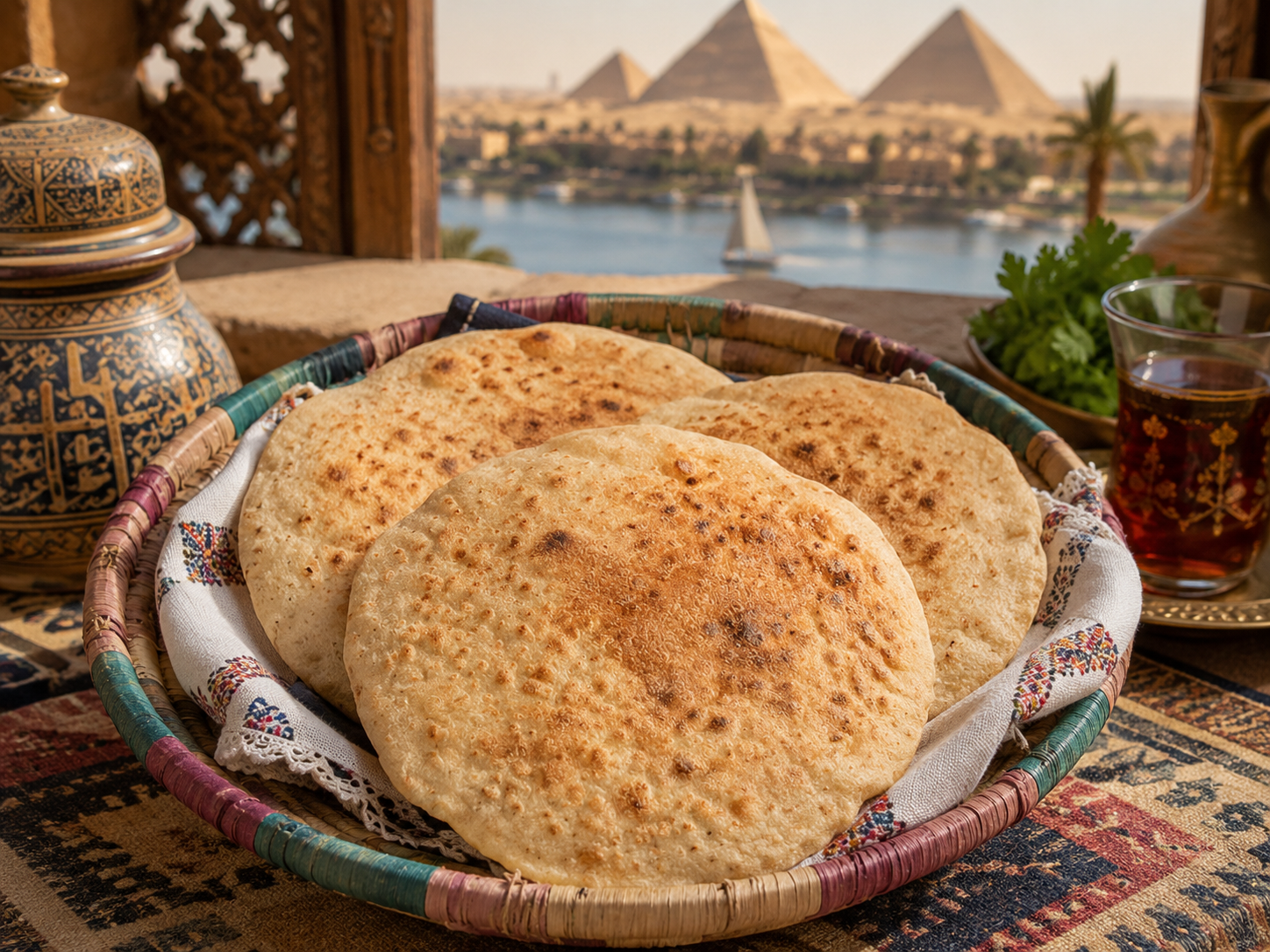
Aish baladi is much more than a simple staple food; it is the very soul of Egyptian gastronomy and, by extension, one of the oldest and most sacred pillars of North African cuisine. The very word aish used in Egypt to refer to bread is highly indicative of its status. While in most of the Arabophone world, bread is called khubz, Egyptians chose the term aish, which literally means life. This linguistic equivalence demonstrates how intimately daily life, survival, and the identity of this people are linked to this whole wheat flatbread. The word baladi, meanwhile, translates to local, traditional, or of the country, emphasizing its authenticity and popular roots in contrast to breads of Western or modern influence.
Where to find it
Look for the exact food-grade form required by the recipe at markets and specialist shops. Check the product name, ingredients, condition and storage instructions.
Explore further: Cooking tips · Food hygiene and safety advice.
History and uses
The origins of Aish baladi date back to time immemorial, directly to the Pharaonic era of ancient Egypt. Bas-reliefs in temples and tomb paintings in the Valley of the Kings frequently depict scenes of wheat harvesting, grain grinding, and baking round breads very similar to contemporary Aish baladi. Ancient Egyptians were among the first to master the use of wild yeast to leaven bread and to design clay ovens capable of reaching extremely high temperatures. Over the millennia, despite invasions, dynastic changes, Islamization, and modernization, the recipe and baking technique of Aish baladi have remained remarkably unchanged, transmitting an invaluable culinary heritage from generation to generation.
🏛️ SOCIAL AND ECONOMIC IMPORTANCE OF AISH BALADI 💸
In modern Egypt and throughout its contemporary history, Aish baladi holds absolutely colossal political, economic, and social importance. Due to its universal consumption, which transcends all social classes, the Egyptian government has heavily subsidized this bread for decades to ensure it remains accessible even to the most modest families. Sold for a fraction of its real cost in state bakeries, this subsidized bread is the guarantor of social peace. Egyptian history has shown that any threat to the price or availability of Aish baladi could trigger major popular riots, often referred to as bread riots, reminding us that this food is the thermometer of national stability.
In the bustling streets of Cairo, Alexandria, or Luxor, the sight of bread carriers is an inseparable part of the urban landscape. Young men cycle through heavy traffic, balancing large openwork wooden boards, called kafas, laden with dozens of hot breads fresh from the oven, on their heads. This daily distribution testifies to the absolute freshness demanded by consumers, who buy their bread several times a day to accompany every meal. Aish baladi is not only consumed at home; it is the heart of street food, wrapping local falafels or serving as a base for meals eaten on the go in popular markets.
🥣 TRADITIONAL MANUFACTURING AND BAKING PROCESS 🌋
The making of Aish baladi relies on a simple but rigorous alchemy, requiring high-quality basic ingredients and a unique baking technique. The dough consists mainly of whole wheat flour, warm water, salt, and yeast. Traditionally, a portion of the previous day's dough, acting as a natural sourdough starter, is incorporated to give the bread its characteristic slightly tangy flavor and improve its preservation.
After vigorous kneading, the dough is divided into small individual balls. Each ball is then generously coated with wheat bran (raddah in Arabic), which serves as a working surface and prevents the dough from sticking. It is this wheat bran that gives Aish baladi its unique rough outer texture and its much-appreciated nutty taste. The dough balls are then flattened by hand or with a small rolling pin to form thin disks about fifteen to twenty centimeters in diameter. They are then left to rise on wooden boards sprinkled with bran, often under the hot Egyptian sun, which activates fermentation.
The baking stage is a striking visual spectacle. Aish baladi must be baked at an extremely high temperature, generally between four hundred and five hundred degrees Celsius, in traditional brick or clay ovens fueled by gas or wood. The dough disks are placed in the oven using a long flat wooden peel. Under the effect of this intense and instantaneous heat, the water contained in the dough immediately turns into steam, causing a spectacular and immediate swelling of the bread. The bread separates into two distinct layers, creating a perfect air pocket in its center. In less than a minute, the outer crust browns slightly, the wheat bran toasts, releasing an irresistible aroma, and the bread is removed from the oven, soft inside and delicately crispy outside.
In my books

Continue exploring the continent’s cuisines with Africa at the Table — 54 countries, 54 iconic dishes, by Alioune FALL. This book is in English.
Explore further
🥙 THE PLACE OF AISH BALADI IN AFRICAN CUISINE 🌍
Within the mosaic of African cuisines, Aish baladi occupies a singular and strategically important place. While sub-Saharan Africa is traditionally dominated by tuber-based starches like fufu, cassava, or yam, and by cereal porridges like millet or sorghum, North Africa is characterized by its millennial culture of wheat and bread. Aish baladi is the most emblematic representative of this North African cereal tradition, linking Mediterranean, Middle Eastern, and purely African influences.
In the context of continental food security, Aish baladi shows how a local cereal, when consumed in its whole form with its bran coating, can be a source of essential nutrients for millions of people. Unlike modern white breads made from highly refined imported flours, Aish baladi preserves the fiber, B vitamins, iron, and magnesium of the wheat grain. This nutritional richness makes it a powerful ally in traditional African diets, which favor dense, satiating, and digestive health-protective foods. Furthermore, its natural preservation method, facilitated by the air pocket that allows it to be easily dried or reheated, is perfectly adapted to the continent's hot climatic conditions.
🍛 ACCOMPANIMENTS AND DAILY CULINARY USES 🥗
Aish baladi is the indispensable companion to almost all dishes on the Egyptian and North African table. Its unique pocket-like structure makes it the natural kitchen utensil par excellence. Indeed, in Egypt, it is very common to do without a fork or spoon: one simply tears off a piece of warm Aish baladi, folds it to form a kind of small scoop with the fingers, and uses it to pick up food directly from the communal dish.
It is the essential partner of foul mudammas, the Egyptian national dish made of slow-cooked fava beans, seasoned with olive oil, garlic, lemon juice, and cumin. For breakfast, Aish baladi is also filled with taameya, the Egyptian version of falafel prepared with green fava beans instead of chickpeas, which gives it an incredibly light and airy texture. Tomatoes, onions, and a generous ladle of tahini sauce are added to make the country's most popular street sandwich.
During other meals, Aish baladi accompanies meat stews, grilled fish from the Mediterranean or the Nile, and a multitude of mezzes like baba ghanoush, hummus, or traditional white cheese called gibna beyda. It is also used to prepare the famous hawawshi, a delicious dish where the bread is stuffed with raw minced meat seasoned with spices, onions, and chilies, then baked until the bread becomes crispy and soaks up the meat's cooking juices. Finally, even when it becomes stale, Aish baladi is never wasted: it is cut into pieces, fried or grilled to serve as a crispy base for fattah, a festive dish made of rice, meat, and a garlic and vinegar sauce.
🗣️ SYNONYMS AND VARIATIONS OF BALADI BREAD 🌍
Aish baladi is known by various names that reflect its nature, geographical origin, and preparation method. Understanding these synonyms helps to better grasp its influence in the African and Arab culinary world.
The most direct and common synonym is eish baladi or eish balady, which corresponds to transliteration variations from Egyptian Arabic to Western languages. In English, it is very often called baladi bread or simply Egyptian bread. In some international cookbooks, it is referred to as Egyptian flatbread or Egyptian pita, although the latter term is technically reductive because Aish baladi is more rustic, richer in fiber, and has a much more pronounced flavor than classic Greek or Lebanese pita thanks to the systematic use of wheat bran.
It is also worth mentioning very similar breads that share its history, such as aish shamsi, also called sun bread. This variety, typical of Upper Egypt, is prepared with a similar dough but left to rise for a long time under the scorching sun before being baked, which gives it a thicker texture and a denser crumb. Although different, Aish baladi and aish shamsi share the same heritage of whole and ancient bread-making.
🌟 CONCLUSION AND HERITAGE VALUE 🥖
Ultimately, Aish baladi is much more than just food: it is the symbol of a continuous civilization and the common thread that connects modern Egypt to its pyramid-building ancestors. Its presence on every African and Mediterranean table reminds us that the simple pleasures of the table are often the most enduring and meaningful. Its artisanal manufacturing method, its perfect texture combining softness and crispiness, and its exceptional nutritional qualities make it a masterpiece of humanity's intangible cultural heritage. While the modern world turns to standardized industrial products, Aish baladi remains the proud and warm guardian of an authentic culinary tradition that continues to nourish and bring people together around the sharing of life.
Synonyms for Aish baladi: eish baladi, eish balady, baladi bread, Egyptian bread, Egyptian flatbread, Egyptian pita.
Keywords: Aish baladi, Egypt, flatbread, whole wheat, food.
In the kitchen : Aish baladi
Recipes from the site to put your knowledge into practice:
Discover these cuisines at a restaurant
Explore our restaurant and caterer directories. Choose your destination and check the establishment’s menu to confirm which dishes are offered and available.
Continue exploring
Enjoy discovering ingredients and African cuisines? Join our newsletter. The illustrated PDF 10 sauces africaines incontournables is in French and is offered after confirming a subscription to the French or bilingual edition.