Msemen
Maghreb
Understanding : Msemen
🌾 INTRODUCTION AND ESSENCE OF MSEMEN 🌍
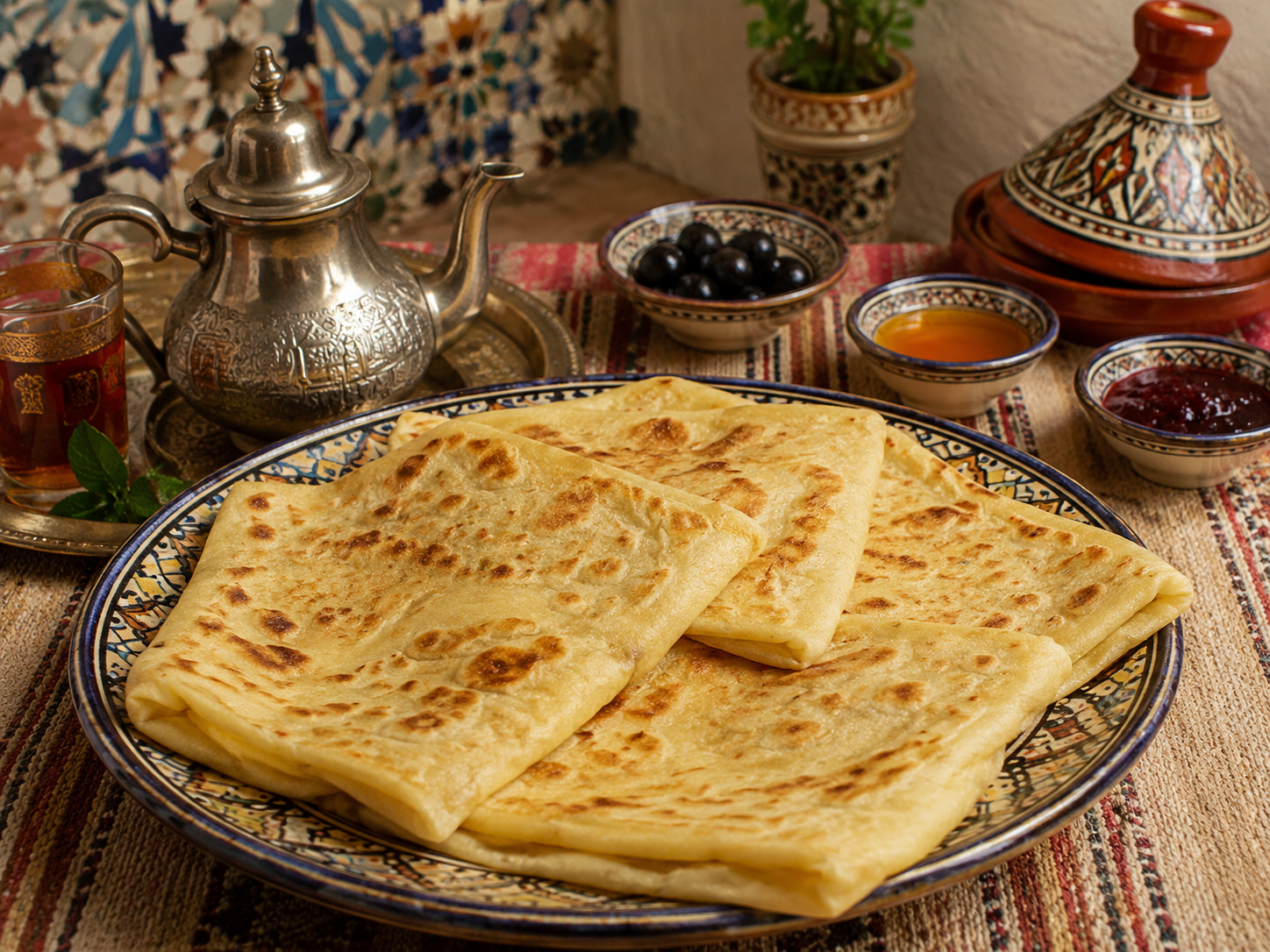
Msemen, also spelled msemmen, msamman, or m'simen, is a jewel of North African culinary art and one of the most beloved and consumed specialties across the Maghreb, particularly in Morocco, Algeria, and Tunisia. It is a traditional layered flatbread, characterized by its square shape, and a texture that is both crispy on the surface and incredibly tender and melt-in-your-mouth inside. This exceptional pancake, made without leaven but meticulously worked with a technical folding method, is a pillar of daily sustenance and shared moments.
Where to find it
Look for the exact food-grade form required by the recipe at markets and specialist shops. Check the product name, ingredients, condition and storage instructions.
Explore further: Cooking tips · Food hygiene and safety advice.
History and uses
In the gastronomic landscape of the African continent, msemen embodies the conviviality, generosity, and hospitality of North Africa. Traditionally eaten warm, it is the undisputed king of family breakfasts, comforting afternoon snacks, and plays a fundamental ritual role during religious holidays, particularly during the holy month of Ramadan where it is served to break the fast. Both economical, nutritious, and boasting a formidable range of sweet or savory variations, msemen has conquered palates far beyond its homeland to become a true icon of street food and African family cuisine on an international scale.
🥣 THE ART AND TECHNIQUE OF TRADITIONAL LAMINATING 👩🍳
The secret to msemen's incomparable texture lies entirely in a unique manual savoir-faire, passed down from generation to generation. Unlike Western puff pastries that use cold butter and require long resting times in the refrigerator, msemen's lamination is a dynamic process performed at room temperature using vegetable oil and extra-fine semolina.
The basic ingredients for the dough are disarmingly simple: extra-fine semolina, white wheat flour, warm water, salt, and a very light pinch of baking powder or baker's yeast (sometimes omitted) to add a touch of lightness. The semolina provides structure, body, and a rustic taste, while the flour provides the necessary elasticity to stretch the dough without tearing it.
The dough is kneaded extremely vigorously by hand or in a stand mixer for about twenty minutes, until it becomes incredibly supple, elastic, soft to the touch, and begins to make small popping sounds under finger pressure. This texture is essential for successful folding. The dough is then divided into tangerine-sized balls, generously coated with oil to prevent drying, and left to rest for about thirty minutes.
Shaping is the most technical step in the process. On a clean and abundantly oiled work surface, the cook flattens a ball of dough with the palm of the hand, then gently stretches it from the center outwards with circular movements using oiled fingers, until a translucent, almost transparent sheet of dough is obtained, so thin that the work surface can be seen through it.
To create the layers, this sheet of dough is sprinkled with a fine dusting of extra-fine semolina, which will act as a physical barrier preventing the layers from sticking together during cooking. The sheet is then folded into thirds lengthwise, then again into thirds widthwise to form a perfect square of several superimposed layers. The semolina and oil trapped between the folds will swell under the effect of heat, separating the layers and creating that much-desired flakiness.
Cooking is done immediately on a heavy, hot cast-iron griddle (a traditional coating called ferrah or a terracotta tagine) or in a thick, flat-bottomed pan. The square of dough is lightly flattened by hand before being placed on the hot griddle. It is cooked on both sides, being turned regularly and drizzled with a few drops of oil, until the msemen swells spectacularly, takes on a beautiful golden color dotted with crispy brown spots, and reveals its multiple flaky layers when cut.
In my books

Continue exploring the continent’s cuisines with Africa at the Table — 54 countries, 54 iconic dishes, by Alioune FALL. This book is in English.
Explore further
🍛 VERSATILITY AND TABLE ACCOMPANIMENTS 🍯
Msemen's strength also lies in its formidable culinary versatility. In its sweet version, warm msemen is traditionally topped with a mixture of pure honey and melted butter, or spread with fig or apricot jam, accompanied by a glass of hot, very sweet, and frothy traditional Moroccan mint tea.
In its savory version, msemen transforms into a complete and nourishing meal. The most famous variant is stuffed msemen, often called mahjouba in Algeria or rghaif b'chehma in Morocco. For this preparation, the sheet of dough is filled, before folding, with a flavorful stuffing based on melting onions, simmered tomatoes, garlic, sweet or hot peppers, spices like cumin and paprika, and finely chopped mutton or beef fat (or minced meat). The layers absorb the flavors and juice of the stuffing during cooking, offering an explosion of flavors in the mouth.
Another exceptional savory variation is Moroccan rfissa, a traditional festive dish. For rfissa, msemens cooked the day before are finely torn by hand into small ribbons, then arranged in a large dish. They are then drizzled with a hot, very fragrant, and creamy broth made from free-range chicken, lentils, fenugreek (helba), onions, and a mixture of oriental spices like ras el hanout. The bread absorbs the fragrant broth while retaining a deliciously tender texture, making this dish a supreme comfort food reserved for large family celebrations and for women who have just given birth to restore their strength.
🌍 THE PLACE OF MSEMEN IN AFRICAN CUISINE 🗺️
Within the rich gastronomic diversity of the African continent, msemen occupies a highly strategic place. It beautifully illustrates the richness of North Africa's cereal traditions, a region historically nicknamed the granary of the Mediterranean due to its high-quality durum and soft wheat crops.
While East African countries also have their own flatbreads influenced by exchanges with the Indian Ocean (such as Kenyan or Tanzanian chapati, which shares similar stretching techniques), North African msemen stands out for its unique geometric square shape and its exclusive use of semolina as a key texturizing ingredient.
It embodies the ingenuity of African cooks who, with extremely simple, inexpensive, and universally available ingredients (flour, water, oil, salt), have managed to develop a complex physical baking technique that elevates a simple mixture of water and flour to the rank of a textural masterpiece. Msemen also shows how a food can travel with human migrations: today, excellent msemens can be found in markets and bakeries in major European, American, and African capitals, testifying to its universal popularity and its role as an ambassador of African culture around the world.
🗣️ SYNONYMS AND REGIONAL DENOMINATIONS 🌍
Due to the great cultural and linguistic diversity of the Maghreb, msemen goes by different names depending on the countries, regions, and local languages.
In Morocco, the generic term is msemen for the classic square flatbread, while the plural rghaif or the singular rghifa is very frequently used to designate this type of stretched layered dough.
In Algeria, the word msemmen is also used, but the spicy stuffed version with onion and tomato takes the emblematic name of mahjouba (or mhadjeb in the plural).
In Tunisia, it is sometimes called mlawi or mlaoui, although the latter term can also apply to a version of a round flatbread rolled on itself.
Another very close relative is the Moroccan meloui (or melloui). While msemen is folded into a square shape, meloui is rolled into a sausage shape like a snail, then flattened vertically to form a round flatbread with concentric circles. This rolling method gives meloui an even tighter flakiness and a slightly softer and airier texture.
This profusion of denominations shows how much this laminating technique is part of the intangible heritage shared by all the peoples of the region, uniting North Africa under the same crispy and warm culinary banner.
Synonyms for msemen: msemmen, msamman, rghaif, rghifa, meloui, mlawi, mahjouba.
Keywords: msemen, Maghrebi cuisine, lamination, semolina, Morocco. Send message
In the kitchen : Msemen
Recipes from the site to put your knowledge into practice:
Discover these cuisines at a restaurant
Explore our restaurant and caterer directories. Choose your destination and check the establishment’s menu to confirm which dishes are offered and available.
Continue exploring
Enjoy discovering ingredients and African cuisines? Join our newsletter. The illustrated PDF 10 sauces africaines incontournables is in French and is offered after confirming a subscription to the French or bilingual edition.