Kesra
Algeria
Understanding : Kesra
🌾 ORIGINS AND HISTORY OF KESRA
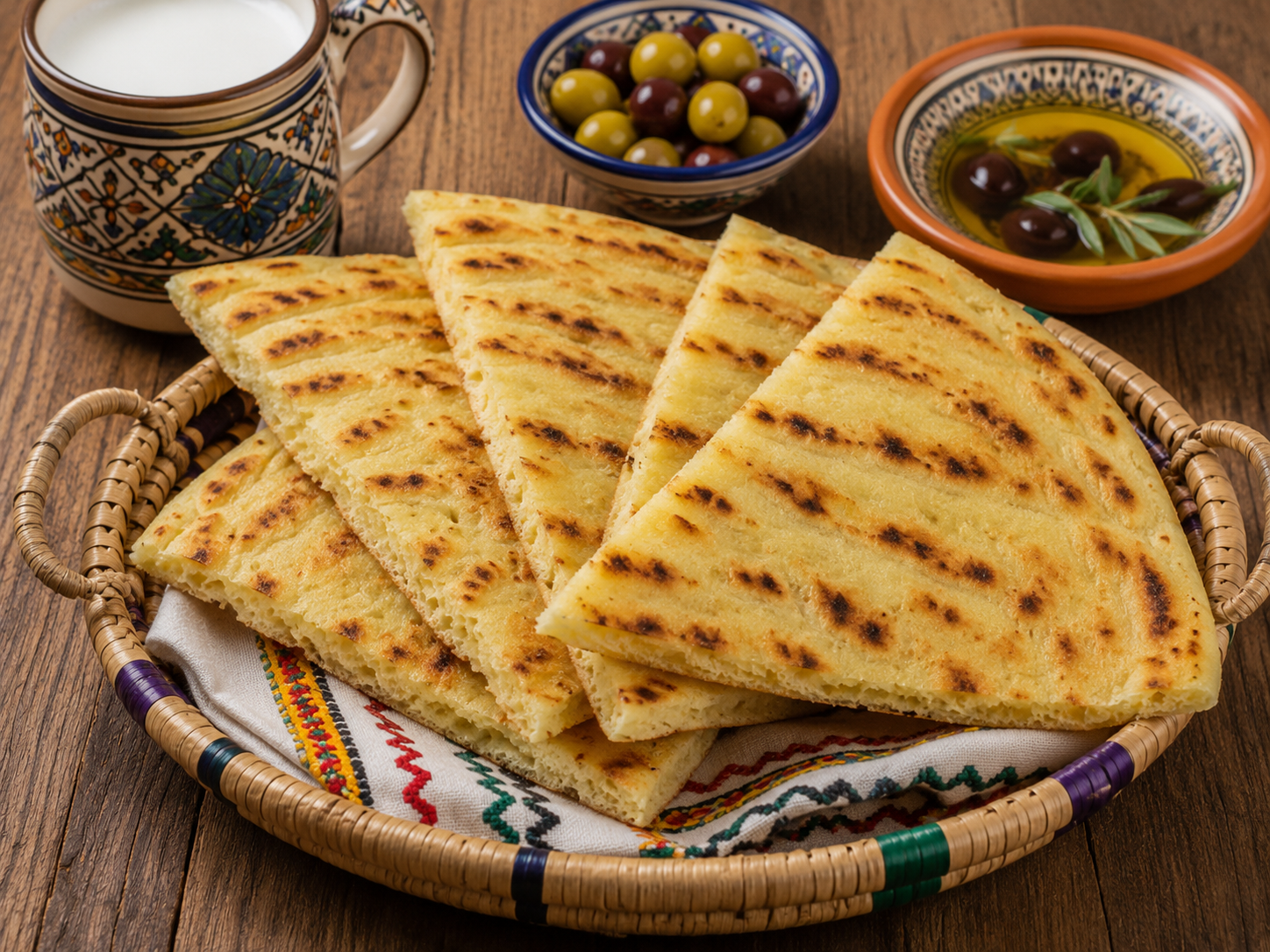
Kesra is more than just a food accompaniment; it is a true monument of North African culinary art, particularly in Algeria. Its origins date back to ancient times, deeply rooted in the Numidian and pre-Roman Berber periods. Since antiquity, the Mediterranean basin and the African continent have cultivated durum wheat. North Africa, often referred to as the granary of Rome during the Roman era, saw the birth of a grain civilization where semolina became the basis of daily nutrition. In this historical context, kesra established itself as the quintessential daily bread. Unlike breads requiring long rising times and complex clay ovens, this flat semolina galette had the advantage of being quickly prepared on an open hearth. It thus perfectly adapted to the semi-nomadic or pastoral lifestyle of the indigenous Berber populations. Over the centuries, the recipe has been passed down orally from generation to generation, mainly by women who hold the secret of the essential knack for its success. Every home, from mountainous Kabylia to the oases of the Sahara, passing through the plains of the High Plateaus, daily resonates with the rhythmic sound of kneading and the comforting smell of toasted semolina, making this bread an essential identity and emotional landmark of the African table.
🥣 INGREDIENTS AND PREPARATION OF THE GALETTE
The purity of kesra lies in the simplicity and nobility of its components. To shape a traditional galette, only medium-quality durum wheat semolina, lukewarm water, salt, and a fat are needed. The exclusive use of durum wheat semolina, rather than soft wheat flour, gives this bread its distinctive granular texture and high nutritional value. The fat used varies according to the region and local resources. In olive-growing regions like Kabylia, extra-virgin olive oil is king, bringing its fruity aroma and golden color. Elsewhere, neutral vegetable oil can be combined with melted butter or smen, a traditional slightly rancid clarified butter, to add depth to the flavors.
The secret to a successful kesra lies in the crucial step called "sablage" (sanding). The cook first mixes the semolina, salt, and optionally a tiny pinch of baker's yeast, which will only serve to soften the crumb without making it swell excessively. Then, she pours the oil and vigorously rubs the mixture between her open palms. This ancestral gesture coats each grain of semolina with a thin lipid film, preventing the gluten network from becoming too elastic and ensuring the friable character of the galette. Once the sablage is complete, lukewarm water is added gradually.
Kneading kesra follows strict rules. Unlike classic white bread that is stretched for a long time, kesra dough must be worked by crushing and successive pressures. The goal is not to give it body, but rather to assemble the ingredients into a homogeneous and compact ball. If the dough is over-kneaded, it will become elastic and rubbery when cooked, losing its legendary crispness. Once the ideal texture is obtained, the dough is flattened with the palms of the hands or with a rolling pin into a regular disc about one centimeter thick. Finally, the surface is pricked with a fork or a traditional wooden punch to prevent the formation of air bubbles during cooking.
🔥 THE ART OF TRADITIONAL COOKING
Cooking kesra is a spectacular ritual that appeals to all senses. It is done on a specific tagine, which here refers to a circular refractory terracotta or heavy cast iron plate. This cooking plate is placed directly on the flame of a traditional gas stove called a tabouna, or ideally on an olive wood ember fire. The tagine must be heated dry for a long time before receiving the galette.
When the galette is placed on the hot surface, a soft hiss is heard, and a light smoke with the scent of toasted cereals begins to rise. To ensure perfectly even cooking, the cook uses a flat, round wooden utensil with a handle, or a simple folded clean cloth, to gently press the galette while regularly turning it. This continuous circular motion uniformly browns the reliefs left by the grooves of the terracotta tagine, drawing a network of small, very aesthetic brown squares on the bread.
The galette is then skillfully flipped to cook the second side using the same process. Fire control is essential here: too high a heat would burn the outside while leaving the inside raw, while too low a heat would dry out the galette, making it hard as a rock. Once cooked, the kesra is placed vertically on its edge in a wicker basket to allow internal moisture to escape without softening the crust. It is enjoyed warm or at room temperature.
🍽️ INDISPENSABLE COMPANION OF THE ALGERIAN AND AFRICAN TABLE
In the hierarchy of African breads, kesra holds a special place due to its extraordinary versatility. From morning to evening, it adapts to all times of the day and all budgets. At daybreak, it is accompanied by fresh butter, fig jam, or wild honey, escorted by a hot coffee with milk or mint tea. For a quick and invigorating midday snack, it is traditionally broken into pieces and consumed with lben, a fresh and tangy fermented milk, or raib, natural curdled milk. This ancient combination constitutes the quintessential pastoral meal, rich in protein and highly digestible, ideal for field workers or travelers crossing arid areas.
During main meals, kesra acts as a receptacle and tasting utensil. Its firm texture allows for cleanly scooping up stews, tagines, and especially the famous hmiss or hamis, an Algerian summer salad made of grilled peppers and tomatoes, finely chopped and drizzled with olive oil. It also wonderfully accompanies traditional soups like chorba or harira during Iftar (breaking the fast) evenings during the month of Ramadan.
On a continental level, kesra belongs to the large family of unleavened or lightly leavened African flatbreads. It shares obvious technical similarities with Somali sabaayad or East African chapati, although the latter use more soft wheat flour and folding for flakiness. In contrast, it clearly differs from Sudanese kisra which, despite the phonetic similarity of its name, is a thin fermented crepe made from sorghum or millet. Maghrebi kesra remains unique for its sandy texture, density, and aromatic richness due to durum wheat, illustrating the ability of African cultures to magnify local cereals.
🔄 SYNONYMS AND REGIONAL VARIATIONS
Depending on geography, local history, and Berber or Arabic dialects, kesra changes its name and preparation subtleties, reflecting the country's multicultural richness:
Rakhsis or Kesra Rakhsis: Name given mainly in eastern Algeria, particularly in Constantine, Annaba, or Guelma, to designate the version enriched with oil and slightly leavened, particularly crispy and melting in the mouth. Aghroum or Aghroum Aqoran: In the Berber Tamazight language, especially in Kabylia, this term means bread or dry bread. This variant highlights local olive oil and is characterized by a complete absence of yeast, offering a very firm and rustic texture that keeps for several days. Khobz El Fetir: Literally unleavened bread in Arabic, this name emphasizes the unleavened nature of the traditional galette, prepared hastily without any fermentation. Khobz El Tajine: Descriptive term used in some coastal or urban regions to refer to bread baked on a clay plate, although it can sometimes also refer by extension to matlouh, a very leavened and soft semolina bread. El M'besses: Although this term sometimes refers to a sweet semolina pastry, in some local variants, it describes an extremely sandy kesra, rich in fat, which crumbles delicately under the fingers. Keywords:
Galette Semolina Algeria Tagine Rakhsis Send message
Where to find it
Look for the exact food-grade form required by the recipe at markets and specialist shops. Check the product name, ingredients, condition and storage instructions.
Explore further: Cooking tips · Food hygiene and safety advice.
In my books

Continue exploring the continent’s cuisines with Africa at the Table — 54 countries, 54 iconic dishes, by Alioune FALL. This book is in English.
In the kitchen : Kesra
Recipes from the site to put your knowledge into practice:
Discover these cuisines at a restaurant
Explore our restaurant and caterer directories. Choose your destination and check the establishment’s menu to confirm which dishes are offered and available.
Continue exploring
Enjoy discovering ingredients and African cuisines? Join our newsletter. The illustrated PDF 10 sauces africaines incontournables is in French and is offered after confirming a subscription to the French or bilingual edition.