Batbout
Morocco
Understanding : Batbout
🥙 ORIGINS AND HISTORY OF BATBOUT
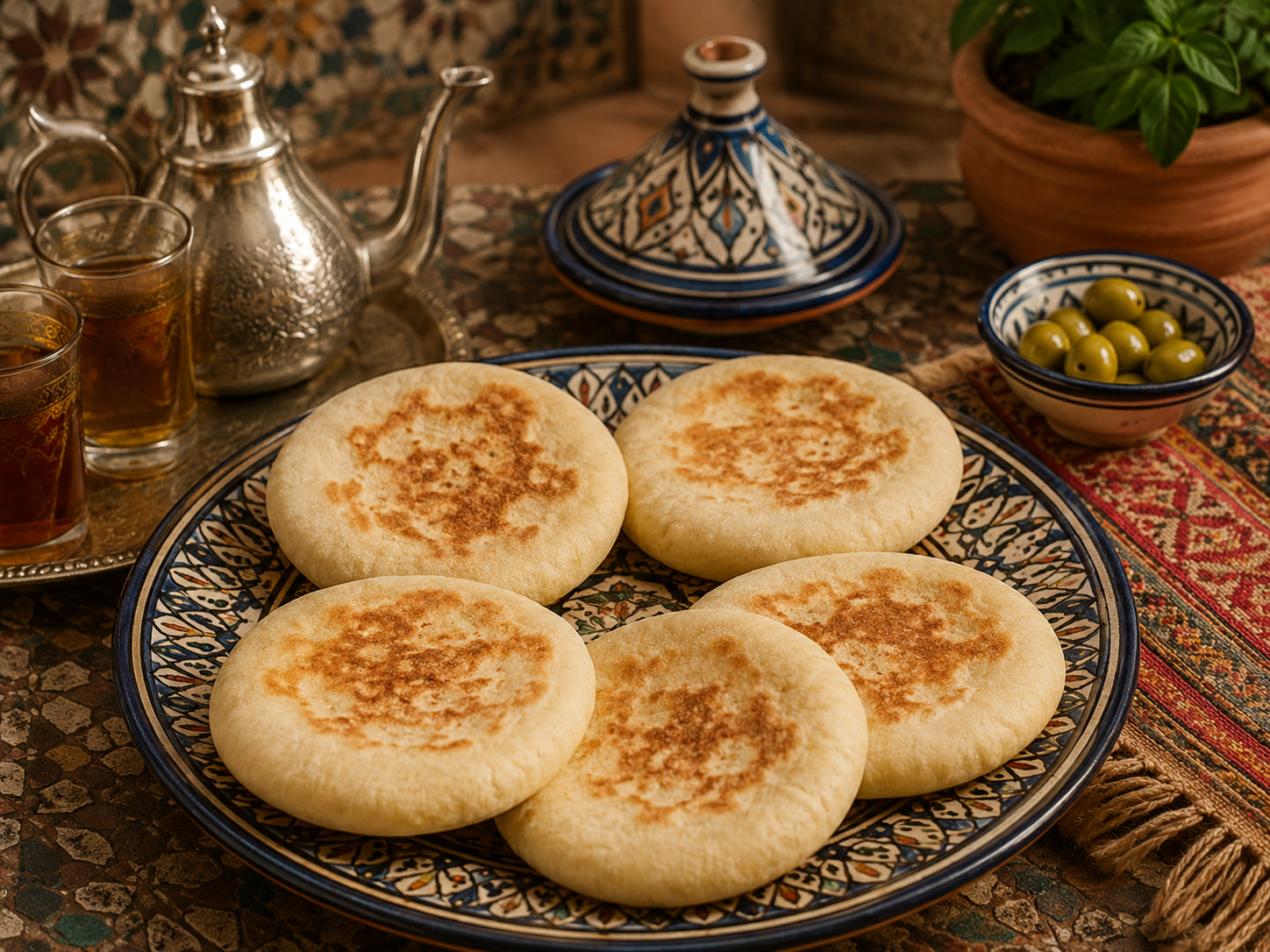
Batbout is a treasure of North African gastronomy, particularly rooted in the culinary traditions of Morocco. This small, leavened, pan-fried bread is the direct heir to a long tradition of Amazigh (Berber) bread-making that dates back several millennia. In North Africa, bread has always been considered a sacred food, a symbol of life, sharing, and celestial blessing, often referred to as naama. The history of batbout is intimately linked to the domestic and nomadic life of Berber populations. Unlike large breads baked in communal ovens or outdoor clay ovens, batbout was designed to be prepared quickly at home on a simple heated griddle. This rapid cooking method over fire allowed families or travelers to be fed promptly without requiring significant fuel resources. Over the centuries, this simple and ingenious recipe has been passed down from mother to daughter, becoming an essential part of every household's culinary repertoire. Today, batbout embodies a perfect alliance between rural tradition and urban modernity, adapting remarkably flexibly to new eating habits while preserving its original soul.
🌾 PREPARATION TECHNIQUE AND ALCHEMY OF INGREDIENTS
The making of batbout relies on a selection of very simple ingredients: fine or extra-fine durum wheat semolina, soft wheat flour, warm water, salt, and baker's yeast. The combined use of semolina and flour is essential. Semolina provides structure, a subtle cereal flavor, and a beautiful light yellow color, while flour gives the bread the necessary suppleness and elasticity to puff up spectacularly during cooking.
The process begins with kneading, a step that requires energy and consistency. The dough is worked vigorously for long minutes until it becomes smooth, silky, and elastic to the touch. Gradual hydration is crucial to allow the semolina to absorb water optimally. Once the ideal consistency is achieved, the dough is rolled out on a work surface dusted with fine semolina, to a thickness of about one centimeter. It is at this point that the breads are cut, traditionally into regular circles. Sizes can vary from the size of a saucer to a small bite-sized version for miniature versions intended for stuffing. The dough discs are then placed on a clean cloth and covered for a fermentation phase of about an hour. This rising step must be closely monitored: an over-risen dough would lose its strength and not puff up correctly during cooking, while an insufficiently rested dough would remain dense and heavy.
🎈 THE PHENOMENON OF PAN COOKING AND PUFFING
What fundamentally distinguishes batbout from most other breads is its cooking on a heavy cast iron or terracotta pan, without any added fat, and its characteristic puffing. The cast iron tagine or pan must be preheated dry over a medium to high heat. When the risen dough disc is gently placed on the hot surface, the thermal shock immediately seizes the base of the bread, creating a thin, sealed crust.
After only a few seconds, as soon as small bubbles begin to form on the surface of the dough, the bread is flipped. It is during this phase that the magic happens. The water contained within the dough rapidly turns into steam under the effect of intense heat. Trapped between the two sealed crusts that have formed on each side, this steam tries to escape and pushes the walls outwards. The batbout then begins to puff up spectacularly, transforming into a true balloon, completely empty inside. The cook flips the bread several times to ensure even cooking and a golden color on both sides. This physical phenomenon of puffing creates a unique natural air pocket, without superfluous crumb, making batbout the perfect receptacle for all kinds of fillings.
🍽️ BATBOUT IN TABLE ART AND ITS CULINARY USES
On the North African table, batbout is an extraordinarily versatile player. Traditionally, it is eaten hot, straight from the pan. Its soft texture and light crumb make it the ideal accompaniment for breakfast or a snack, where it is cut in half and generously spread with a warm mixture of melted butter and honey, or simply drizzled with first cold-pressed olive oil. It is then the inseparable companion to steaming mint tea.
However, it is in its stuffed form that batbout has conquered modern tables and street food. Thanks to its natural air pocket, it is enough to delicately incise the edge of the bread to obtain a pocket ready to welcome an infinity of fillings. During the holy month of Ramadan, stuffed batbout becomes an essential star of the Ftour table, the meal for breaking the fast. Mini-batbouts are then filled with cold mixtures such as tuna, olives, corn, and mayonnaise, or hot preparations based on spicy minced meat, curry-marinated chicken, sautéed vegetables, or kefta. Its solid yet tender structure allows it to hold the filling without spilling or tearing, offering a practical and flavorful tasting experience.
🌍 PLACE AND INFLUENCE IN AFRICAN CUISINE
Beyond the borders of the Maghreb, batbout remarkably illustrates the universality and circulation of bread-making techniques across the African continent. It belongs to the large family of flat pan-fried breads found in different forms and names in many regions of Africa. Its technical simplicity and quick cooking meet needs shared by many African cultures, where the management of cooking time and fuel has historically been crucial.
In East Africa, particularly in Kenya, Tanzania, and Uganda, similarities in form and use are observed with the local chapati, although the latter incorporates oil and is flaky. In the Horn of Africa, sabaayad shares this function of pan-fried morning bread. Furthermore, migratory flows and trade within the continent have allowed batbout to spread and adapt to the local tastes of other sub-Saharan African countries, where it is often adopted for picnics or fast street food. Batbout thus embodies a modern and dynamic Africa, capable of transforming an ancestral heritage into a nomadic and trendy consumer product, appreciated by all generations for its conviviality and generosity.
🔄 SYNONYMS AND VARIATIONS IN NAME
Batbout, due to its historical presence in different territories and dialects, is known by several names that highlight its regional specificities:
Toghrift: An ancient Amazigh name still alive in several Berber-speaking regions of Morocco, referring to the traditional cooking method on a hot griddle. Matlouh: Although this term often refers to a larger and thicker leavened bread, in some regions of Algeria and eastern Morocco, it is used interchangeably with batbout to designate this pan-fried bread. Khobz El Mokla: Literally translated as 'pan bread' in dialectal Arabic, this descriptive name emphasizes its cooking technique as opposed to oven-baked breads. Tachgourt: A vernacular Berber name used in some oases and valleys of southern Morocco to designate this puffed flatbread. Semolina balloon bread: A modern nickname popularized by international gastronomy and culinary blogs, referring to its spectacular ability to puff up with air during cooking.
Keywords:
Yeast Pan Morocco Filling Soft
Where to find it
Look for the exact food-grade form required by the recipe at markets and specialist shops. Check the product name, ingredients, condition and storage instructions.
Explore further: Cooking tips · Food hygiene and safety advice.
In my books

Continue exploring the continent’s cuisines with Africa at the Table — 54 countries, 54 iconic dishes, by Alioune FALL. This book is in English.
In the kitchen : Batbout
Recipes from the site to put your knowledge into practice:
Discover these cuisines at a restaurant
Explore our restaurant and caterer directories. Choose your destination and check the establishment’s menu to confirm which dishes are offered and available.
Continue exploring
Enjoy discovering ingredients and African cuisines? Join our newsletter. The illustrated PDF 10 sauces africaines incontournables is in French and is offered after confirming a subscription to the French or bilingual edition.