Mhadjeb
Algeria
Understanding : Mhadjeb
🌶️ ORIGINS AND HISTORY OF MHADJEB
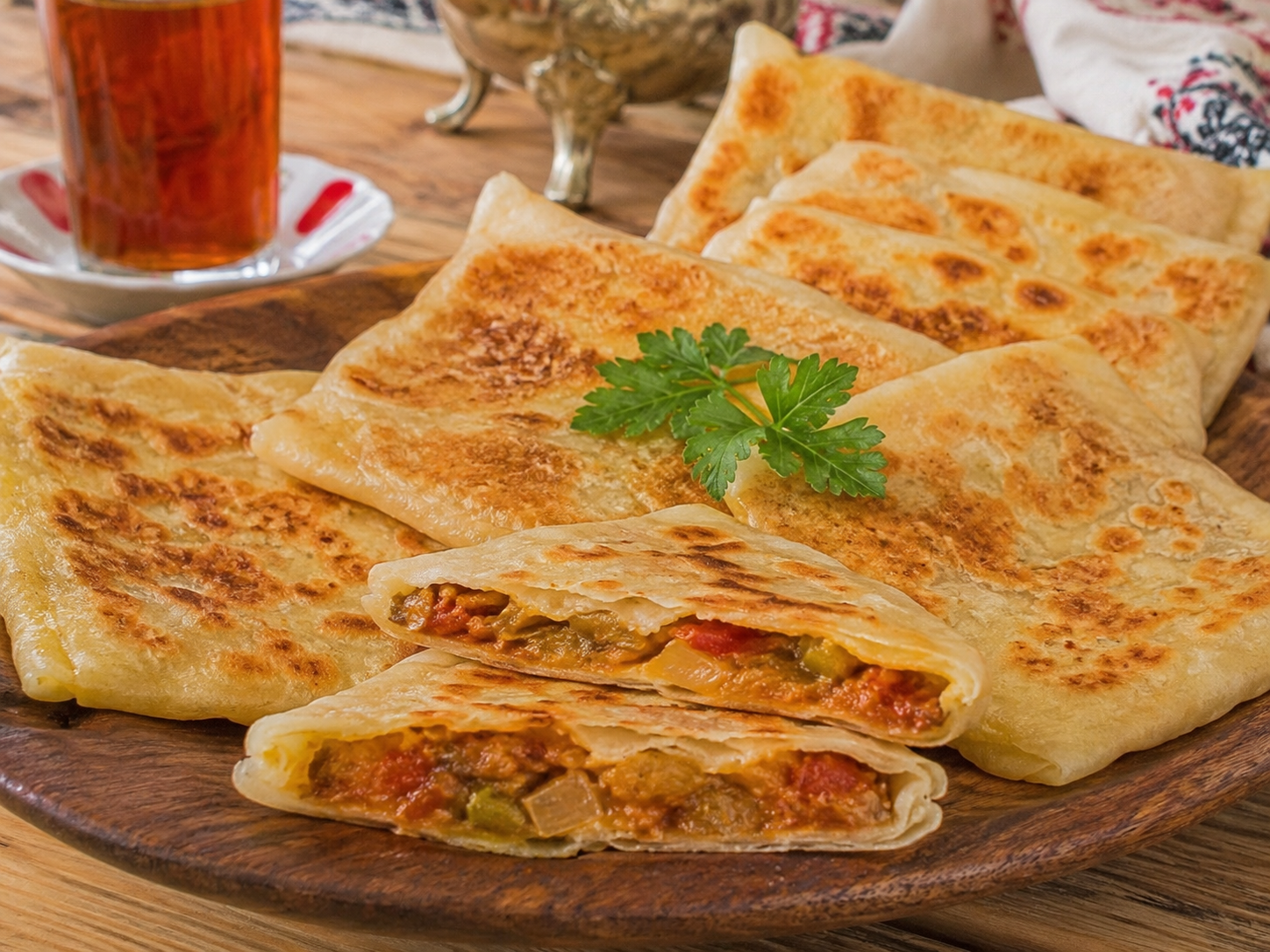
Mhadjeb represent one of the most emblematic highlights of popular North African cuisine, and more specifically Algerian cuisine, where they enjoy an almost sacred status among all segments of the population. This generous and spicy stuffed pastry has its historical origins in the nomadic and peasant traditions of the Algerian high plateaus and pre-Saharan areas, particularly the Biskra region, often celebrated as the original birthplace of this recipe. Originally, this dish was closely linked to basic local agricultural resources: durum wheat semolina and dried or fresh garden vegetables depending on the season. The art of mhadjeb developed as an ingenious way to create a complete, hearty, easy-to-transport, and extremely flavorful meal with minimal economic means.
Where to find it
Look for the exact food-grade form required by the recipe at markets and specialist shops. Check the product name, ingredients, condition and storage instructions.
Explore further: Cooking tips · Food hygiene and safety advice.
History and uses
Etymologically, the word mhadjeb derives from the Arabic verb hadjaba, meaning to cover or veil, directly referring to the preparation technique where the spicy filling is literally wrapped and concealed within multiple layers of translucent dough. This poetic image of the veil perfectly illustrates the modesty and refinement of local culture, where the greatest treasures are discovered hidden from view. Passed down from generation to generation through exclusively female apprenticeship, the act of preparing mhadjeb is a fascinating spectacle that combines the physical strength required to knead the semolina with the extreme delicacy needed to stretch the dough without tearing it. Today, mhadjeb have conquered the entire Algerian national territory and have established themselves as the king of street food, present on every street corner in popular stalls where they are prepared live in front of delighted customers.
🌾 THE DOUGH AND THE EXTREME LAMINATION TECHNIQUE
The absolute success of mhadjeb depends entirely on the quality of its dough and the dexterity of its shaping, which is akin to a true artisanal feat. The basic ingredients of the dough are disarmingly simple: extra-fine durum wheat semolina, warm water, and sea salt. Unlike most Western breads, no yeast is incorporated, which classifies this preparation in the category of unleavened doughs, whose final texture depends solely on human mechanical work.
Kneading is a remarkably physically intense step. The semolina is first moistened with salted water, then vigorously kneaded with the palms of the hands. The key lies in progressive hydration: the cook adds water in small increments while crushing and stretching the dough to develop the durum wheat gluten network. After about twenty minutes of this rhythmic work, the dough acquires a silky texture, with extraordinary elasticity, capable of stretching without breaking. It is then divided into small, regular balls, generously coated with vegetable oil to relax the gluten fibers and prevent desiccation, then left to rest for at least an hour.
The spreading step is the most spectacular moment. Each ball of dough is placed on a previously oiled work surface. With oil-soaked fingertips, the cook flattens the dough then gently stretches it from the center outwards by sliding their hands underneath. Through this fluid and circular motion, the dough thins until it becomes a translucent, almost invisible veil, through which one can distinguish the details of the work surface. A spoonful of warm filling is placed on this dough veil, before the dough is folded into a wallet shape to form a perfect square of several layers of lamination that hermetically enclose the filling.
🍅 THE SOUL OF MHADJEB IN ITS SPICY FILLING
If the dough is the body of mhadjeb, the filling is undeniably its soul. The traditional recipe for the filling, called chtitha or tchektchouka, is a flavorful reduction of onions, ripe tomatoes, garlic, cayenne pepper or harissa, all slowly cooked in olive oil. The onions, cut into thin slices, are patiently caramelized to provide a natural sweet softness that will counterbalance the heat of the chili. Fresh tomatoes, peeled and crushed, are added to provide acidity and binding, while garlic and spices like ras el hanout, black pepper, and paprika complete this culinary picture.
In my books

Continue exploring the continent’s cuisines with Africa at the Table — 54 countries, 54 iconic dishes, by Alioune FALL. This book is in English.
Explore further
The particularity of this filling lies in its texture: it must be perfectly reduced, almost candied, and contain no trace of free water to avoid soaking and tearing the thin semolina dough during folding and cooking. In the most traditional and rustic variations, particularly in southern Algeria, melted and dried sheep or beef fat, called chhma, is added to this preparation, which brings an authentic local flavor and incomparable creaminess. Today, recipes are modernizing and adapting to contemporary tastes, sometimes incorporating minced meat, shredded chicken, spreadable cheese, or portions of melted cheese to soften the chili for children, although purists prefer the original onion, tomato, and chili version, which remains unrivaled.
🔥 THE RITUAL OF COOKING AND TASTING
Mhadjeb are cooked on a heavy cast-iron tagine or a smooth metal griddle called a tawa, preheated and lightly greased with vegetable oil. As soon as the stuffed square is placed on the hot griddle, the pastry begins to puff up under the action of the steam generated by the moist filling trapped inside.
The cook carefully monitors the cooking, flipping the pastry several times with a spatula or directly by hand to achieve a golden color and characteristic brown spots on both sides. Cooking must be quick so that the outside remains extremely crispy while the inside retains all its softness and melt-in-your-mouth quality. Mhadjeb are eaten piping hot, fresh off the griddle, wrapped in simple kraft paper. They are folded in half to be eaten by hand, allowing the fragrant steam and spicy tomato juice to escape, offering an intense taste experience where the crispiness of the outer dough layers harmoniously blends with the sweet, savory, and spicy melt of the filling.
🌍 PLACE AND INFLUENCE IN AFRICAN CUISINE
In the vast mosaic of African cuisine, mhadjeb hold a particularly interesting position as perfect representatives of popular, convivial, and accessible street food. They embody a culinary philosophy shared by many cultures on the continent, which consists of transforming local cereals and seasonal vegetables into a complete, nourishing, and flavorful meal, without requiring sophisticated cooking equipment.
The dough stretching technique of mhadjeb shows striking technical correspondences with other African specialties such as the flaky chapati of East Africa or certain folded flatbreads from the Horn of Africa. However, the systematic integration of a candied spicy filling within the pastry itself before cooking remains a remarkable North African specificity. Traveling across the continent and beyond through the diaspora, mhadjeb have become ambassadors of the generosity and spiciness of Algerian cuisine, seducing palates worldwide with their unique texture and comforting character. They bear witness to the vitality of contemporary African cuisine, capable of preserving ancestral gestures while remaining at the heart of modern urban life.
🔄 SYNONYMS AND VARIATIONS IN DENOMINATION
The word mhadjeb is the most universally shared term, but this stuffed pastry has different names depending on the regions and neighboring North African countries:
Mahjouba: Singular form of the word mhadjeb, very frequently used to designate a single piece of this delicious pastry. Msemmen farci: A descriptive name commonly used in Morocco and Tunisia, as well as by the diaspora, to explain the recipe by referring to the basic unstuffed square flaky pastry called msemmen. Rghaïf farcie: A generic term for flaky breads, used in western Algeria and Morocco to designate this folded and garnished flatbread. Chakhchoukha de Biskra: Although chakhchoukha is technically another dish of crumbled pasta sheets drizzled with sauce, in some historical regions, the two preparations share similar dough and filling bases and are sometimes confused by visitors. Galette farcie algérienne: A simplified name used in Francophone and international gastronomic literature to present this street specialty to travelers and world cuisine enthusiasts. Keywords:
Semolina Onion Chili Algeria Flaky pastry
In the kitchen : Mhadjeb
Recipes from the site to put your knowledge into practice:
Discover these cuisines at a restaurant
Explore our restaurant and caterer directories. Choose your destination and check the establishment’s menu to confirm which dishes are offered and available.
Continue exploring
Enjoy discovering ingredients and African cuisines? Join our newsletter. The illustrated PDF 10 sauces africaines incontournables is in French and is offered after confirming a subscription to the French or bilingual edition.