Khobz eddar
Algeria
Understanding : Khobz eddar
🏠🥖 HISTORICAL ORIGINS AND FAMILY TRADITIONS
Khobz eddar, whose literal translation from Arabic means 'house bread', is one of the most cherished treasures of North African culinary heritage, particularly in Algeria. It embodies the very essence of hospitality, conviviality, and domestic savoir-faire. Unlike daily flatbreads such as kesra or matlouh, baked on terracotta or cast-iron griddles, khobz eddar is a leavened brioche-like bread traditionally baked in an oven. Its origins date back to a distant era when every home had a terracotta or refractory brick oven, called a koucha, for baking family bread. In Maghrebi culture, preparing bread at home is not just a household chore, but a highly valued spiritual and social ritual. Presenting homemade khobz eddar to guests is the most beautiful proof of respect and affection a host can offer. This bread is historically linked to major family celebrations, rites of passage, as well as sacred days like Fridays, Eid, or the month of Ramadan. Passed down orally from mother to daughter, the skill required to achieve its airy texture and inimitable fragrance constitutes a true intangible cultural heritage that unites generations of African women around the traditional kneading trough.
🌾🥚 NOBLE INGREDIENTS AND BRIOCHE TEXTURE
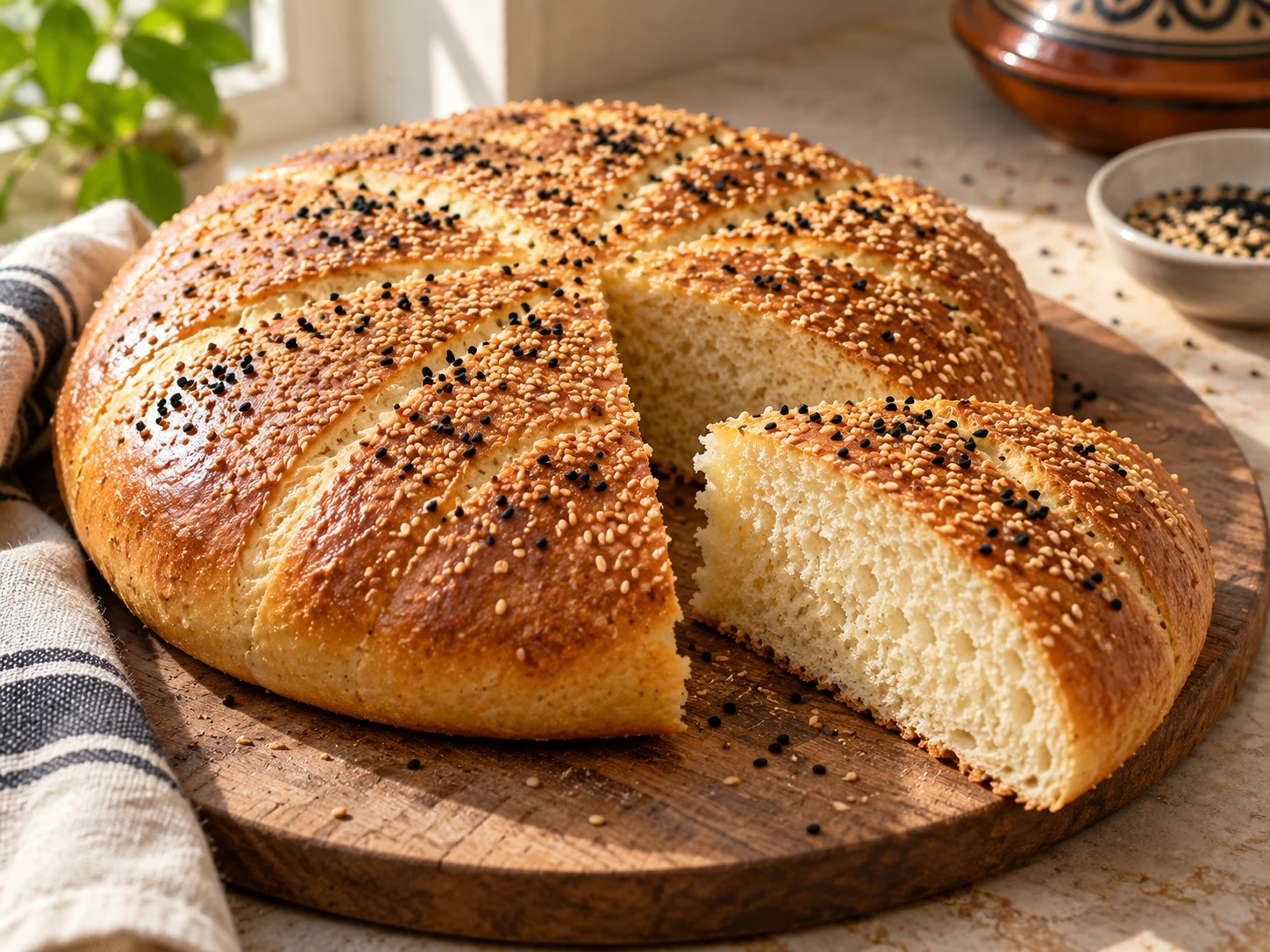
The uniqueness of khobz eddar lies in the richness and nobility of its composition, placing it at the subtle boundary between table bread and festive brioche. The base of the dough consists of very fine durum wheat semolina, often called finot, which is sometimes combined with a proportion of soft wheat flour to provide more lightness and softness to the crumb. Unlike ordinary breads made only of water, salt, and yeast, khobz eddar incorporates enriching ingredients that give it its soft texture and characteristic golden-yellow color. Fresh eggs, warm milk (replacing all or part of the water), and a choice fat such as melted butter, smen (traditional clarified butter), or first-press olive oil are added. Furthermore, the dough is traditionally flavored with orange blossom water or rose water, which brings a delicate floral note typical of North African gastronomy. Finally, the visual and gustatory identity of this bread is inseparable from the aromatic seeds incorporated directly into the dough or sprinkled on its surface, such as nigella, anise, sesame, or fennel seeds, each bringing digestive virtues and a unique aromatic profile.
🥣⏳ THE ART OF KNEADING AND FERMENTATION
The making of khobz eddar is a true physical and technical performance that demands patience and devotion. The first step involves rubbing the semolina with the chosen fat to thoroughly impregnate each grain, thus ensuring the melt-in-your-mouth quality of the crumb. Activated baker's yeast is then incorporated into a little warm sweetened milk, along with eggs and salt. Kneading is traditionally done in a large enameled terracotta or wooden dish, called a gassaâ or djefna. This is where the cook's talent shines: the dough must be worked vigorously by stretching, folding, and regularly beating it against the sides of the container. Warm water or milk is added very gradually in small quantities, a delicate technique that allows maximum hydration of the semolina without making the dough soggy. At the end of this rhythmic work, lasting about twenty minutes, the dough transforms from a firm texture to an extremely soft, smooth, and slightly sticky dough. It is then left to rest in a warm place, away from drafts, covered with a clean cotton cloth. During this first fermentation, which generally lasts one to two hours, the dough doubles in volume and fills with air bubbles that foreshadow the lightness of the future crumb.
🔥🍯 A GOLDEN BAKE AND A SEED GARNISH
After the first rise, the dough is gently degassed by light kneading, then shaped into a large circular or oval flatbread which is placed in a round mold previously buttered and dusted with a veil of fine semolina. The bread is left to rise a second time directly in its baking mold until it dramatically swells again. Just before baking, the surface of the bread is brushed with a mixture of egg yolk and milk, or sometimes a touch of strong coffee, to ensure a brilliant and intensely coppery brown color after baking. It is at this moment that the bread is generously sprinkled with nigella and sesame seeds, often forming traditional geometric or floral patterns. Baking takes place in a hot oven, where the bread swells dramatically one last time. The heat transforms the sugars and proteins of the milk and egg into a thin, supple, and shiny crust, while the inside bakes gently to produce an extremely airy, stringy, and soft crumb. As soon as it comes out of the oven, the khobz eddar exudes an enchanting aroma of sourdough, warm butter, orange blossom water, and toasted seeds that instantly fills the entire house.
🍽️👑 ROYAL COMPANION FOR FESTIVITIES AND HOSPITALITY
On the Maghrebi table, khobz eddar is the undisputed king of special occasions and shared days. Its rich and fragrant texture makes it the ideal companion for the most prestigious festive dishes of North African cuisine. It is essential to accompany tajine el khokh (minced meat peach tajine), chicken tajine with olives and preserved lemon, or lham lhelou, a sweet and savory lamb stew with prunes and dried apricots flavored with cinnamon, where the brioche-like crumb of the bread pairs divinely with the syrupy sauces. During the holy month of Ramadan, it is prepared daily to accompany chorba or harira, providing comfort and energy after the day of fasting. Khobz eddar is also served for breakfast on festive days, such as Eid, cut into large triangular portions that are enjoyed still warm, spread with farm butter and orange blossom honey, or simply dipped in a large bowl of café au lait. Offering a slice of warm khobz eddar with a glass of lben (fermented milk) is a sacred gesture of welcome, sealing friendship and peace between host and visitor.
🌍🗺️ PLACE AND INFLUENCE IN AFRICAN CUISINE
Khobz eddar, although originating from the northern fringe of the continent, holds an emblematic place in the great history of African bread-making. It masterfully illustrates how African cultures have appropriated staple grains to create breads of a complexity and richness comparable to the world's best pastries. On a continental scale, the oven baking of rich breads containing eggs and milk is found in several cultures, testifying to mutual influences across Saharan and maritime trade routes. For example, similarities in textures and aromas can be observed with Sudanese sesame bread or certain traditional East African brioches influenced by exchanges with the Arab and Persian world. Khobz eddar represents African excellence in transforming durum wheat semolina into a highly gastronomic and spiritual product. It reminds us that bread in Africa is much more than a nutritious commodity: it is a strong social bond, a symbol of blessing, and a vehicle for cultural transmission that spans centuries through immutable gestures and rituals.
🔄🗣️ SYNONYMS AND VARIATIONS IN DENOMINATION
Depending on the countries, cities, and regions of North Africa, khobz eddar is referred to by different names that highlight its domestic character, baking method, or richness:
Khobz El Koucha: Literally translated as 'oven bread', this name emphasizes the oven baking method as opposed to breads baked on a griddle or pan. Khobz Eddar Constantinois: A specific appellation referring to the famous variant from the city of Constantine, renowned for its richness in eggs, its ultra-soft texture, and its artistic shaping. Pain brioché à la semoule: A descriptive French name widely used in gastronomic circles and by the African diaspora to introduce this bread to world cuisine enthusiasts. Khobz El Bey: A nickname sometimes given in certain coastal regions to particularly rich and decorated versions of this house bread, evoking the luxury of the Ottoman governors' table. Aghroum n'dar: A term from local Berber dialects combining the Berber word for bread with the Arabic word for house, illustrating the cultural blending of the region.
Keywords:
Semolina Nigella Soft Brioche Algeria
Where to find it
Look for the exact food-grade form required by the recipe at markets and specialist shops. Check the product name, ingredients, condition and storage instructions.
Explore further: Cooking tips · Food hygiene and safety advice.
In my books

Continue exploring the continent’s cuisines with Africa at the Table — 54 countries, 54 iconic dishes, by Alioune FALL. This book is in English.
In the kitchen : Khobz eddar
Recipes from the site to put your knowledge into practice:
Discover these cuisines at a restaurant
Explore our restaurant and caterer directories. Choose your destination and check the establishment’s menu to confirm which dishes are offered and available.
Continue exploring
Enjoy discovering ingredients and African cuisines? Join our newsletter. The illustrated PDF 10 sauces africaines incontournables is in French and is offered after confirming a subscription to the French or bilingual edition.