Harcha
Morocco
Understanding : Harcha
🌅 🥞 ORIGINS AND CULTURAL SIGNIFICANCE OF HARCHA
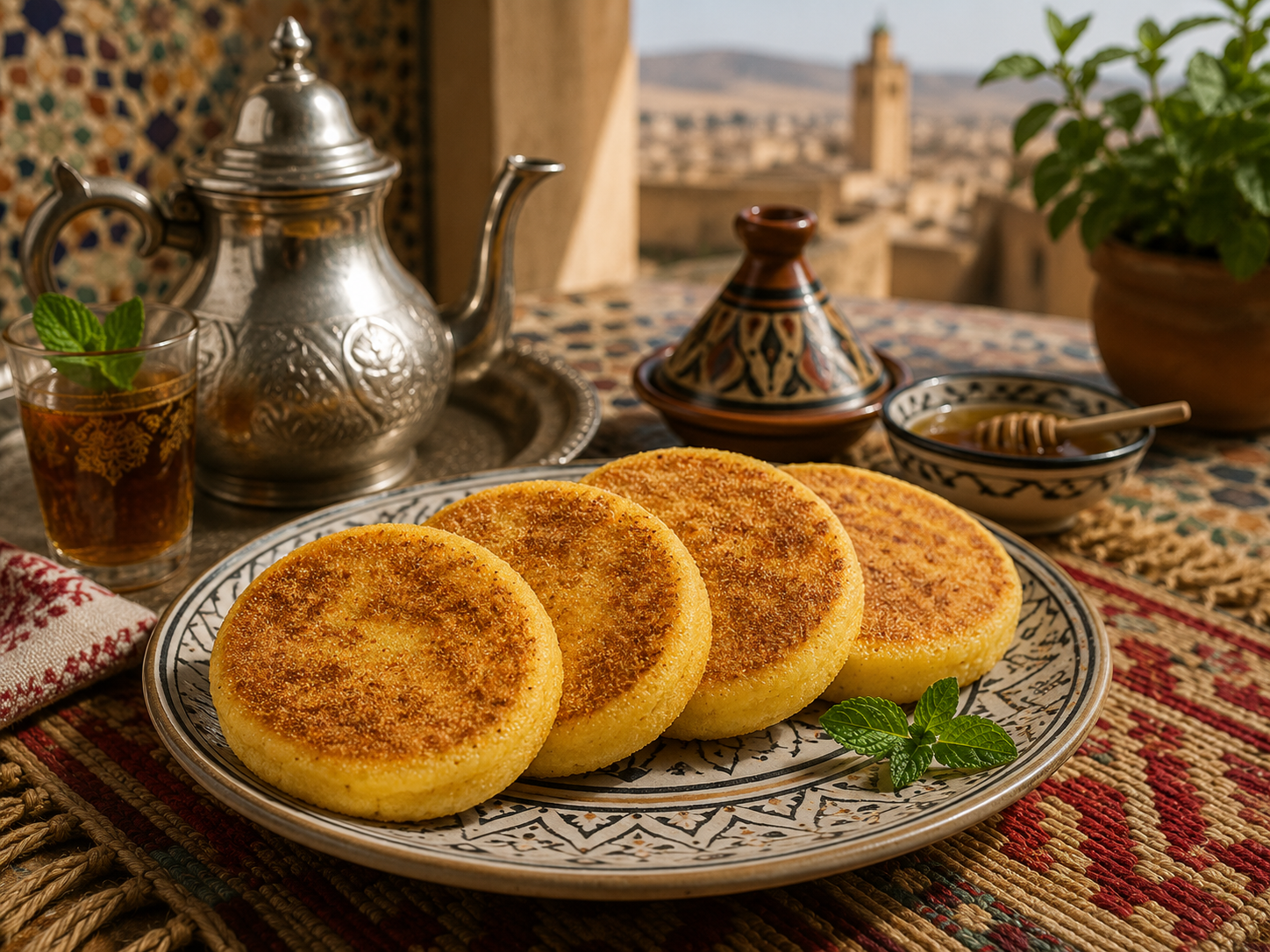
Harcha is an essential culinary specialty of North Africa, finding its historical cradle and most popular expression in Morocco. This flatbread, resembling a pancake and characterized by its granular texture on the surface and melt-in-your-mouth interior, is one of the most vibrant symbols of Moroccan home and popular cuisine. The word harcha comes from the dialectal Arabic adjective harach, which means rough or coarse, directly referring to the thin film of dry semolina that covers the pancake and gives it its unique feel. Historically, harcha originated from the pastoral and agricultural traditions of the Berber populations. In these rural societies, durum wheat semolina was the cornerstone of the diet. Harcha established itself as an ingenious and quick solution to feed the family without requiring heavy cooking infrastructure, such as a traditional bread oven. Unlike leavened breads that require several hours of work and fermentation, harcha is prepared in a few minutes and cooked directly on a stone or terracotta griddle placed over the fire. This instant bread, rustic and comforting, has spanned the ages to now be found in all urban bakeries, cafes, and family tables across the continent, testifying to the incredible longevity of ancestral African know-how.
🌾 🥣 INGREDIENTS AND SECRETS OF THE MELT-IN-YOUR-MOUTH SANDING TECHNIQUE
The preparation of harcha relies on a handful of basic ingredients but requires scrupulous adherence to the steps to achieve its unique sandy texture. The authentic recipe calls for medium-ground durum wheat semolina, melted unsalted or clarified butter, sometimes combined with a drizzle of vegetable oil, a pinch of sea salt, a hint of sugar to promote browning, baking powder for lightness, and finally, warm milk or water for assembly. The key step in its making is the sanding, or m'besses in Arabic. This technique involves pouring the melted fat over the dry semolina and gently rubbing the mixture between open palms. This meticulous gesture coats each grain of semolina with a thin lipid film. This fat barrier prevents gluten from developing excessively when liquids are added, thus preventing the pancake from becoming elastic, hard, or rubbery. Once the semolina is perfectly sanded, the warm milk is incorporated. This is where the greatest difficulty lies: the dough must not be kneaded. The cook must simply mix with fingertips to gather the ingredients into a moist and supple mass. The dough is then left to rest for a few minutes to allow the semolina grains to gently absorb the liquid, thus becoming perfectly malleable and ready to be shaped.
🍳 🔥 THE TRADITIONAL DRY COOKING TECHNIQUE
Once the dough has rested, the shaping of the harcha can begin. The traditional method involves generously sprinkling the work surface with extra-fine or fine durum wheat semolina. The dough is placed on it to be gently flattened with the palm of the hand or with a rolling pin, to a thickness of about one centimeter. One can choose to make a single large family pancake, which will then be cut into triangles, or to cut out small individual pancakes using a circular cookie cutter. Each pancake is then turned several times in the dry semolina so that its surface is entirely and uniformly covered with grains, which will guarantee its rough and crispy texture. Cooking harcha is a delicate step that is done without any fat on a heavy cast-iron pan, traditionally called makla or Oujda tagine in Morocco. The pan must be preheated for a long time dry over medium heat. The pancakes are gently placed on it. Under the effect of direct heat, the outside quickly sears, creating a crispy and granular crust, while the heart of the pancake cooks by steaming under the action of trapped moisture, remaining wonderfully soft and crumbly. The harchas are turned halfway through cooking using a spatula or a flat plate. This manipulation requires skill, as the hot dough, rich in butter and unleavened, is extremely fragile and can break with the slightest abrupt movement. Once they have a beautiful golden color dotted with small brown cooking spots, they are removed from the heat and left to cool on a clean cloth.
🍽️ 🍯 IDEAL COMPANION FOR TEA AND HOSPITALITY
On the Moroccan and North African table, harcha is synonymous with sharing, sweetness of life, and conviviality. It is the guest of honor at hearty breakfasts and afternoon snacks, essential moments of relaxation in social life. Harcha must be enjoyed hot or warm, when it releases all its aromas of grilled semolina and warm butter. Traditionally, it is split horizontally in two to spread soft farm butter and warm orange blossom honey, which melt instantly and seep between the semolina grains for unparalleled gustatory pleasure. It also pairs wonderfully with local fresh cheese, Berber jben, whose fresh acidity balances the richness of the pancake, or with first-press olive oil. On special occasions, it is accompanied by amlou, this exceptional Berber spread made from grilled almonds, honey, and argan oil. Serving homemade harchas to guests is an essential gesture of Maghrebi hospitality. They are presented arranged in a rosette on a large plate, surrounded by small bowls of various accompaniments, and escorted by traditional steaming mint tea poured from high to create a generous foam. This contrast between the warmth and roughness of the harcha and the sweet freshness of mint tea embodies the art of African hospitality.
🌍 🗺️ SHARED KNOW-HOW AND INFLUENCES IN AFRICA
Harcha, although typically Moroccan, fits beautifully into the global landscape of African baking and gastronomy. It testifies to a culinary intelligence shared across the continent, consisting of valuing basic grains and cereals through healthy, quick, and dry cooking methods on griddles or pans. The technique of sanding semolina or flour to obtain a crumbly texture is found in other African preparations, whether sweet treats or savory pancakes. In East Africa, for example, pancakes made from millet, corn, or sorghum share this same rusticity and simplicity of execution, cooked dry on terracotta or metal griddles over the fire. Harcha shows how North Africa has developed a true civilization of durum wheat, pushing the refinement of semolina textures to the extreme. Through migratory waves and the influence of Maghrebi culture throughout the world and the continent, harcha has also been exported, attracting new populations with its practicality and deliciousness. It embodies this ability of African cuisine to make simplicity an everyday luxury, where the authentic taste of grain and earth is honored without artifice.
🔄 🗣️ SYNONYMS AND VARIATIONS OF DENOMINATION
Depending on the regions, living environments, and dialects of North Africa, harcha can have different names that emphasize its preparation method, its sandy texture, or its basic ingredients:
Harsha or El Harcha: The most common spelling and pronunciation in dialectal Arabic, referring to the characteristic rough and granular texture of the bread's crust. Moroccan semolina pancake: A descriptive French-language name widely used by gourmets, tourist guides, and members of the diaspora to present this specialty. Mbessess de poêle: A name sometimes used in certain border areas or areas of Algerian influence, linking the sanding technique to the flat cooking method on the pan. Aghroum n'Smid: A term from the Amazigh Berber language, which literally translates to semolina bread, in homage to the original and sovereign ingredient of this recipe. Moroccan sandy flatbread: A modern nickname used in international culinary literature to present this pancake with sandy textures. Keywords:
Semolina Sanding Pan Morocco Conviviality
Where to find it
Look for the exact food-grade form required by the recipe at markets and specialist shops. Check the product name, ingredients, condition and storage instructions.
Explore further: Cooking tips · Food hygiene and safety advice.
In my books

Continue exploring the continent’s cuisines with Africa at the Table — 54 countries, 54 iconic dishes, by Alioune FALL. This book is in English.
In the kitchen : Harcha
Recipes from the site to put your knowledge into practice:
Discover these cuisines at a restaurant
Explore our restaurant and caterer directories. Choose your destination and check the establishment’s menu to confirm which dishes are offered and available.
Continue exploring
Enjoy discovering ingredients and African cuisines? Join our newsletter. The illustrated PDF 10 sauces africaines incontournables is in French and is offered after confirming a subscription to the French or bilingual edition.