Mbesses
Algeria
Understanding : Mbesses
🏺 HISTORICAL ORIGINS AND TRADITIONS OF MBESSES
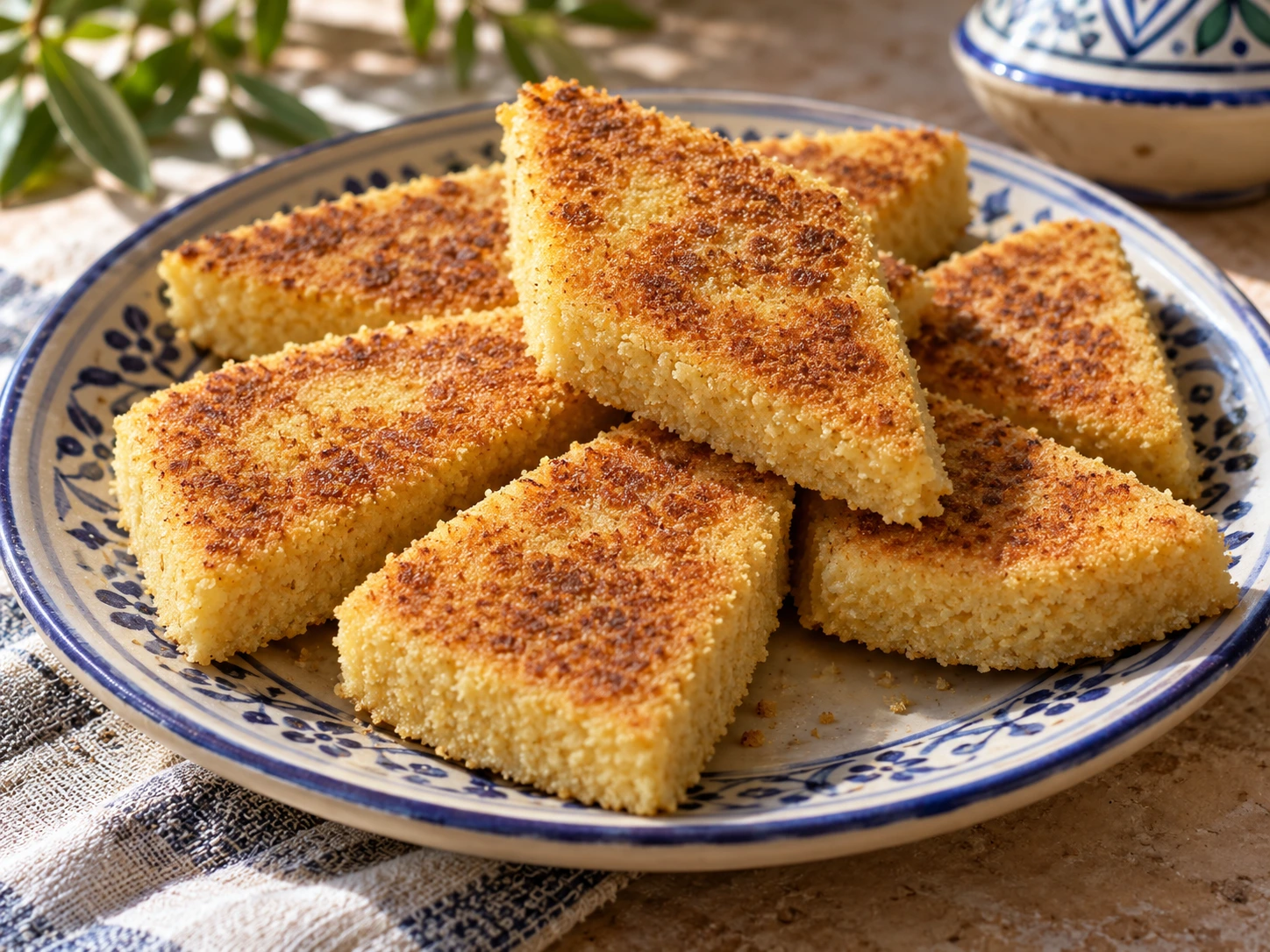
Mbesses is a jewel of traditional Algerian bakery and pastry, gracefully embodying the richness of North African culinary art. This semolina shortbread or cake has its roots in the millennia-old history of Berber civilization, a distant era when agrarian and pastoral life dictated the rhythm of culinary creation. In these territories marked by harsh climates and precious resources, durum wheat semolina established itself as the unshakeable pivot of daily sustenance, giving rise to an incredible variety of flatbreads and sweets. Mbesses was born from this domestic ingenuity, which aimed to transform simple and highly durable basic ingredients into food that was at once energetic, festive, and deeply comforting.
Where to find it
Look for the exact food-grade form required by the recipe at markets and specialist shops. Check the product name, ingredients, condition and storage instructions.
Explore further: Cooking tips · Food hygiene and safety advice.
History and uses
Linguistically, the word itself derives directly from the verb 'bessa' in Algerian dialectal Arabic, which means to sand, to impregnate with fat, or to sand the semolina. This term precisely describes the fundamental physical operation that gives this cake its unique and inimitable texture. Transmitted through the centuries by Algerian women who jealously guard its technique and know-how, mbesses goes far beyond being a simple sweet snack. It is a true vector of collective memory, a precious witness to family rituals, and an authentic expression of the generosity and legendary hospitality that characterize North Africa. Its presence on the table is a feast for the senses and a constant tribute to the work of the land.
🌾 THE ART OF SANDING AND INGREDIENT SELECTION
The magic of mbesses rests on an extremely simple list of ingredients, revealing how the purest simplicity can give birth to the greatest gastronomic delicacy. The traditional recipe requires only medium-ground durum wheat semolina, fat in the form of melted butter, smen (traditional clarified butter with a pronounced aroma), or vegetable oil, a pinch of salt to enhance the flavors, a touch of sugar or honey for coloring, and lukewarm water flavored with orange blossom water or rose water to bind it all.
The ultimate secret to successful mbesses lies in the technical gesture of 'sablage' (sanding), a manual skill that requires patience and precision. The cook places the semolina in a large enameled terracotta or wooden dish called a 'gassaâ'. She pours in the still-warm melted fat, then patiently and vigorously rubs the mixture between her open palms for several minutes. This circular and rhythmic movement allows each individual grain of semolina to be enveloped in a thin protective layer of fat. This coating prevents the grains from absorbing water too quickly and blocks the excessive development of gluten when liquids are added. It is this physical barrier that ensures the cake will achieve that ultra-crumbly, almost powdery consistency that literally melts in the mouth without ever becoming rubbery or elastic.
Once the semolina is perfectly 'sablée', the orange blossom-flavored water is delicately sprayed onto the mixture. The dough must under no circumstances be kneaded. It is simply gathered with the fingertips, with extreme gentleness, into a soft, cohesive, and moist mass, then left to rest so that the semolina harmoniously absorbs the liquids and soaks up the floral aromas.
🔥 THE TWO TRADITIONAL COOKING METHODS
Mbesses primarily comes in two distinct traditional cooking methods, each offering a different but equally exquisite sensory experience for the palate. The first method, the most rustic and everyday, is cooking on a griddle or a terracotta tagine. The shortbread dough is delicately spread on a work surface to a thickness of about one and a half centimeters, then cut with a knife into regular diamonds or squares. These diamonds are placed directly dry on the preheated tagine. Cooking is done over medium heat and requires constant monitoring and a very gentle touch. Under the effect of the heat, the semolina slowly browns on the surface, forming a thin crispy crust, while the fat inside keeps the flatbread extremely tender. Turning these diamonds requires infinite dexterity, as the hot, unleavened dough is extremely fragile and can crumble at the slightest shock.
The second method, particularly festive and gourmet, is that of fried and honeyed mbesses, often called 'mbesses el assal'. In this variation, the dough diamonds are plunged into a bath of hot oil where they instantly acquire a crispy texture and a deep golden-brown color. As soon as they come out of the fryer, still burning hot, they are immediately immersed in a bath of warm honey flavored with orange blossom. Through a physical aspiration phenomenon, the porous and sandy structure of the cake absorbs the honey to its core, creating a striking contrast between the crispiness of the caramelized outer shell and the syrupy, warm melt-in-your-mouth interior.
In my books

Continue exploring the continent’s cuisines with Africa at the Table — 54 countries, 54 iconic dishes, by Alioune FALL. This book is in English.
Explore further
🍽️ THE PLACE OF MBESSES IN TABLE ART AND CONVIVIALITY
On the Algerian and Maghrebi table, mbesses is inseparable from moments of conviviality, sharing, and relaxation with family or friends. Traditionally, mbesses cooked on a tagine are enjoyed warm as an afternoon snack or for breakfast. It is delicately broken by hand to be dipped in a mixture of melted farm butter and orange blossom honey, or it is accompanied by a large bowl of hot milk coffee. Another extremely popular, rustic, and refreshing way to consume it is to pair it with a large glass of lben (fresh fermented milk) or raib (curdled milk). The fresh acidity and velvety texture of the fermented milk spectacularly balance the rich fat and sweetness of the mbesses, offering a healthy, digestible, and particularly appreciated snack on hot summer days or after a long day of physical work.
The fried and honeyed version, on the other hand, is the undisputed star of spiritual evenings, religious festivals, and major family celebrations. It majestically adorns the Iftar tables during the holy month of Ramadan, providing an immediate and comforting source of energy to the body after long hours of fasting. It is also found to celebrate Mawlid (the birth of the Prophet), exam successes, weddings, or to honor a distinguished visitor. Presented with pride on a beautiful plate, sometimes decorated with toasted sesame seeds or crushed almonds, mbesses el assal is invariably accompanied by steaming mint tea, whose slight bitterness and vegetal freshness sublimate the sweet taste of the cake.
🌍 THE INFLUENCE AND CONNECTIONS IN AFRICAN CUISINE
Although mbesses belongs to the culinary heritage of North Africa, its manufacturing technique and its place in the diet resonate deeply with other gastronomic traditions across the African continent. It testifies to a shared culinary intelligence, consisting of valuing basic grains and cereals through highly effective preservation and cooking methods. Indeed, by combining a local cereal with a high proportion of fat and a sweetening agent like honey, African populations have for centuries created energetic, stable, and durable travel foods. These flatbreads were capable of being transported over long distances across trans-Saharan caravan routes or pastoral trails without suffering from the alteration of time and climate.
Technically, the method of 'sablage' (sanding) semolina or local flours (such as millet, sorghum, or corn) is found in many Sub-Saharan African preparations, where fried or dry-cooked flatbreads are made that share this same sandy, satisfying, and comforting texture. Mbesses illustrates how North Africa has pushed the refinement of durum wheat semolina to the extreme, turning a simple grain into a friable work of art. In the era of culinary globalization, mbesses is successfully exported beyond its original borders thanks to the African diaspora, establishing itself as an ambassador of the richness, diversity, and generosity of the continent's culinary know-how.
🔄 SYNONYMS AND REGIONAL VARIATIONS
Depending on the regions of Algeria and North Africa, mbesses is known by several names that highlight its sandy texture, geometric shape, or traditional cooking method:
Mtekba or M'tekba: A very common name in central Algeria, particularly in Algiers and its surroundings, referring to the fact that the flatbread is pricked with a fork before cooking to prevent it from swelling or cracking on the tagine. Bradj nature: In some regions of eastern Algeria, when the shortbread is prepared identically but without the characteristic date filling of bradj, it is simply called bradj nature. Khobz M'besses: A name that emphasizes the sandy nature of the bread, often used to refer to less sweet and denser versions intended to accompany savory dishes or soups. Mtobga or M'tobga: A term sometimes used in Saharan and southern regions to refer to this flatbread cooked on a hot griddle. Algerian semolina shortbread: A descriptive translation and name widely adopted by Francophone and international gastronomic literature to present this specialty to world cuisine enthusiasts.
Keywords:
Semolina Sablage Honey Tagine Algeria
In the kitchen : Mbesses
Recipes from the site to put your knowledge into practice:
Discover these cuisines at a restaurant
Explore our restaurant and caterer directories. Choose your destination and check the establishment’s menu to confirm which dishes are offered and available.
Continue exploring
Enjoy discovering ingredients and African cuisines? Join our newsletter. The illustrated PDF 10 sauces africaines incontournables is in French and is offered after confirming a subscription to the French or bilingual edition.