Bazeen
Libya
Understanding : Bazeen
🌾 ORIGINS AND HISTORY OF BAZEEN
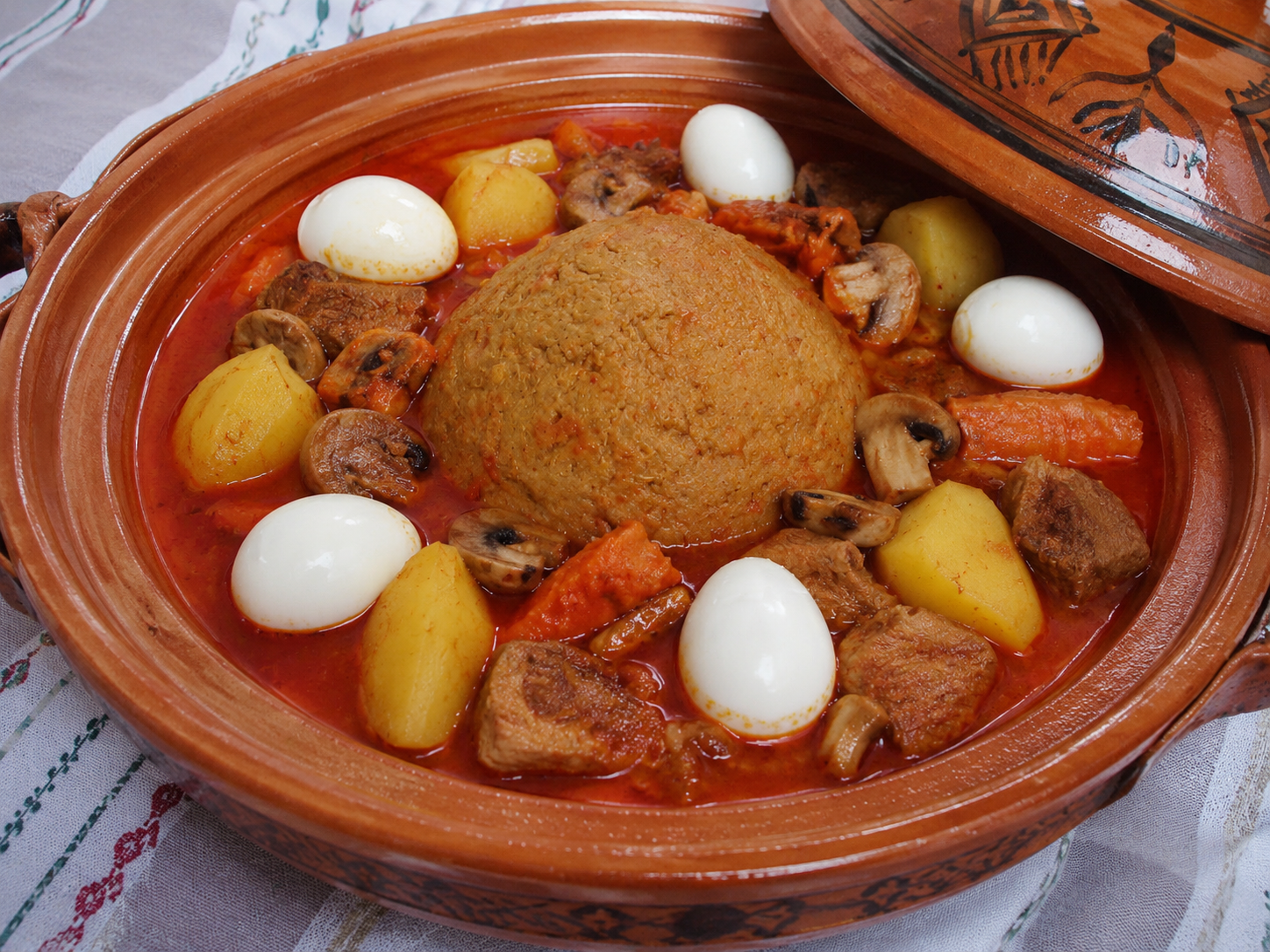
Bazeen is a masterpiece of North African gastronomy, deeply rooted in the culinary traditions of Libya and neighboring Saharan regions. This dish, both humble in its ingredients and complex in its technique, takes the form of a compact dome of cereal dough, surrounded by a rich, fragrant, and generous sauce. Historically, bazeen originates from the Amazigh people who have inhabited and cultivated the arid lands of North Africa for millennia. Barley, a robust cereal particularly suited to the dry climates and difficult soils of the region, forms the fundamental element of this preparation. In an environment where wheat was often a luxury reserved for special occasions, barley established itself as the staple cereal par excellence. Thus, bazeen was born from the necessity to transform a local and rustic resource into a highly nutritious meal, capable of sustaining agricultural workers and caravanners crossing the Sahara. Over the centuries, this subsistence dish transcended its status as a basic food to become a true symbol of identity, synonymous with celebration, reunion, and family devotion. Today, it embodies the quintessence of Libyan culinary heritage, while sharing deep links with the culinary rituals of other African and Saharan nations.
🥣 PREPARATION TECHNIQUE AND CULINARY RITUAL
The preparation of bazeen is not improvised; it requires remarkable physical strength and precise gestural know-how that is passed down from generation to generation, primarily from mother to daughter. The process begins by mixing pure barley flour, water, and a pinch of salt. This simple dough is shaped into balls which are then plunged into a large pot of boiling salted water. The cooking of these dough pieces is a crucial step: they must cook thoroughly to lose the bitterness of raw barley while maintaining their cohesion. Once cooked in water, the hot dough is removed and placed in a traditional wooden or clay vessel called a gasra. It is at this precise moment that the real work of strength begins: the kneading or beating of the dough using a robust wooden stick, specifically designed for this purpose, called a magraf. The cook must vigorously beat the hot dough for long minutes to eliminate lumps and give it a perfectly smooth, dense, and homogeneous elasticity and texture. This work requires so much energy that it is common to see several family members helping each other with this task. Once the ideal texture is obtained, the dough is shaped by hand to form a perfectly smooth and shiny dome, proudly positioned in the center of a large circular serving dish. This dome, similar to a miniature hill, will serve as a receptacle for the sauce and meat.
🍗 THE SAUCE AND ASSEMBLY: A BALANCE OF FLAVORS
Bazeen would not be complete without its accompanying sauce, a carefully simmered stew that contrasts superbly with the neutrality of the barley dough. The traditional sauce is based on tomatoes, caramelized onions, garlic, and a blend of warm spices emblematic of the Saharan region, including turmeric, red chili powder, black pepper, and sometimes the Libyan spice blend known as bzhar. The meat of choice for this dish is usually mutton, lamb, or, in more desert regions, camel meat. These meats, rich in fat and particularly flavorful, simmer slowly in the tomato sauce to give it an incomparable creaminess and depth of taste. Potatoes and sometimes pieces of pumpkin or squash are added to bring sweetness and body to the stew. When the sauce is ready, it is poured all around the barley dome, delicately coating its sides without submerging it. Tender pieces of meat are then arranged on the sides or on top of the dome. To top it all off, hard-boiled eggs, previously cooked and then fried or browned in the sauce, are harmoniously arranged around the structure. Some variations also include chickpeas or fried green chilies to add a touch of spice and extra texture. The visual ensemble is spectacular, evoking a fertile volcano whose lava would be this red and creamy sauce.
🌍 THE SYMBOLIC PLACE OF BAZEEN IN AFRICAN CUISINE
African cuisine is characterized by a great diversity of cereal preparations that share a common philosophy: the transformation of local flour into a dense and filling dough served with a stew or seasoned sauce. From this point of view, bazeen occupies a prominent place and is part of a vast family of dishes across the continent. One immediately thinks of fufu from Central and West Africa, prepared from cassava or yam, ugali from East Africa, made from corn, or tuwo from sub-Saharan Africa, made from millet or sorghum. Bazeen is the northern and Saharan representative of this same culinary approach, demonstrating that despite geographical and climatic barriers, African peoples have developed surprisingly similar nutritional and gastronomic solutions. However, the use of barley gives bazeen a unique taste signature, more rustic, slightly earthy, and very rich in fiber, which distinguishes it from preparations based on tubers or white corn. It is also a testament to the intense historical exchanges between Mediterranean North Africa and sub-Saharan Africa through caravan routes. As an emblematic dish of Libya, it embodies the perfect fusion between local Berber agricultural traditions, Arab-Islamic influences from the East, and the nomadic character of desert peoples.
🤝 CONVIVIALITY AND RITUALS OF SHARING
Bazeen is essentially a communal and family dish, never consumed alone. Its tedious preparation and presentation in a single large circular dish necessitate sharing. Traditionally, bazeen is the preferred dish for Friday lunch, a holy day in Islam, when families gather after the great prayer. It is also at the heart of major life celebrations, such as weddings, births, and religious holidays like Eid. Around the bazeen dish, hierarchies fade in favor of conviviality. Guests sit on the ground or on low floor mats, surrounding the dish. Traditionally, one eats with the right hand, respecting an informal but strict protocol: each person takes a piece of dough from the dome in front of them, rolls it slightly between their fingers to form a small ball, makes a slight depression with their thumb to capture some sauce, meat, and egg, then brings it all to their mouth. This gesture, repeated rhythmically by all guests, creates a harmony and social bond of rare intensity. Offering bazeen to a guest is a sign of deep respect and warm hospitality, as the host offers not only a hearty meal but also the considerable time and physical effort required to make it.
🔄 SYNONYMS AND VARIATIONS OF THE DISH
Like any historical and popular dish, bazeen has several names and variations depending on regions, dialects, and cultural contexts. In terms of pronunciation and written transcription, the following synonyms and related terms are frequently encountered:
Bazin, which is the most common spelling in French. Bazine, which is a graphic variant also used in French-language literature. Al-bazeen, corresponding to the formal Arabic form including the definite article. Bazina, referring to regional variations in North Africa sometimes made with other cereals like wheat or barley. Asida or asida, which shares the same beaten dough cooking technique, although it is more often served sweet for breakfast or birth celebrations. Each of these names reflects the linguistic richness and the spread of this culinary know-how across the desert and its fringes. 🔑 REFERENCE KEYWORDS
Here is a list of five essential keywords associated with this traditional dish and its culinary universe:
Barley (the essential base cereal) Libya (the cultural birthplace of the dish) Sharing (the essence of its consumption) Magraf (the traditional beating tool) Saharan (the environment and geographical identity)
Prepare this speciality
Choose a detailed recipe, adjust the portions and prepare your ingredients before starting. Our cooking tips and food safety advice complement the steps described in the recipes.
Explore further: Cooking tips · Food hygiene and safety advice.
In my books

Continue exploring the continent’s cuisines with Africa at the Table — 54 countries, 54 iconic dishes, by Alioune FALL. This book is in English.
In the kitchen : Bazeen
Recipes from the site to put your knowledge into practice:
Discover these cuisines at a restaurant
Explore our restaurant and caterer directories. Choose your destination and check the establishment’s menu to confirm which dishes are offered and available.
Continue exploring
Enjoy discovering ingredients and African cuisines? Join our newsletter. The illustrated PDF 10 sauces africaines incontournables is in French and is offered after confirming a subscription to the French or bilingual edition.