Funge de milho
Angola
Understanding : Funge de milho
🌽 ORIGINS AND HISTORY OF FUNGE DE MILHO
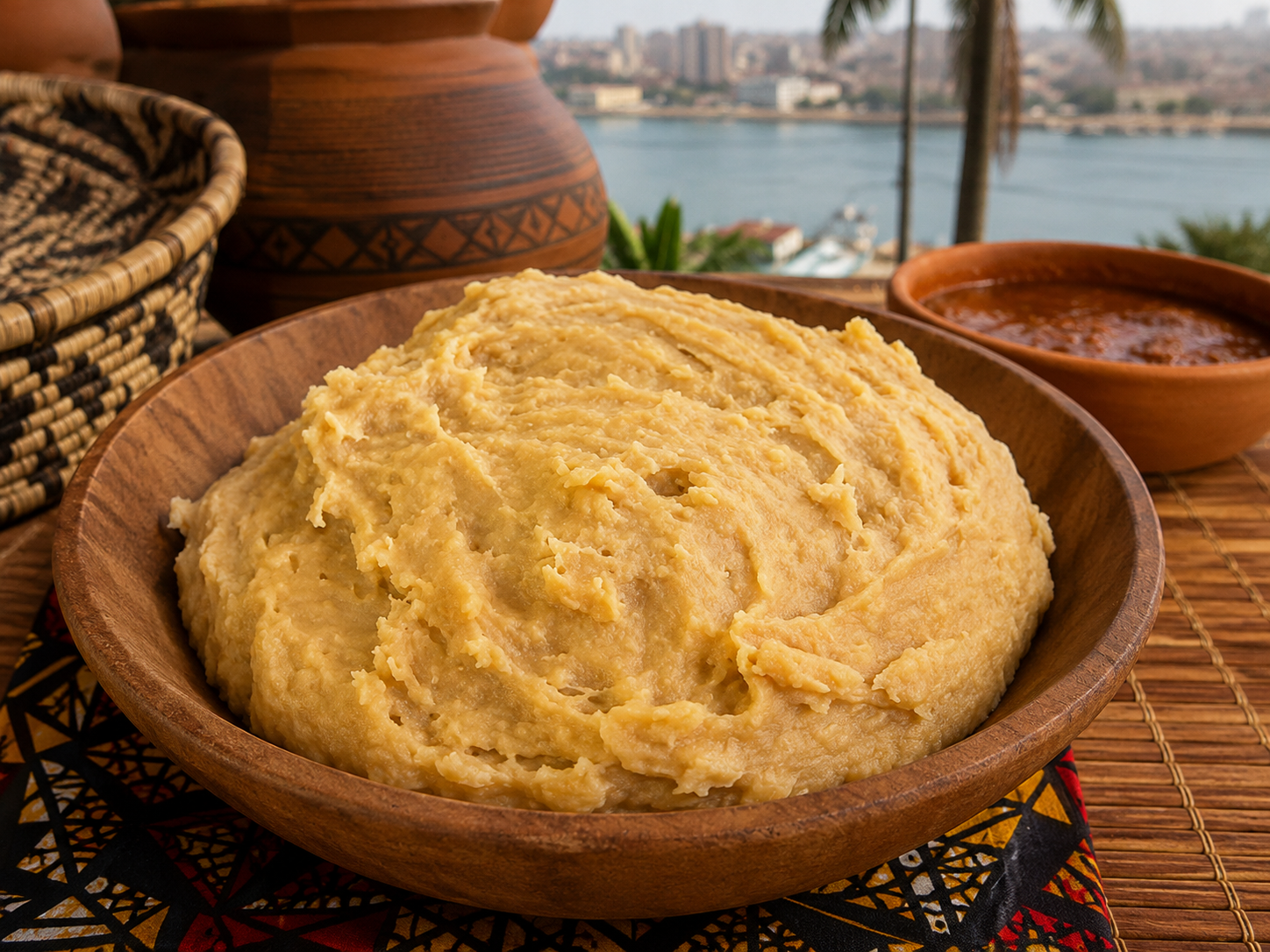
Funge de milho is one of the oldest and most sacred pillars of Angolan gastronomy. Unlike funge de bombo, made from cassava flour, funge de milho uses yellow or white corn flour as its main ingredient. The history of corn in Africa, and particularly in Angola, dates back to the transatlantic exchanges initiated from the sixteenth century by Portuguese navigators. Introduced from the Americas, this hardy cereal quickly established itself in the lands of Southern and Central Africa due to its ease of cultivation, excellent yield, and exceptional nutritional qualities. For local populations, corn became a providential alternative to indigenous cereals like millet or sorghum. Over generations, Angolan cooks perfected the art of grinding corn kernels into a fine and regular flour, thus becoming the raw material for a dense and consistent porridge, cooked in boiling water and vigorously worked. This simple and comforting dish has nourished millions of individuals throughout the centuries, enduring periods of colonization, conflict, and reconstruction to remain today the undisputed symbol of the resilience, national pride, and cultural continuity of the Angolan people.
🥣 RECIPE AND TRADITIONAL PREPARATION TECHNIQUE
The preparation of funge de milho is a true physical and technical art that requires experience, strength, and great precision in movement. The only ingredients required are high-quality corn flour, pure water, and sometimes a pinch of salt, although the traditional version is often prepared without salt to allow the cereal's aromas to fully express themselves and better complement the accompanying sauce. The process begins by bringing a generous amount of water to a boil in a large, sturdy pot, ideally placed over a wood fire to impart a subtle smoky flavor. A portion of the flour is first diluted in cold water to form a liquid and homogeneous mixture. This mixture is poured into the boiling water, stirring constantly to lay the foundation for a smooth and creamy texture. Then, the rest of the corn flour is gradually incorporated in a fine stream. It is at this precise moment that the most demanding stage of preparation begins: the beating of the dough. Using a large, heavy, flattened wooden stick, locally called mufunzo or colher de funge, the cook must crush, stretch, and turn the dough against the inner walls of the pot. This rhythmic and powerful movement eliminates any nascent lumps, evaporates excess water, and results in an extremely dense, elastic, supple, and shiny dough. Cooking continues over low heat for many minutes so that the corn flour is perfectly cooked through, ensuring optimal digestibility. The cooked dough is then shaped into warm, smooth balls, ready to be served immediately.
🥘 THE SYNERGY OF SAUCES AND SIDE DISHES
Funge de milho has a delicate and slightly sweet flavor, characteristic of corn, which calls for powerful, thick, and aromatic sauces to create a perfect culinary balance. Unlike other starches, its dense texture allows it to beautifully capture and absorb cooking juices and simmered sauces. In Angola, the quintessential accompaniment to funge de milho is moamba de galinha, a traditional chicken stew simmered in a creamy sauce made from crude palm oil, garlic, tomatoes, onions, and okra. Okra plays a fundamental role because its gelatinous texture facilitates the smooth passage of funge during chewing and swallowing. Another legendary pairing is calulu, an ancestral preparation of dried or fresh fish simmered for a long time with an abundance of sweet potato leaves, spinach, tomatoes, onions, and palm oil. For meat lovers, funge pairs divinely with rich beef or goat sauces, flavored with local herbs and spiced with a very hot red chili called jindungo. Bean or leafy vegetable sauces also complete this picture, making funge de milho the center of gravity of extremely generous and nourishing meals where each sauce brings its share of spices, noble fat, and distinctive flavors.
🌍 FUNGE DE MILHO AND ITS PLACE IN AFRICAN CUISINE
To understand the place of funge de milho in African cuisine, it must be situated within the vast geography of cereal pastes that structure the daily diet of millions of Africans from east to west and north to south. Funge de milho belongs to this immense family of national dishes that bear different names but share a common philosophy of sustenance and sharing. In West Africa, particularly in Benin, Togo, and Nigeria, it is similar to corn paste commonly known as akassa or tewou. In Central Africa, in both Congos, it shares its identity with corn fufu or luku. Further east and south, it finds extremely close cousins with ugali from Kenya and East Africa, nshima from Zambia and Malawi, sadza from Zimbabwe, pap from South Africa, or oshifima from Namibia. What distinguishes Angolan funge de milho in this vast panorama is its intimate alliance with Creole and Luso-African cuisine, characterized by the use of palm oil, dried fish, and slow simmering techniques inherited from historical maritime exchanges. It embodies a unique meeting point between the rigor of Saharan and sub-Saharan land-based cuisine and the maritime richness of the South Atlantic, positioning itself as a monument of Central and Southern African gastronomy.
🤝 SOCIOCULTURAL DIMENSION AND SHARING RITUALS
Funge de milho extends far beyond a simple daily caloric intake to rise to the rank of a true cultural, social, and spiritual symbol. In Angola, preparing funge de milho is an act of love and respect. It is a dish that brings generations together around the table, or more traditionally around a mat laid on the floor. Eating funge is a codified ritual that requires the exclusive use of the right hand. Guests take a small portion of warm dough, delicately shape it with their fingers to create a slight hollow, then dip it into the common sauce to capture its juices and pieces of meat or fish before swallowing it, often without chewing, according to the local tradition that values the softness of the dough sliding down the throat. This sharing of a single dish strengthens family ties, pacifies tensions, and celebrates the unity of the clan. Moreover, funge de milho is inseparable from major social events, from wedding celebrations to funeral commemorations, as well as family gatherings on Sundays. Serving a perfectly successful, smooth, and lump-free funge de milho is a source of great pride for the hostess, demonstrating her technical mastery and physical strength, qualities highly esteemed in traditional societies.
🔄 SYNONYMS AND LINGUISTIC VARIATIONS
Depending on the regions of Africa, migration waves, and local dialects, funge de milho is known by different names and spellings. In French, it is frequently written as funge de maïs or fange de maïs. In Portuguese, the official language of Angola, the correct spelling is funge de milho, but sometimes only the term funge is encountered, which by default in some southern or central regions specifically refers to the corn version. In Angola's national languages, particularly Kimbundu and Umbundu, the terms vundi or infundi are used to designate this corn preparation. In neighboring French-speaking countries like the Democratic Republic of Congo or Congo-Brazzaville, the dish is referred to as fufu de maïs, foufou de maïs, or bidia in the Kasai region. All these linguistic variations attest to the universality of this recipe and its unshakeable anchoring in the collective memory of the Bantu peoples of this large African region.
🔑 REFERENCE KEYWORDS
Angola (the historical and cultural cradle of the dish) Corn (the essential staple cereal of this version) Moamba (the traditional chicken sauce with palm oil that accompanies it wonderfully) Mufunzo (the large wooden stick used to work the dough) Fufu (the most famous synonym and equivalent in the central region of Africa)
Prepare this speciality
Choose a detailed recipe, adjust the portions and prepare your ingredients before starting. Our cooking tips and food safety advice complement the steps described in the recipes.
Explore further: Cooking tips · Food hygiene and safety advice.
In my books

Continue exploring the continent’s cuisines with Africa at the Table — 54 countries, 54 iconic dishes, by Alioune FALL. This book is in English.
In the kitchen : Funge de milho
Recipes from the site to put your knowledge into practice:
Discover these cuisines at a restaurant
Explore our restaurant and caterer directories. Choose your destination and check the establishment’s menu to confirm which dishes are offered and available.
Continue exploring
Enjoy discovering ingredients and African cuisines? Join our newsletter. The illustrated PDF 10 sauces africaines incontournables is in French and is offered after confirming a subscription to the French or bilingual edition.