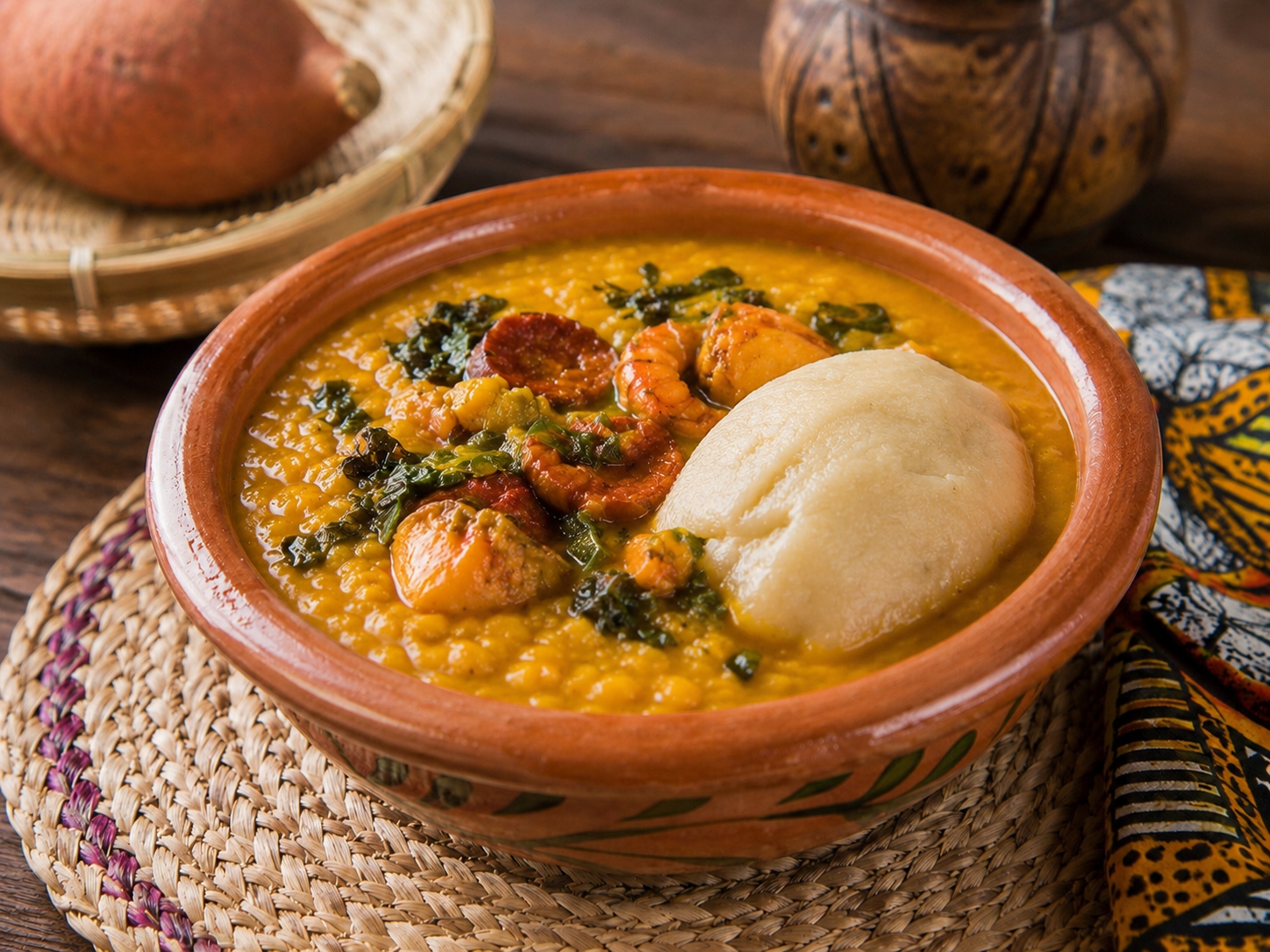
Funge de bombó
Angola
Understanding : Funge de bombó
🌾 ORIGIN AND HISTORY OF FUNGE DE BOMBÓ 🌿
Funge de bombó is a masterpiece of Central and Southern African cuisine, deeply rooted in the history, culture, and daily life of the Angolan people. To understand the genesis of this emblematic dish, one must go back to the maritime trade routes of the sixteenth century, when Portuguese navigators and traders introduced cassava to Africa from South America. This robust plant, exceptionally resistant to diseases and climatic hazards, found an ideal adoptive land in Central Africa. Cassava quickly became a vital subsistence crop for local populations, in some places supplanting indigenous cereals such as millet or sorghum. In Angola, the term bombó or bombo specifically refers to cassava that has undergone a traditional fermentation process by soaking in running river water or in large containers for several days, a method also known as retting. After this soaking, which removes the plant's natural toxins and softens the roots, the cassava is sun-dried and then ground to obtain a very fine flour, slightly acidic and characteristically white. It is this fermented cassava flour, farinha de bombo, that serves as the unique base for making funge de bombó. This dish has spanned eras, from the pre-colonial period to the upheavals of modern history, becoming a true symbol of the resilience, survival, and national identity of the Angolan people.
🥣 TRADITIONAL PREPARATION AND MANUAL SKILL 🏺
The cooking of funge de bombó is a spectacular ritual that requires physical vigor, great dexterity, and constant attention. Unlike a simple porridge, funge must acquire an elastic, smooth, almost translucent consistency, completely free of lumps. To achieve this, the process begins by boiling a large quantity of water in a thick-bottomed pot, traditionally placed over a wood fire in rural areas to infuse a subtle smoky flavor. A small portion of cassava flour is first mixed with cold water to form a homogeneous liquid, which is then poured into the boiling water to create a binding base. The rest of the flour is then gradually incorporated in a fine stream. From this moment on, the preparer uses an indispensable utensil called a mufunzo or colher de funge, a long, heavy wooden stick flattened at its end. The technical gesture consists of vigorously crushing the hot dough against the sides of the pot in a continuous circular motion. This strenuous work, which lasts for many minutes, activates the cassava starch to give the dough its legendary elasticity. The color of the dough then changes from an opaque white to a light, slightly gelatinous and shiny gray, a sign of perfect cooking. Once the ideal consistency is reached, the hot funge is removed and shaped with a moistened ladle to form smooth, plump balls, ready to be served piping hot.
🐟 IDEAL ACCOMPANIMENTS AND GOURMET PAIRINGS 🍲
Funge de bombó has a subtle, very slightly acidic taste due to the fermentation of cassava, which makes it an extraordinary neutral base for highlighting the richest and spiciest sauces of African gastronomy. In Angola, the most prestigious and popular accompaniment is undoubtedly calulu de peixe, an ancestral stew combining fresh and dried fish, simmered with a profusion of sweet potato leaves called quizaca, okra, tomatoes, onions, and crude palm oil. Moamba de galinha, a chicken dish slowly cooked in a creamy sauce made from palm fruit pulp and okra, is another heavenly pairing. The naturally slippery and gelatinous texture of okra plays a major functional role, as it allows small bites of funge to be swallowed effortlessly and without excessive chewing, in accordance with traditional customs. Funge also pairs wonderfully with kisaca, a preparation of pounded cassava leaves cooked in a peanut or palm oil sauce. To enhance the whole, a touch of jindungo is added, a local, extremely spicy red chili macerated in oil or lemon juice. These flavorful combinations transform the simple starch into a feast of incredible aromatic complexity.
🌍 A PROMINENT PLACE IN AFRICAN GASTRONOMY AND CULTURE 🇨🇩
Beyond Angola's borders, funge de bombó is part of the great African tradition of dough balls that form the nutritional basis of most of the sub-Saharan continent. It shares its technical and philosophical DNA with culinary monuments from other countries. These include fufu from West and Central Africa, ugali from East Africa, nshima from Zambia, sadza from Zimbabwe, and placali from Côte d'Ivoire. However, funge de bombó stands out for its unique aromatic profile brought by the prior fermentation of cassava, giving it superior digestibility and a highly sought-after acidic note by connoisseurs. On a social level, funge de bombó embodies values of solidarity, hospitality, and family communion. It is traditionally served in a large single dish placed in the center of the table or floor mat. Guests gather around this dish and take pieces of hot dough with their right hand, forming a small natural spoon with their fingers to scoop up the sauce and pieces of meat or fish. Sharing funge is an act that seals friendship, strengthens family alliances, and honors visiting guests, making each meal a moment of collective celebration and transmission of values of mutual respect.
🔄 SYNONYMS AND REGIONAL VARIATIONS OF THE DISH 🗺️
Due to the vast geographical dispersion of cassava cultivation and historical migratory flows in Africa, funge de bombó is known by a multitude of names and linguistic variants. In the different provinces of Angola and according to national languages such as Kimbundu, Umbundu, or Kikongo, it is commonly called vundi, infundi, or luku. In Portuguese, it is often referred to as funge de mandioca or simply funge de bombo. Among direct neighbors, particularly in the Democratic Republic of Congo and the Republic of Congo, this same preparation based on fermented cassava flour is called fufu, foufou, luku, or bidia. In Côte d'Ivoire and other West African countries, a very similar equivalent called placali is found, which shares the same elastic texture and slightly fermented taste. All these appellations demonstrate that funge de bombó is a link in an uninterrupted cultural chain that unites the peoples of Africa around shared know-how and a common passion for the authentic flavors of the land.
🔑 REFERENCE KEYWORDS 🏷️
Cassava (the plant from which bombó flour is made) Angola (the cradle and spiritual homeland of this dish) Calulu (the traditional fish stew that most often accompanies it) Mufunzo (the essential wooden stick for kneading the cassava dough) Fufu (the most universal linguistic and culinary equivalent in Africa)
Prepare this speciality
Choose a detailed recipe, adjust the portions and prepare your ingredients before starting. Our cooking tips and food safety advice complement the steps described in the recipes.
Explore further: Cooking tips · Food hygiene and safety advice.
In my books

Continue exploring the continent’s cuisines with Africa at the Table — 54 countries, 54 iconic dishes, by Alioune FALL. This book is in English.
In the kitchen : Funge de bombó
Recipes from the site to put your knowledge into practice:
Discover these cuisines at a restaurant
Explore our restaurant and caterer directories. Choose your destination and check the establishment’s menu to confirm which dishes are offered and available.
Continue exploring
Enjoy discovering ingredients and African cuisines? Join our newsletter. The illustrated PDF 10 sauces africaines incontournables is in French and is offered after confirming a subscription to the French or bilingual edition.