Kwanga
DR Congo, Central Africa
Understanding : Kwanga
🌿 ORIGIN AND HISTORY OF KWANGA 🌿
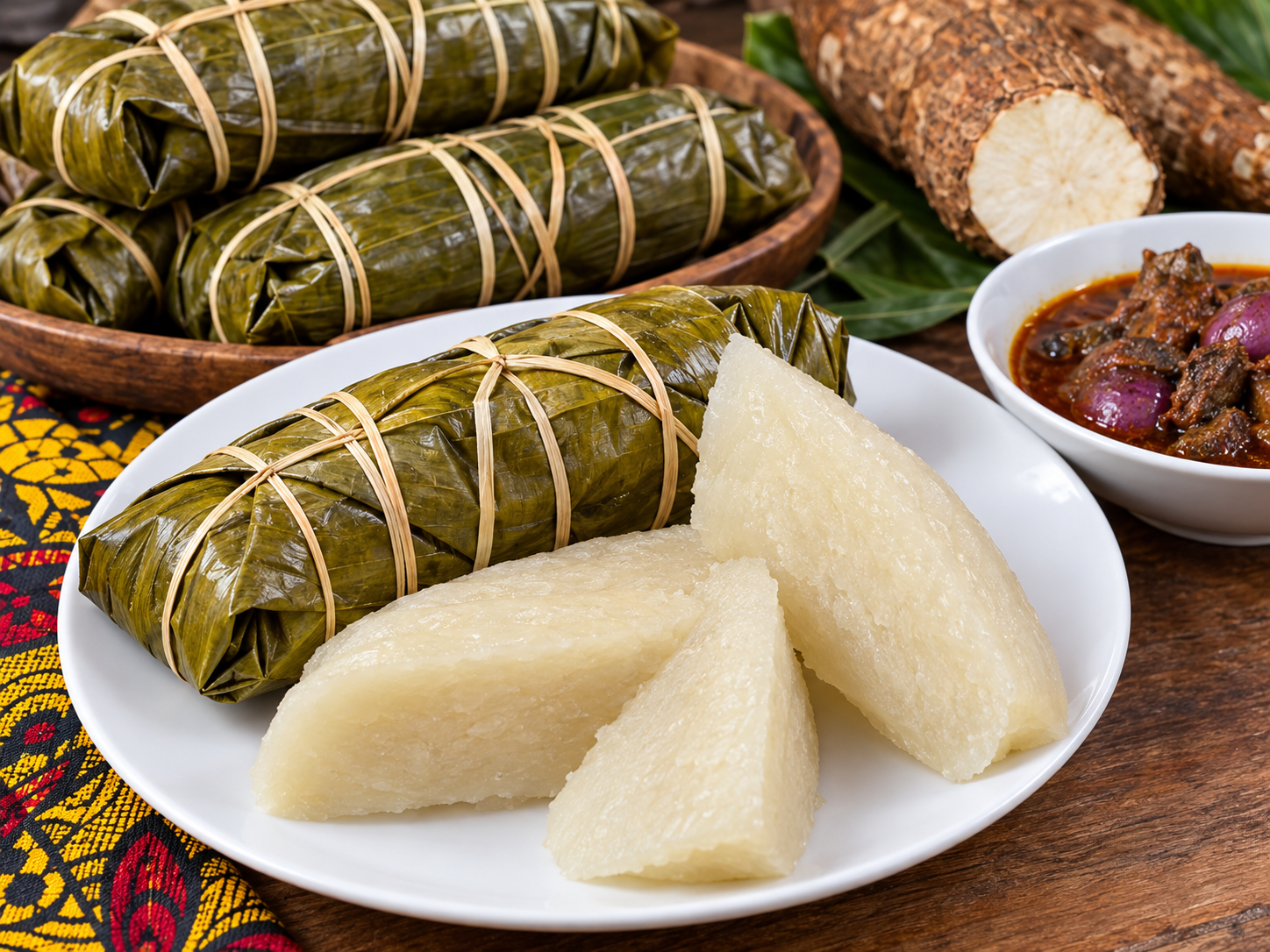
Kwanga, more commonly known by the generic name chicwangue, is a monument of Central African gastronomy. This fermented cassava bread, steamed in vegetable leaves, is a staple food for tens of millions of people, particularly in the Congo Basin, encompassing the Democratic Republic of Congo, the Republic of Congo, Gabon, the Central African Republic, and Cameroon. The history of kwanga is intimately linked to that of cassava, a tuber native to South America introduced to African coasts by Portuguese traders in the sixteenth century. Thanks to its ability to adapt to poor soils and its drought resistance, cassava quickly spread inland in Africa. However, the presence of toxic cyanogenic compounds in raw cassava required the development of complex detoxification techniques. This is how the populations of the Congo Basin perfected the retting and fermentation process to transform this tuber into a healthy, digestible, and extremely nutritious food. Kwanga was born from this quest for preservation: in a region characterized by a hot and humid climate where food spoils quickly, the creation of a dense cassava bread, protected by an airtight leaf wrapper, offered a transportable and durable food source. For travelers, fishermen, hunters, and caravanners, kwanga became the ideal travel companion, capable of being preserved for several weeks without refrigeration.
🥣 THE ANCESTRAL MANUFACTURING TECHNIQUE 🧑🍳
The production of kwanga is a long, laborious, and entirely artisanal process, based on knowledge passed down from generation to generation by women in rural communities. It all begins with the harvesting of bitter cassava tubers, which must be carefully peeled. The tubers are then immersed in streams, ponds, or large water containers for a period of three to five days. This crucial step, called retting, not only softens the roots but, more importantly, eliminates toxic hydrocyanic acid through natural fermentation. Once retting is complete, the cassava is removed from the water, drained, and vigorously trampled or pressed to extract excess water and fibers. The resulting paste is then pounded in a large wooden mortar or ground on a millstone until a fine and regular texture is obtained. This raw paste is sieved to remove any remaining fibrous filaments. Next comes the pre-kneading and dry pre-cooking stage in a pot, where the paste is heated while being vigorously kneaded with a wooden spatula to give it its characteristic elasticity. The paste is then shaped into rolls or cylindrical loaves. Packaging is an essential artistic step: the cassava loaves are hermetically wrapped in several layers of marantaceae leaves, often called ngungu leaves, or sometimes in banana leaves previously softened over fire. This vegetable packaging is secured with lianas or raffia thread. The packages are finally placed in a large pot for a long final steaming, which can last several hours. It is this final cooking that gives kwanga its translucent, firm, elastic texture and its color ranging from creamy white to pale yellow.
🥘 ACCOMPANIMENTS AND TASTING RITUALS 🍲
Kwanga is distinguished by its slightly acidic taste, resulting from the fermentation process, and by its dense and compact texture. It is never consumed alone but serves as a neutral and filling base to balance flavorful and often very spicy main dishes. To enjoy it, it is traditionally cut into regular slices using a simple clean sewing thread or a sharp knife. In Central African homes, kwanga accompanies a multitude of local specialties. It is the ideal partner for pondu, a national stew made from pounded cassava leaves, palm oil, onions, and fish. It also pairs wonderfully with liboke, a banana leaf papillote dish containing fish or meat seasoned with chili, tomato, and onion. Grilled meat lovers appreciate kwanga with kamundele, spicy beef skewers, or with the famous wood-fired grilled chicken. Creamy sauces like soso ya lamba, chicken simmered in a peanut sauce, or smoked fish stew find in kwanga a perfect vehicle to absorb the fragrant juices. When tasted, kwanga provides a lasting feeling of satiety, making it the meal of choice for manual laborers and for large family gatherings where conviviality is key.
🌍 THE SOCIAL AND ECONOMIC PLACE OF KWANGA 🇨🇬
Beyond its purely nutritional function, kwanga plays a major economic and cultural role in Central Africa. In rural areas, kwanga production is the main source of income for thousands of women's cooperatives. These courageous producers transform cassava grown in their fields to sell it in urban markets, thus supplying large metropolises like Kinshasa, Brazzaville, Libreville, or Bangui. This informal but structured trade ensures the financial autonomy of many families and finances children's schooling. Kwanga is also a very strong marker of cultural identity. For the African diaspora settled in Europe, America, or elsewhere, consuming kwanga during celebrations or family Sundays is a way to reconnect with roots, celebrate ancestral heritage, and rediscover the comforting flavors of the homeland. In popular songs, literature, and Central African art, kwanga is often celebrated as the symbol of food that never fails, that sustains the people in difficult times as well as in periods of abundance.
🔄 SYNONYMS AND REGIONAL VARIATIONS 🗺️
Due to its popularity and wide geographical distribution, kwanga is known by several names and presents subtle variations in shape or texture depending on the region:
Chicwangue, which is the most widespread Frenchified term used in urban and international circles. Kwanga, the Lingala name, very popular in both Congos. Agene, a term sometimes used by certain local communities to designate specific variants of cassava bread. Mangbele, which refers to a smaller and often firmer variety of chicwangue, highly appreciated in the north of the Democratic Republic of Congo. Bobolo, the Cameroonian equivalent, which comes in the form of a long, thin roll wrapped in marantaceae leaves, while miondo is an even thinner and elongated version. All these names celebrate the same culinary genius consisting of enhancing cassava through the combination of fermentation and cooking in vegetable leaves. 🔑 REFERENCE KEYWORDS 🏷️
Cassava (the nourishing root at the base of the paste) Retting (the essential fermentation process in water) Steam (the slow cooking method in a vegetable wrapper) Chicwangue (the universal synonym for this traditional bread) Ngungu (the protective vegetable leaves used for packaging)
Where to find it
Look for the exact food-grade form required by the recipe at markets and specialist shops. Check the product name, ingredients, condition and storage instructions.
Explore further: Cooking tips · Food hygiene and safety advice.
In my books

Continue exploring the continent’s cuisines with Africa at the Table — 54 countries, 54 iconic dishes, by Alioune FALL. This book is in English.
In the kitchen : Kwanga
Recipes from the site to put your knowledge into practice:
Discover these cuisines at a restaurant
Explore our restaurant and caterer directories. Choose your destination and check the establishment’s menu to confirm which dishes are offered and available.
Continue exploring
Enjoy discovering ingredients and African cuisines? Join our newsletter. The illustrated PDF 10 sauces africaines incontournables is in French and is offered after confirming a subscription to the French or bilingual edition.