Bobolo
Cameroon, Central Africa
Understanding : Bobolo
🇨🇲 ORIGIN AND HISTORY OF BOBOLO IN THE FORESTS OF CAMEROON 🌿
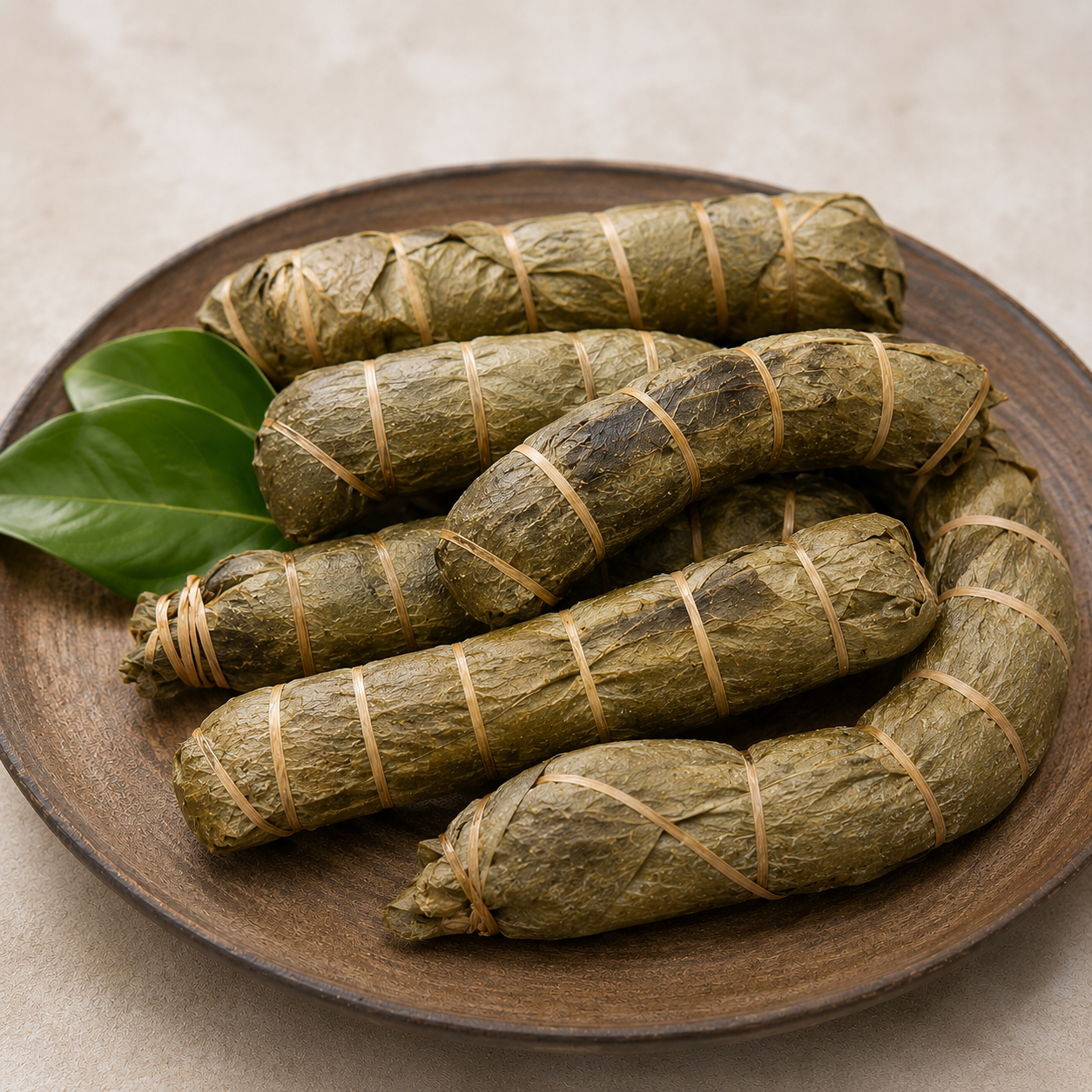
Bobolo is a jewel of Central African gastronomy, deeply rooted in the culinary traditions of Cameroon. This dish, both rustic due to its unique ingredient and sophisticated due to its manufacturing method, originates from the populations of the forest zone in the Center and South of the country, particularly among the Beti, Eton, and Ewondo peoples. To understand the history of bobolo, one must go back to the introduction of cassava to the African continent by Portuguese traders during the sixteenth century, from South America. Cassava found an ideal environment to thrive in the warm, humid soils of the Cameroonian equatorial forests, quickly becoming a leading food crop. However, bitter cassava, the most cultivated variety for its resistance, contains highly toxic cyanogenic glycosides in its raw state. Local populations therefore had to demonstrate remarkable ingenuity by developing complex detoxification and preservation processes. It was from this necessity that bobolo was born. In hot regions where food preservation was a daily challenge, transforming cassava into a fermented paste, hermetically wrapped and steamed, allowed for a transportable and durable cassava bread that could be stored for several weeks. Initially designed as a travel food for hunters and farmers, bobolo gradually established itself as a central element of Cameroon's cultural and festive identity, crossing all regional and social boundaries.
🥣 TECHNICAL KNOW-HOW AND ANCESTRAL PREPARATION 👩🍳
The making of bobolo is an art of patience and physical rigor, requiring ancestral know-how jealously passed down from generation to generation, mainly by women. It all begins with the selection and harvesting of mature bitter cassava tubers. After being carefully peeled to remove the thick skin, the tubers are immersed in fresh water, often in large barrels or directly in slow-flowing forest streams. This essential step is called retting or cassava retting. For three to five days, natural lactic fermentation occurs underwater, softening the tuber's fiber while eliminating toxic hydrocyanic acid. Once this fermentation is complete, the softened tubers are removed, drained, and reduced to a very fine paste by crushing or grinding them. This moist paste is then pressed in cloth bags to extract as much water as possible, then it is meticulously sieved to remove all woody fibers and residual impurities. The purified paste, soft and malleable, is then spread on a wooden table where it is shaped by hand into long cylinders or thin, regular sticks, generally measuring between thirty and fifty centimeters long. The wrapping of bobolo is a crucial technical phase: the paste sticks are tightly wrapped in several layers of green leaves from a local forest plant of the Marantaceae family, scientifically known as Megaphrynium macrostachyum. These leaves, which give bobolo its inimitable vegetal aroma during cooking, are securely tied along their entire length with natural lianas or robust threads. Finally, the packages are stacked in a large pot for a long steaming process of about an hour, during which the cassava starch gelatinizes to give bobolo its firm, elastic, translucent texture and its characteristic cream color.
🐟 CULINARY PAIRINGS AND THE RITUAL OF TASTING 🌶️
Bobolo is distinguished by a delicately tangy flavor, the result of its controlled fermentation, and by a dense, springy texture when bitten. To enjoy it, the protective leaves are gently removed as it is consumed, much like peeling a banana. In Cameroon, the perfect and essential pairing for bobolo is grilled fish. Whether it's sea bass, tilapia, or mackerel, the fish is generously marinated in a mixture of local spices including Penja white pepper, djansang, pebe, and garlic, then grilled over a wood fire. The striking contrast between the hot, crispy, and spicy flesh of the grilled fish and the fresh, acidic, and dense texture of the bobolo creates a memorable harmony of flavors on the palate. This dish is almost always accompanied by a formidable fresh crushed red chili. But bobolo is not limited to grilled fish. It wonderfully accompanies other national specialties such as ndole, a dish of bitter leaves simmered with peanuts and shrimp, or mbongo tchobi, a black and intensely fragrant fish or meat stew. It is also highly appreciated with grilled beef skewers, commonly known as soya. Bobolo is a very filling food that releases its energy slowly, making it the ideal companion for convivial meals and large celebrations where people gather to share a warm feast.
🌍 BOBOLO'S MAJOR PLACE IN AFRICAN CUISINE 🇨🇬
In the culinary landscape of Sub-Saharan Africa, bobolo belongs to the vast and prestigious family of cassava breads and pastes that form the basis of the diet for millions of people. From West Africa to Central Africa, fermented cassava is available in multiple forms, demonstrating remarkable technological inventiveness. Bobolo shares a close kinship with chikwangue from the Democratic Republic of Congo, the Republic of Congo, and the Central African Republic, as well as with placali from Côte d'Ivoire. However, while chikwangue often comes in the form of large heavy blocks or massive oval packages, bobolo stands out for its geometric elegance and finesse. Its elongated stick shape allows for more homogeneous cooking and offers an ideal ratio between the paste and the aromatic leaf wrapping. Moreover, its texture is generally firmer and more elastic than that of its Congolese cousins, offering a different sensory experience. It shows how the same agricultural resource, cassava, has been uniquely shaped by different cultures to meet specific regional aesthetic and taste preferences. Thus, bobolo represents one of the pinnacles of cassava processing sophistication in Africa, demonstrating the ability of local cultures to sublimate an imported plant to make it a monument of their own culinary heritage.
💼 SOCIO-ECONOMIC IMPACT AND THE ROLE OF WOMEN IN THE CHAIN 📈
Beyond its taste and nutritional qualities, bobolo is a pillar of the informal economy and a powerful vector of empowerment for women in Cameroon. The bobolo value chain, from cassava harvesting to its final sale in urban markets, is almost entirely dominated by women. In rural areas, bobolo production is often organized within women's cooperatives who help each other to carry out the arduous steps of retting and sieving the paste. For these women, selling bobolos to wholesalers and retailers represents a regular and essential source of income, allowing them to provide for their households, ensure their children's education, and achieve true financial autonomy. In large cities like Douala or Yaoundé, vendors of grilled or steamed bobolo enliven the nightlife of popular neighborhoods, setting up their tables next to grilled fish stalls to feed workers and night owls until dawn. Nowadays, bobolo has also crossed oceans. Thanks to the dynamism of the Cameroonian and African diaspora, it is exported vacuum-packed or frozen to Europe, North America, and Asia, where it is sold in exotic grocery stores. This globalization of bobolo makes it not only a source of pride for its country of origin but also a true cultural and economic ambassador that promotes African agricultural know-how worldwide.
🔄 SYNONYMS AND LINGUISTIC VARIATIONS OF THE PRODUCT 🗺️
Bobolo, due to its history and spread across different regions and linguistic communities, is associated with several synonyms, variations, or close relatives:
Cassava stick, the universally used French term to describe its characteristic cylindrical shape. Cassava bobolo, the descriptive formula that specifies the nature of the starch used. Miondo, which refers to an extremely similar coastal variant developed by the Sawa people, but which is distinguished by a much finer diameter, a softer texture, and the use of different wrapping leaves. Chikwangue, or chicouangue, the generic Central African term for cassava bread cooked in leaves, often used by extension. Kwanga, the Lingala term for fermented cassava breads throughout the Congo Basin. These different terms highlight the linguistic richness of this region of Africa and the universal importance of this cassava preservation technique.
🔑 REFERENCE KEYWORDS FOR BOBOLO 🏷️
Cassava (the essential plant raw material for its production) Cameroon (the native and cultural land of this stick specialty) Retting (the fundamental fermentation step in water to soften the paste) Stick (the elongated, thin, and characteristic shape of the cooked product) Grilled (the preferred cooking method for the accompanying fish of this dish)
Where to find it
Look for the exact food-grade form required by the recipe at markets and specialist shops. Check the product name, ingredients, condition and storage instructions.
Explore further: Cooking tips · Food hygiene and safety advice.
In my books

Continue exploring the continent’s cuisines with Africa at the Table — 54 countries, 54 iconic dishes, by Alioune FALL. This book is in English.
In the kitchen : Bobolo
Recipes from the site to put your knowledge into practice:
Discover these cuisines at a restaurant
Explore our restaurant and caterer directories. Choose your destination and check the establishment’s menu to confirm which dishes are offered and available.
Continue exploring
Enjoy discovering ingredients and African cuisines? Join our newsletter. The illustrated PDF 10 sauces africaines incontournables is in French and is offered after confirming a subscription to the French or bilingual edition.