Miondo
Cameroon, Central Africa
Understanding : Miondo
🌊 ORIGINS AND HISTORY OF MIONDO ON THE CAMEROONIAN COAST 🌊
Miondo is a jewel of Central African gastronomy, particularly associated with the Sawa people, the water community inhabiting the coastal regions of Cameroon. This product, remarkably refined in both its physical form and its taste qualities, is intimately linked to the culture of the sea and the Wouri River estuary. The history of miondo begins with the spread of cassava on the coasts of the Gulf of Guinea from the sixteenth century. Imported from South America by Portuguese traders, this tuber found an ideal environment to thrive in the sandy and humid soils of the Cameroonian coast. The Sawa populations, composed of exceptional fishermen and navigators, quickly adopted cassava for its resilience and high energy value. To adapt to the constraints of life at sea, where fishing trips could last several days, it was crucial to develop a subsistence food that was not only nourishing but, above all, had an exceptional ability to preserve at room temperature. It was from this requirement for survival and mobility that miondo was born. By applying retting and natural lactic fermentation methods to cassava, then wrapping the dough extremely tightly in protective plant leaves, the ancestors of the Sawa created a portable cassava bread, resistant to mold and marine humidity. While the populations of the forest hinterland developed bobolo, a thicker and more rustic version, the Sawa favored miondo, a variant of extreme finesse and great geometric elegance, testifying to the refinement and aesthetic sensibility of their coastal culture.
👩🍳 THE COMPLEX AND METICULOUS TRADITIONAL PREPARATION 👩🍳
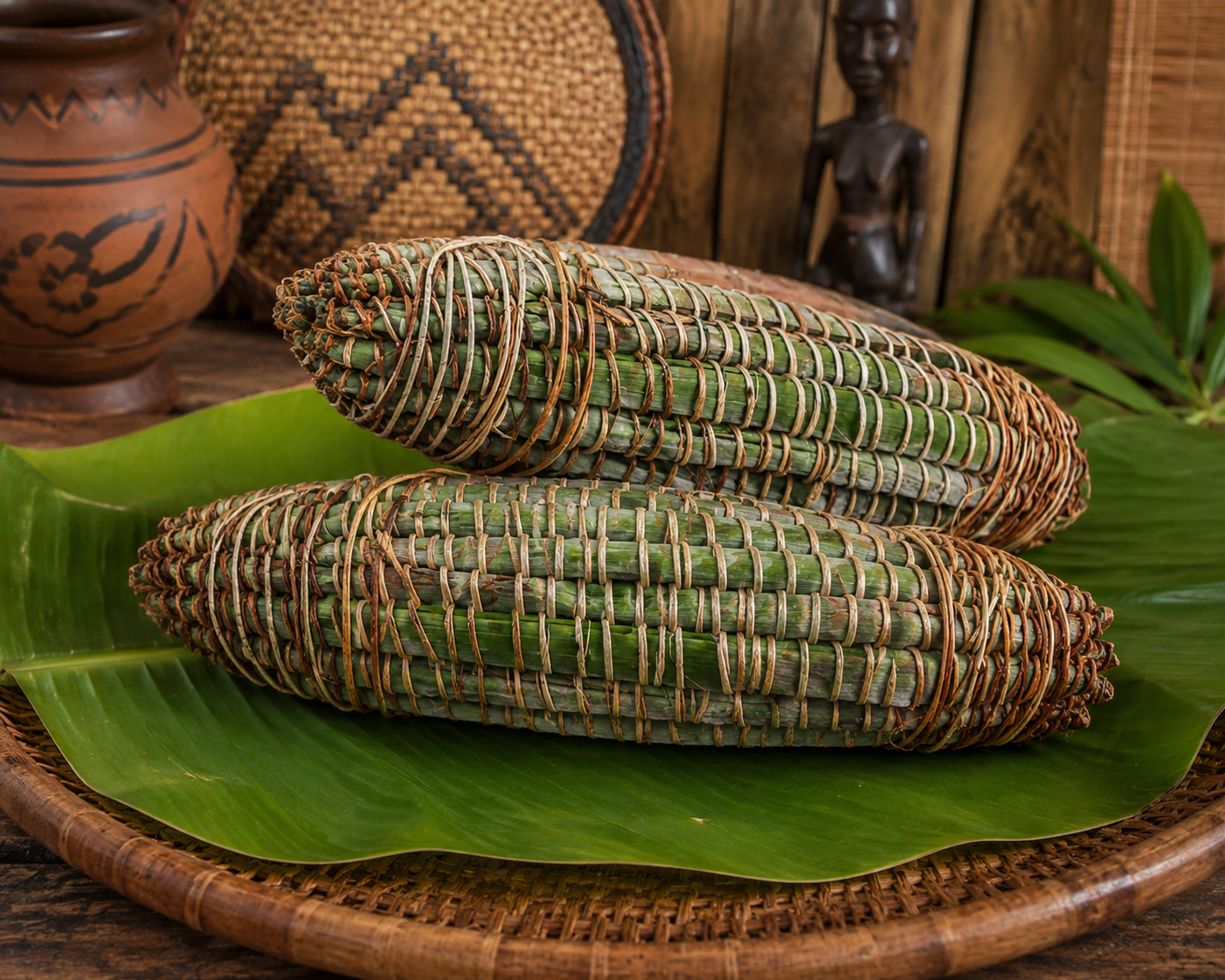
The making of miondo is a highly technical and physical task based on ancestral knowledge jealously transmitted within coastal women's families. It all begins with the meticulous harvesting of bitter cassava roots. After peeling and carefully washing the tubers, they are immersed in streams or large water tanks to begin the retting process, which lasts between three and five days. This controlled fermentation is essential to eliminate the toxic compounds naturally present in bitter cassava, while giving the future dough its supple texture and characteristic acidity. Once retting is complete, the softened cassava is removed from the water, drained, and then vigorously ground to obtain a smooth paste. This paste is then pressed into porous bags weighted with heavy stones to extract excess water. The next crucial step is fine sieving, performed to remove all residual woody fibers from the plant. The purified paste obtained is then spread on large wooden surfaces where it is shaped by hand into very thin sticks, whose diameter generally does not exceed one to one and a half centimeters, for a length of thirty to forty centimeters. It is this extreme finesse that fundamentally distinguishes miondo from all other cassava sticks in the region. The wrapping is then done using marantaceae plant leaves, carefully cleaned and softened over fire. The leaf is spirally wrapped tightly around the dough stick, then the package is securely tied along its entire length with thin threads or raffia fibers. The miondos are finally steamed in large pots for about forty-five minutes. Under the effect of heat, the starch gelatinizes, which gives miondo its elastic consistency, its translucency, and its slightly grayish or creamy color, while allowing it to absorb the aromatic essential oils released by the plant packaging.
🐟 GASTRONOMIC PAIRINGS AND THE ART OF TASTING 🐟
Miondo has a unique sensory profile characterized by a delicately tangy taste and an elastic texture, firm to the bite but melting in the mouth. In Cameroonian culinary art, it is the quintessential and inseparable side dish to the famous ndolé, the national dish composed of bitter ndolé leaves, fresh peanut paste, shrimp, and meat, all drizzled with hot onion-flavored oil. The slight acidity of miondo balances and cuts through the richness and creaminess of the ndolé peanut sauce, creating a perfect gustatory harmony sought by all gourmets. Another legendary and deeply popular pairing is miondo with grilled fish. The fish, usually sea bass or mackerel caught off the coast, is marinated in a clever blend of local condiments including Penja white pepper, djansang, ginger, garlic, and chili, before being grilled on a charcoal barbecue. The tasting of miondo follows a true ritual: one grasps the warm miondo, slowly unwraps the tying thread, then peels the plant leaf in a spiral to release the thin steaming stick. Small bites of miondo are then cut with the fingers to dip them in spicy sauce or combine them with a piece of grilled fish or ndolé. It is a dish that calls for conviviality, sharing, and the expression of joie de vivre, whether during Sunday family lunches, in chic restaurants in Douala, or on the stalls of street vendors along the beaches of Limbe and Kribi.
🌍 THE SPECIFIC PLACE OF MIONDO IN AFRICAN CUISINE 🌍
In the vast landscape of Sub-Saharan African gastronomy, where cereal and tuber pastes form the basis of the diet, miondo occupies a uniquely singular place. It belongs to the large family of fermented cassava starches, alongside fufu, Congolese chikwangue, kwanga, or Ivorian placali. However, miondo is undoubtedly its most sophisticated and technically refined variation. Its extreme geometric finesse is not just a simple aesthetic coquetry: it allows for much faster and perfectly uniform steaming right to the heart of the dough, thus avoiding undercooked or overly hard areas. Moreover, this very high surface ratio between the dough and the packaging leaf promotes maximum impregnation of the forest aromas of the marantaceae leaf into the miondo, giving it an herbaceous olfactory signature that no other cassava bread possesses to this degree. Miondo masterfully illustrates how African cultures have appropriated a plant from elsewhere to adapt it to their climatic requirements, their nomadic or maritime lifestyles, and their local aesthetic criteria. It testifies to the culinary genius of the water peoples, who transformed a rustic tuber into a side dish of a finesse worthy of the greatest gastronomic tables on the continent and in the world.
📈 SOCIO-ECONOMIC IMPACT AND PRESERVATION OF CULINARY HERITAGE 📈
Beyond its nutritional qualities, miondo is a major economic pillar for rural and coastal communities in Cameroon. The miondo production sector is almost exclusively supported by groups of women, locally called miondo mamas. From harvesting cassava to selling it in the markets of Douala, Yaoundé, or other urban centers, this activity generates thousands of informal jobs and ensures the financial autonomy of many families. The know-how required to roll miondo regularly and package it tightly is a precious intangible heritage passed down from mother to daughter, ensuring the survival of this culinary tradition in the face of urbanization and the industrialization of food. Nowadays, with the expansion of the African and Cameroonian diaspora worldwide, miondo has become international. It is exported vacuum-packed or frozen to European and North American markets, becoming an ambassador of Cameroonian culture abroad. This attachment to miondo shows that it is not just food for the body, but a true emotional and memorial link that unites expatriates to their homeland, recalling with each bite the salty scents of the Atlantic Ocean and the sweetness of their native country.
🔄 SYNONYMS AND LINGUISTIC VARIATIONS OF THE PRODUCT 🔄
Due to its proximity to other cassava processing products and the linguistic richness of the coastal region of Cameroon, miondo has several synonyms and associated appellations:
Fine cassava stick, which describes its characteristic morphology compared to the thicker bobolo. Mwondo, which represents the singular appellation in certain dialects of the Duala language, although the plural miondo is universally adopted by the entire French and English-speaking population. Fine bobolo, a term sometimes used for simplification by inland populations to distinguish it from the classic Beti cassava stick. Fine coastal chikwangue, a descriptive expression used in a broader Central African regional context to link it to the leaf-wrapped cassava breads of the Congo Basin. These different denominations reflect the importance and notoriety of this culinary specialty far beyond its original cultural cradle.
🔑 REFERENCE KEYWORDS FOR MIONDO 🔑
Cassava (the fundamental tuber essential for its production) Sawa (the coastal people of Cameroon who created this recipe) Ndolé (the bitter leaf stew it traditionally accompanies) Retting (the fermentation method in water that softens the dough) Steaming (the gentle cooking method in a forest leaf wrapper)
Where to find it
Look for the exact food-grade form required by the recipe at markets and specialist shops. Check the product name, ingredients, condition and storage instructions.
Explore further: Cooking tips · Food hygiene and safety advice.
In my books

Continue exploring the continent’s cuisines with Africa at the Table — 54 countries, 54 iconic dishes, by Alioune FALL. This book is in English.
In the kitchen : Miondo
Recipes from the site to put your knowledge into practice:
Discover these cuisines at a restaurant
Explore our restaurant and caterer directories. Choose your destination and check the establishment’s menu to confirm which dishes are offered and available.
Continue exploring
Enjoy discovering ingredients and African cuisines? Join our newsletter. The illustrated PDF 10 sauces africaines incontournables is in French and is offered after confirming a subscription to the French or bilingual edition.