Barley Couscous
Maghreb
Understanding : Barley Couscous
🌾 HISTORY AND ROOTS OF BARLEY IN NORTH AFRICA 🌾
Barley couscous, a true pillar of traditional North African cuisine, is one of the oldest expressions of the agricultural and culinary genius of this region. Unlike durum wheat couscous, which is now ubiquitous and industrialized, the barley-based version has its roots in the prehistoric history of the Berber people, the Amazighs, who have inhabited the region for millennia. Barley is a cereal of exceptional resilience, capable of thriving in the most arid climates, poor soils, and mountainous areas of the Atlas or Saharan fringes, where wheat could not survive. For indigenous populations, barley has long been the staple cereal par excellence, ensuring the survival of families during long years of drought. The transformation of barley into steamed couscous grains is a centuries-old technique developed to overcome the naturally rough and tough texture of this cereal. Over the centuries, what was originally a rustic subsistence dish has become a cultural symbol of invaluable worth, synonymous with terroir, authenticity, and a return to roots. Today, as consumers rediscover the virtues of healthy and natural eating, barley couscous is experiencing a formidable renaissance, appearing on the humblest family tables as well as in gourmet restaurants keen to promote African culinary heritage.
🥣 GRAIN PREPARATION AND COOKING TECHNIQUE 🥣
Preparing barley couscous from raw cereal is a long and meticulous process that requires highly perfected manual skill. The first step is to grind the pre-cleaned barley grains to obtain semolina of a specific granularity. This barley semolina, grayish or dark beige in color, is then subjected to the ritual of rolling. In a large terracotta bowl called a gasra or gassa, the cook moistens the semolina with lightly salted water. With precise and rhythmic circular movements of the palm of her hand, she rolls the grains to agglomerate them into small, regular balls. To obtain a perfect grain and prevent it from becoming sticky, small amounts of fine barley flour are sprinkled as the rolling progresses. The resulting grains are then calibrated using sieves made of vegetable fibers or metal. The cooking of barley couscous is the main stage that will reveal its full texture. It is done exclusively by steaming using a traditional couscoussier. As barley is much harder and richer in fiber than wheat, it generally requires at least three successive steamings to be perfectly tender and digestible. Between each cooking, the couscous is transferred to the gasra, aerated with a wooden spoon to separate the grains, then sprinkled with cold water and a drizzle of olive oil or traditional clarified butter called smen. Under the action of steam, the barley grains swell, soften, and take on a characteristic dark color, exuding a woody and rustic aroma of great authenticity.
🥘 TRADITIONAL ACCOMPANIMENTS AND SAUCES 🥘
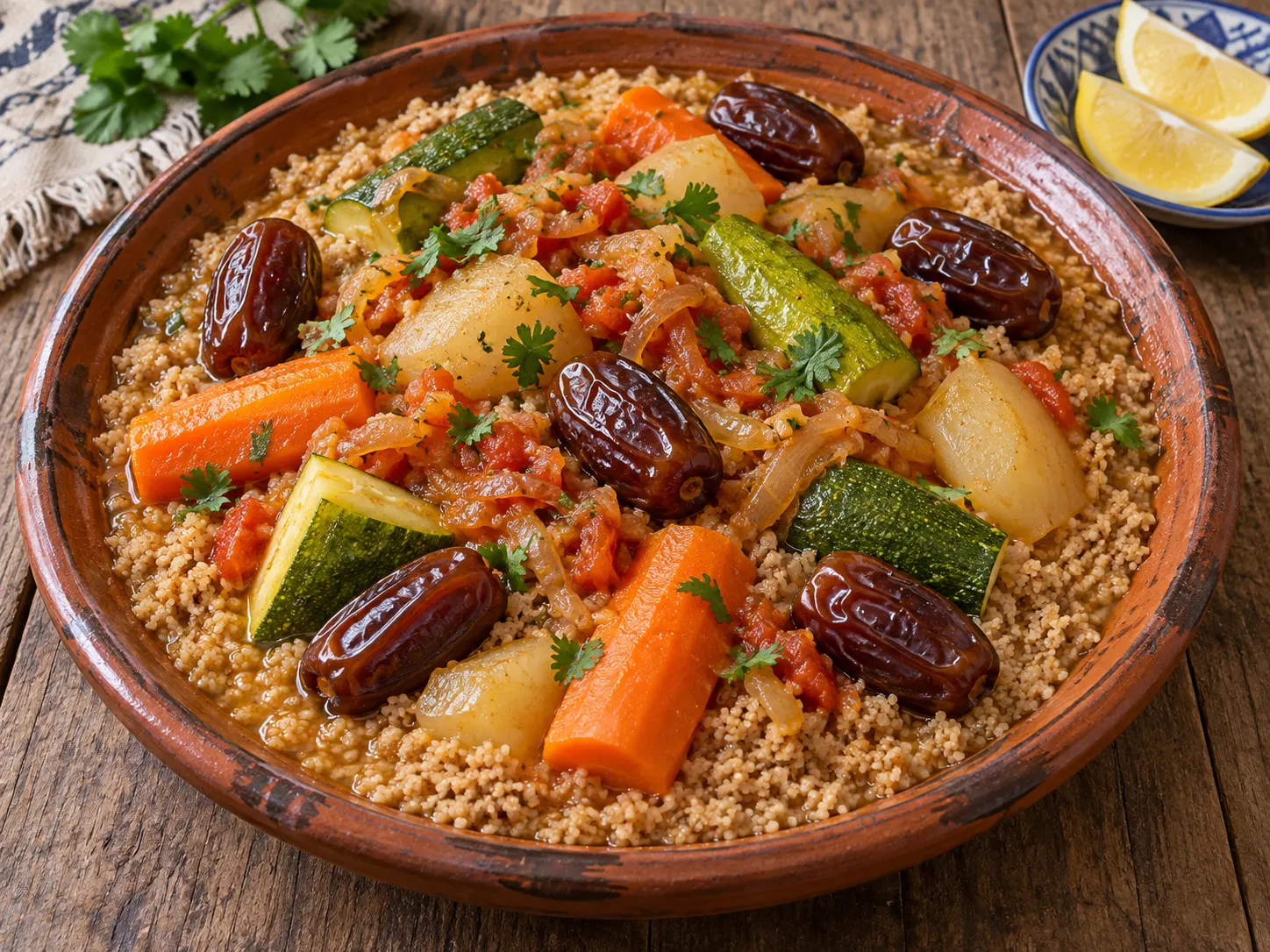
Barley couscous has a unique, more pronounced, slightly earthy and nutty flavor that pairs beautifully with robust sauces and generous seasonal vegetable stews. One of the most famous pairings in North Africa is barley couscous with seven vegetables, prepared with pieces of mutton, lamb, or beef, slow-cooked in a broth flavored with saffron, ginger, and turmeric, accompanied by carrots, turnips, zucchini, pumpkin, cabbage, chickpeas, and onions. In coastal regions, barley couscous is frequently served with a sauce made from fresh rock or deep-sea fish, flavored with cumin and red chili, creating a striking contrast between the strength of the cereal and the delicacy of the fish. For lean times or to celebrate the end of harvests, more rustic but extremely flavorful versions are prepared, such as barley couscous with wild herbs, where the grains are steamed with mint, thyme, oregano leaves, and other mountain plants. In Saharan and pre-Saharan areas, it is also common to consume barley couscous in a very simple and refreshing way, simply drizzled with fresh fermented milk or lben, sometimes accompanied by fresh dates or dried figs, offering a complete, healthy meal perfectly suited to the desert's intense heat.
🌍 THE SOCIAL, CULTURAL, AND DIETARY PLACE OF THE DISH 🌍
Barley couscous holds a place of paramount importance in the social and cultural structure of North African countries. It is the very embodiment of conviviality, generosity, and a sense of hospitality. Traditionally, barley couscous is the preferred dish for Friday meals, a day of prayer and family gathering, but also during major community life events such as weddings, births, agricultural festivals, and funerals. Presented in a large circular glazed terracotta dish, it invites sharing: guests sit around the single dish and take couscous with spoons or by forming small balls with their right hand, respecting an informal but very strict code of politeness. From a nutritional and dietary perspective, barley couscous is a true health treasure. Naturally richer in fiber, minerals, especially iron, magnesium, and phosphorus, and having a lower glycemic index than wheat couscous, it promotes lasting satiety and excellent digestive health. This exceptional nutritional contribution has made it the historical ally of rural populations in facing arduous physical labor and harsh winters in the Atlas Mountains.
🔄 SYNONYMS AND LINGUISTIC VARIATIONS 🔄
Depending on the regions, Amazigh dialects, and local North African languages, barley couscous is known by a multitude of synonyms that attest to its cultural richness:
Belboula, the extremely popular Moroccan appellation referring to medium to coarse barley semolina processed into couscous. Tchicha, another very common Moroccan and Algerian name referring to barley semolina. Berber couscous, a term often used by travelers and in cookbooks to highlight the Amazigh origin of the cereal. Dchicha, a spelling and pronunciation variant used in eastern Algeria and Tunisia. Whole barley couscous, which emphasizes the unrefined nature of the grain used. All these appellations refer to the same love for this ancestral cereal that nourishes the bodies and souls of the peoples of this region of the continent.
🔑 REFERENCE KEYWORDS 🔑
Barley (the rustic and resistant staple cereal) Amazigh (the indigenous peoples of North Africa who originated the dish) Belboula (the popular and warm synonym for the dish in Morocco) Steam (the gentle cooking method repeated several times) Smen (the traditional clarified butter that flavors the cooked grains)
Where to find it
African grocery shops and international food aisles are good starting points. Check which form the recipe needs: whole grain, flour, semolina or a precooked product. Cooking times vary.
Explore further: Cooking tips · Food hygiene and safety advice.
Search Amazon.fr — affiliate link →
Check availability and delivery on Amazon.fr. Compare ingredients, packaging and sellers.
As an Amazon Associate I earn from qualifying purchases.
In my books

Continue exploring the continent’s cuisines with Africa at the Table — 54 countries, 54 iconic dishes, by Alioune FALL. This book is in English.
In the kitchen : Barley Couscous
Recipes from the site to put your knowledge into practice:
Discover these cuisines at a restaurant
Explore our restaurant and caterer directories. Choose your destination and check the establishment’s menu to confirm which dishes are offered and available.
Continue exploring
Enjoy discovering ingredients and African cuisines? Join our newsletter. The illustrated PDF 10 sauces africaines incontournables is in French and is offered after confirming a subscription to the French or bilingual edition.