Berkoukes (Aïch)
Algeria, Tunisia, Morocco
Understanding : Berkoukes (Aïch)
🌾 ORIGINS AND HISTORY OF BERKOUKES IN NORTH AFRICA 🌾
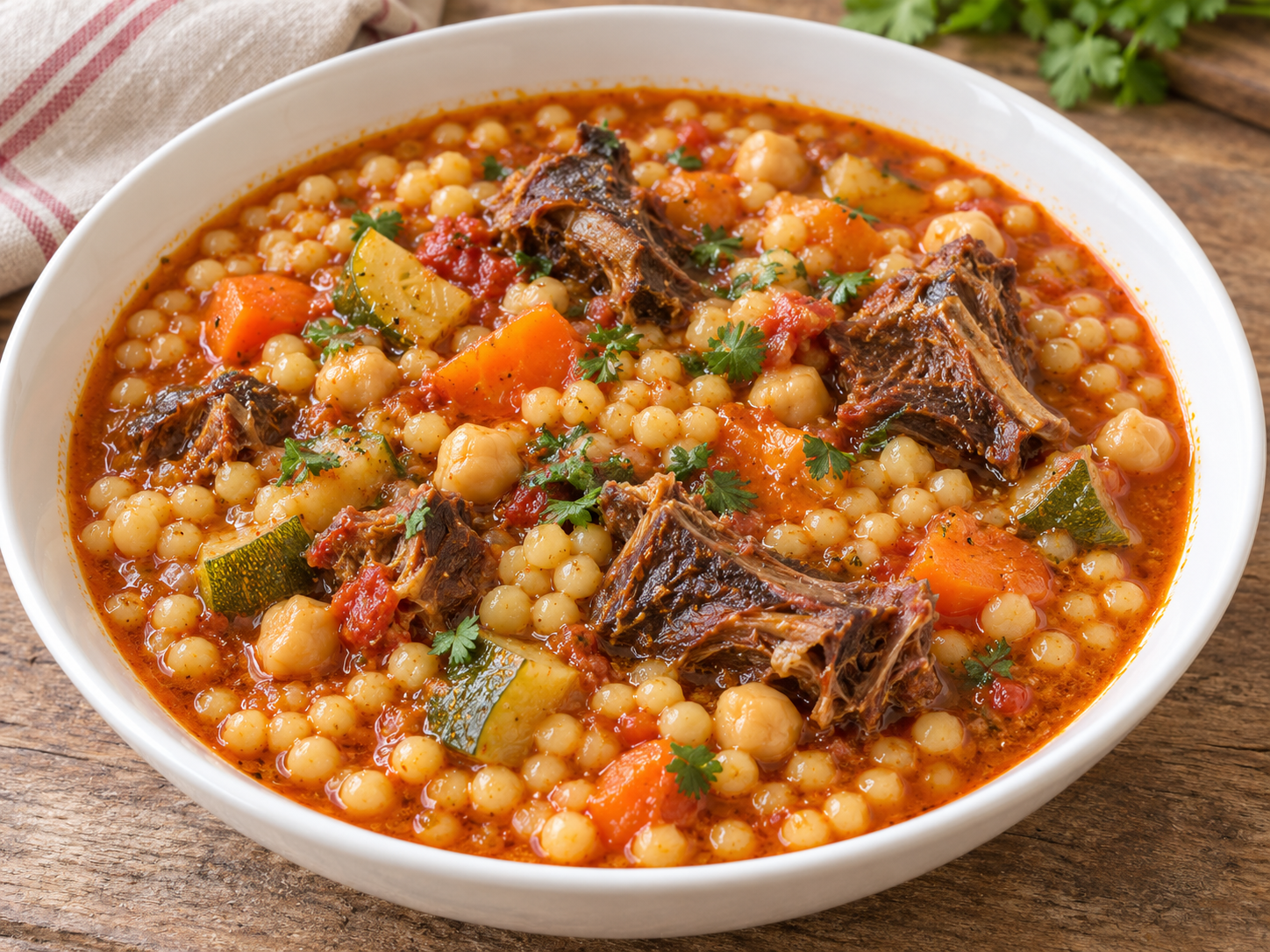
Berkoukes, also known as aïch in some regions, is a heritage dish from North Africa of inestimable historical and cultural value. This rustic and deeply comforting dish consists of large, hand-rolled pasta pearls made from durum wheat semolina or barley, then cooked in a rich tomato sauce with vegetables, spices, and meat. The origin of berkoukes dates back to the pre-Islamic period among the Berber peoples, the Amazighs, who have inhabited the Atlas Mountains and coastal plains since antiquity. Historically, berkoukes was an ingenious adaptation of grain preservation techniques. Berber women would roll fresh durum wheat semolina to form these pasta pearls, about three to four millimeters in diameter, much larger than classic couscous. Once shaped, these pasta pearls were slowly dried in the sun on large wicker trays, becoming a non-perishable and easily storable food resource for long winter months or to cope with periods of scarcity. Berkoukes was thus born from subsistence know-how that, over generations, has been enriched by successive contributions from Maghrebi and Mediterranean cuisine to become a prestigious and festive dish. Today, it is the perfect embodiment of North African terroir, a living testament to the memory of ancestors and the ingenuity of women who have preserved this culinary treasure through the ages.
🥣 UNIQUE GRAIN SHAPING AND COOKING TECHNIQUE 🥣
The making of berkoukes grains is a meticulous art that requires patience, consistency, and great manual skill. To roll berkoukes, women sit in front of a large circular glazed terracotta or wooden dish called a gasra. The process begins by moistening high-quality durum wheat semolina with salted water. With a broad, regular circular hand motion, the cook rotates the wet semolina against the sides of the container, allowing it to agglomerate into small pearls. To make these pearls grow to the characteristic size of berkoukes, she periodically sprinkles fine semolina and flour, alternating solid and liquid additions with remarkable precision. The resulting grains are then calibrated using a special sieve called gharbel El-berkoukes, whose large holes only allow pearls that have reached the perfect diameter to pass through. Once rolled, fresh berkoukes can be used immediately or sun-dried for preservation. Traditional berkoukes cooking also includes a pre-cooking steaming step in a couscoussier placed over an aromatic broth. This step helps set the shape of the grain and prevents it from becoming pasty or sticky during its final immersion in the sauce. After this first steaming, the barley or durum wheat pearls are poured directly into the pot of boiling sauce to simmer slowly, absorbing the aromas of the broth until they become perfectly tender, juicy, and melt-in-your-mouth.
🥘 ACCOMPANIMENTS AND SAUCES FOR A FLAVORFUL STEW 🥘
Berkoukes is always enjoyed in a generous, thick, creamy, and very spicy sauce that contrasts with the mildness of the grain. The traditional sauce is prepared with concentrated tomatoes, caramelized onions, fresh garlic, and a blend of warm spices emblematic of the Saharan and Mediterranean regions, notably ras el hanout, turmeric, ginger, paprika, black pepper, and red chili. The dish is garnished with a wide variety of seasonal vegetables such as fresh or dried fava beans, chickpeas, turnips, carrots, zucchini, and potatoes. The meat used is generally lamb or mutton, whose fat provides an incomparable creaminess to the sauce, although free-range chicken or dried meat called keddid can also be used. In some particularly comforting variations prepared during the harsh winters, a handful of lentils or white beans is also added to increase the dish's consistency. Just before serving, berkoukes is sprinkled with fresh chopped cilantro, dried mint, and sometimes kosbor, adding a herbaceous freshness that awakens the senses. In desert regions or eastern Algeria, it is customary to accompany berkoukes with fried hot green chilies or local harissa for an explosion of bold flavors.
🌍 THE SOCIAL, FAMILIAL, AND RITUAL PLACE OF BERKOUKES 🌍
Berkoukes is a dish of immense sociocultural and ritual significance in North Africa. It is the ultimate symbol of thermal and emotional comfort, primarily prepared during major life transitions and celebrations. It is the quintessential dish offered to women who have just given birth: prepared with a profusion of medicinal herbs and warm spices, it is renowned for strengthening the new mother's body, stimulating lactation, and restoring her energy. Berkoukes is also at the heart of Amazigh New Year celebrations, Yennayer, celebrated in mid-January. On this occasion, the preparation of a giant berkoukes with seven vegetables and chicken is a ritual of blessing to attract abundance, fertile lands, and prosperity for the coming year. It is also the dish prepared during harsh snowy winters in the mountains of Kabylia or Aurès, as its warmth and nutritional density bring the family together around the hearth. Berkoukes is never eaten alone: it is a highly communal dish, served in a large circular gasra where everyone dips their wooden spoon in an atmosphere of sharing, fraternity, and mutual respect for elders.
🔄 SYNONYMS AND REGIONAL VARIATIONS 🔄
Due to the vast geographical expanse of North Africa and the diversity of Amazigh and Arabic dialects, berkoukes has several synonyms and local names depending on the country and region:
Aïch, the most commonly used term in eastern Algeria and many regions of Tunisia to refer to this same dish of large pasta pearls. Avrekoukes, the original Berber name in the Kabyle language. El-Mhamsa, which refers to similar pasta pearls in Tunisia and eastern Algeria, although they are sometimes slightly smaller than traditional berkoukes. Couscous de plomb or gros couscous (lead couscous or large couscous), descriptive denominations commonly used in French to facilitate understanding of its unique texture. Mardoud, the specific name used in southern Algeria, in the Sahara oases, to refer to a very spicy variant particularly rich in local aromatic herbs.
🔑 REFERENCE KEYWORDS 🔑
Berkoukes (the traditional and most universal name for this dish) Durum wheat (the essential base cereal for rolling the large grains) Yennayer (the Amazigh New Year for which it is the flagship celebratory dish) Stew (the long cooking method for vegetables and meat in a thick sauce) Gasra (the large traditional circular terracotta dish used for rolling and sharing)
Prepare this speciality
Choose a detailed recipe, adjust the portions and prepare your ingredients before starting. Our cooking tips and food safety advice complement the steps described in the recipes.
Explore further: Cooking tips · Food hygiene and safety advice.
In my books

Continue exploring the continent’s cuisines with Africa at the Table — 54 countries, 54 iconic dishes, by Alioune FALL. This book is in English.
In the kitchen : Berkoukes (Aïch)
Recipes from the site to put your knowledge into practice:
Discover these cuisines at a restaurant
Explore our restaurant and caterer directories. Choose your destination and check the establishment’s menu to confirm which dishes are offered and available.
Continue exploring
Enjoy discovering ingredients and African cuisines? Join our newsletter. The illustrated PDF 10 sauces africaines incontournables is in French and is offered after confirming a subscription to the French or bilingual edition.