Agidi
West Africa
Understanding : Agidi
🌽 INTRODUCTION AND CULINARY IDENTITY OF AGIDI
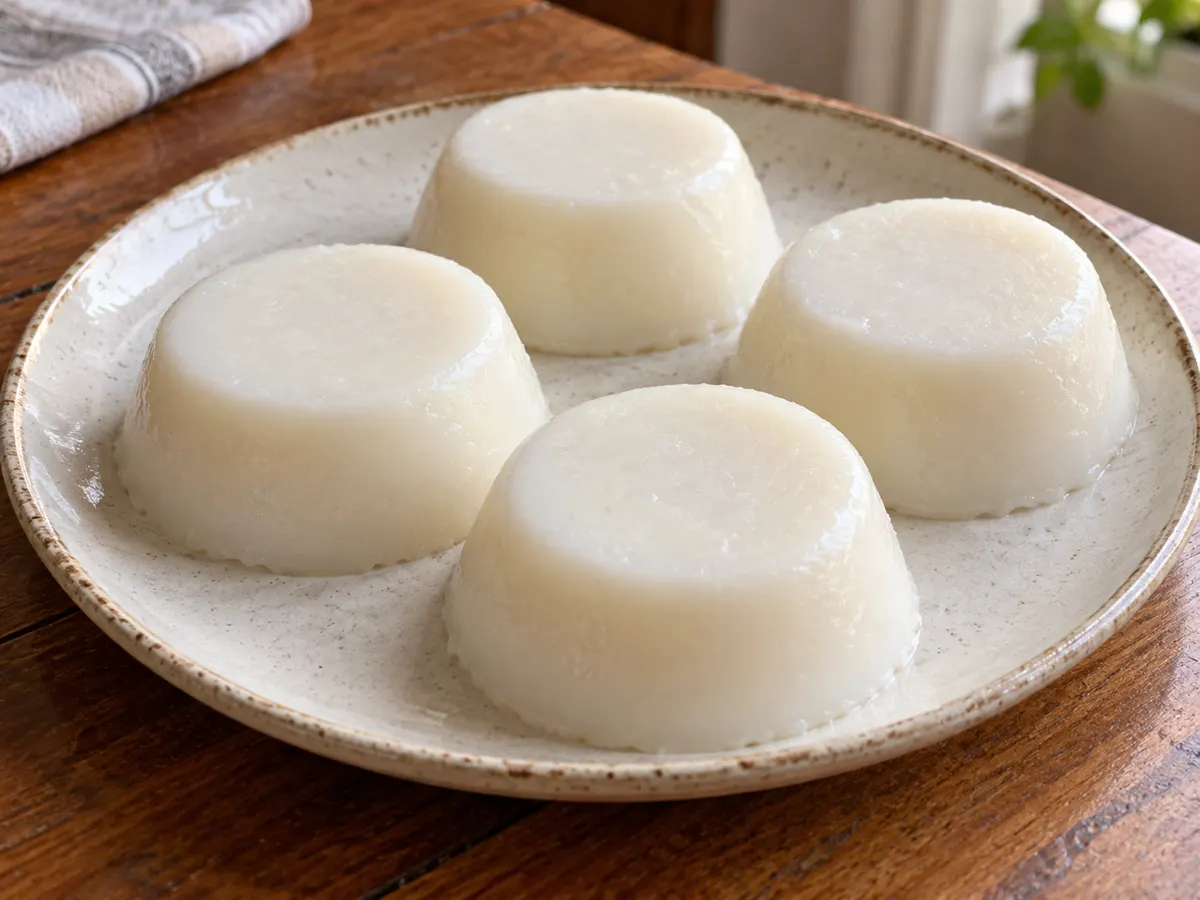
Agidi is a fundamental and essential food in West African gastronomy, particularly famous for its unique gelatinous texture and subtle sweetness. Made from fermented corn starch, this dish is distinguished by its firm yet deliciously melt-in-your-mouth consistency, reminiscent of a savory flan or a cereal jelly. Visually, it takes the appearance of a white or slightly ivory block with a very smooth finish, traditionally molded in vegetable leaves that serve as both a protective casing and an aromatic infuser during its resting and solidification phase. In West Africa, and more specifically in Nigeria, agidi is much more than a simple energetic side dish. It is a true cultural monument that bridges eras and different social classes. Its apparent simplicity actually hides a complex art of fermenting and cooking corn starch, a know-how that African mothers traditionally pass on to their children for generations. This minimalist dish perfectly illustrates the ability of West African cuisine to sublimate a universal cereal like corn into a healthy, digestible, economical, and extremely comforting food for the body and mind.
🌍 HISTORICAL AND GEOGRAPHICAL ORIGINS
The origins of agidi are rooted in the deep agricultural history of the peoples living along the Gulf of Guinea. Before the massive introduction of corn to the African continent by European navigators and merchants in modern times, local populations already exploited local cereals such as millet or sorghum to make porridges and steamed pastes. The introduction of corn revolutionized these habits by offering higher yields and greater ease of cultivation. Ethnic communities such as the Igbos, Yorubas, and Hausas of present-day Nigeria quickly adopted this cereal to integrate it into their culinary rituals. Agidi thus established itself over the centuries as an ideal solution for preserving the nutritional qualities of corn in a form that was easy to transport and ready to consume at any time of the day. Natural packaging in banana leaves or local tree leaves helped maintain moisture and prevent the paste from drying out, playing a crucial role in preservation in humid tropical climates where modern refrigeration methods did not exist.
🥣 MANUFACTURING PROCESS AND ANCESTRAL TECHNIQUES
The traditional production of agidi is a meticulous process that requires patience, precision, and rigor. It all begins with the careful soaking of dry white corn kernels in large containers of clear water for a minimum of two to three days. During this soaking phase, a natural lactic fermentation occurs under the action of ambient microorganisms, giving the preparation its delicately tangy taste. Once softened, the corn kernels are carefully washed, rinsed, and then finely ground. The resulting paste is then diluted with a large quantity of water to be passed through a very fine cloth acting as a sieve. This delicate step allows the isolation of pure, liquid, and smooth starch, while eliminating fibrous corn husk residues. This liquid starch is left to rest to decant at the bottom of the container, forming a dense white paste. This concentrated starch is the raw material for agidi. Cooking is the most physical step of the recipe: the starch is diluted in cold water then slowly poured into boiling water while stirring vigorously and continuously with a long wooden spatula. Under the effect of heat, the starch gelatinizes and the preparation quickly thickens to become a heavy, translucent, and homogeneous paste. The hot paste is then poured in portions into vegetable leaves previously cleaned and softened over fire. The leaves are hermetically folded into a pyramid or rectangle shape, then left to rest. As it cools to room temperature, the starch solidifies definitively to give agidi its characteristic firm consistency.
🌶️ THE PLACE OF AGIDI IN GASTRONOMY AND SOCIETY
In the organization of daily meals in West Africa, agidi shines with its exceptional versatility. Consumed from the first light of day, it is often served hot or warm as a hearty breakfast for schoolchildren and workers. It is then frequently associated with crispy bean fritters called akara, or with a sweet porridge to create a play of textures much appreciated by connoisseurs. For main meals such as lunch or dinner, cold or room temperature agidi replaces rice or fufu to accompany dense and highly spiced local soups, such as egusi soup made from pumpkin seeds, ogbono soup made from wild mangoes, or spicy fish broths. Its gelatinous texture effectively captures the sauce and softens the heat of the chili in the mouth. Beyond domestic consumption, agidi has a strong social dimension. It is produced in large quantities by specialized street vendors who crisscross markets and bus stations, carrying hot packages wrapped in insulating fabrics in large basins on their heads. During significant community events, such as traditional weddings, funerals, or baptisms, agidi is distributed in abundance to guests, symbolizing sharing, warm hospitality, and social cohesion within the community.
🍲 POPULAR VARIATIONS AND CONTEMPORARY DEVELOPMENTS
Although the classic version of agidi is white and neutral to serve as a base for spicy sauces, many flavorful variations have developed over time. The most famous of these variations is agidi jollof, also known as eko jollof. To prepare this very gourmet version, a reduction of spicy tomato sauce, prepared with onions, fresh chilies, and local condiments, is incorporated into the hot starch paste. A piece of tender meat, liver, or bone marrow is often inserted in the center of the package before wrapping the paste for solidification. Once cooled, agidi jollof is consumed directly as a complete and autonomous dish, easy to transport for travel or picnics. With rapid urbanization and the emergence of modern and creative African cuisine, agidi is currently experiencing a true renaissance. Contemporary chefs from the diaspora and major African capitals are revisiting this local product by molding it into sophisticated geometric shapes, associating it with refined sauces, or integrating it into minimalist culinary presentations. This reinvention proves that agidi can adapt to global culinary trends while preserving the authenticity of its original flavors.
📚 SYNONYMS OF AGIDI ACROSS THE CONTINENT
Agidi travels across cultures and geographical borders, which explains the diversity of names it receives depending on the ethnic groups and countries of West Africa:
Eko: this is the most common traditional Yoruba name for this corn starch cake in Nigeria and Benin. Maize pudding: an English expression widely used by urban populations and restaurateurs in the diaspora to explain it to the international public. Corn jello: a descriptive name referring to its bouncy and gelatinous texture obtained naturally without animal gelatin. Akasan: a term used in some regions of Benin for similar corn starch preparations served fried or as a paste. Koko: although more broadly referring to porridges in Ghana, this term shares common linguistic and preparation roots with gelatinized corn. 🔑 LIST OF 5 ESSENTIAL KEYWORDS
Corn Starch Fermentation Nigeria Tradition
Prepare this speciality
Choose a detailed recipe, adjust the portions and prepare your ingredients before starting. Our cooking tips and food safety advice complement the steps described in the recipes.
Explore further: Cooking tips · Food hygiene and safety advice.
In my books

Continue exploring the continent’s cuisines with Africa at the Table — 54 countries, 54 iconic dishes, by Alioune FALL. This book is in English.
In the kitchen : Agidi
Recipes from the site to put your knowledge into practice:
Discover these cuisines at a restaurant
Explore our restaurant and caterer directories. Choose your destination and check the establishment’s menu to confirm which dishes are offered and available.
Continue exploring
Enjoy discovering ingredients and African cuisines? Join our newsletter. The illustrated PDF 10 sauces africaines incontournables is in French and is offered after confirming a subscription to the French or bilingual edition.