Eru
Cameroon
Understanding : Eru
🥬 NATURE AND IDENTITY OF ERU IN CENTRAL AFRICA
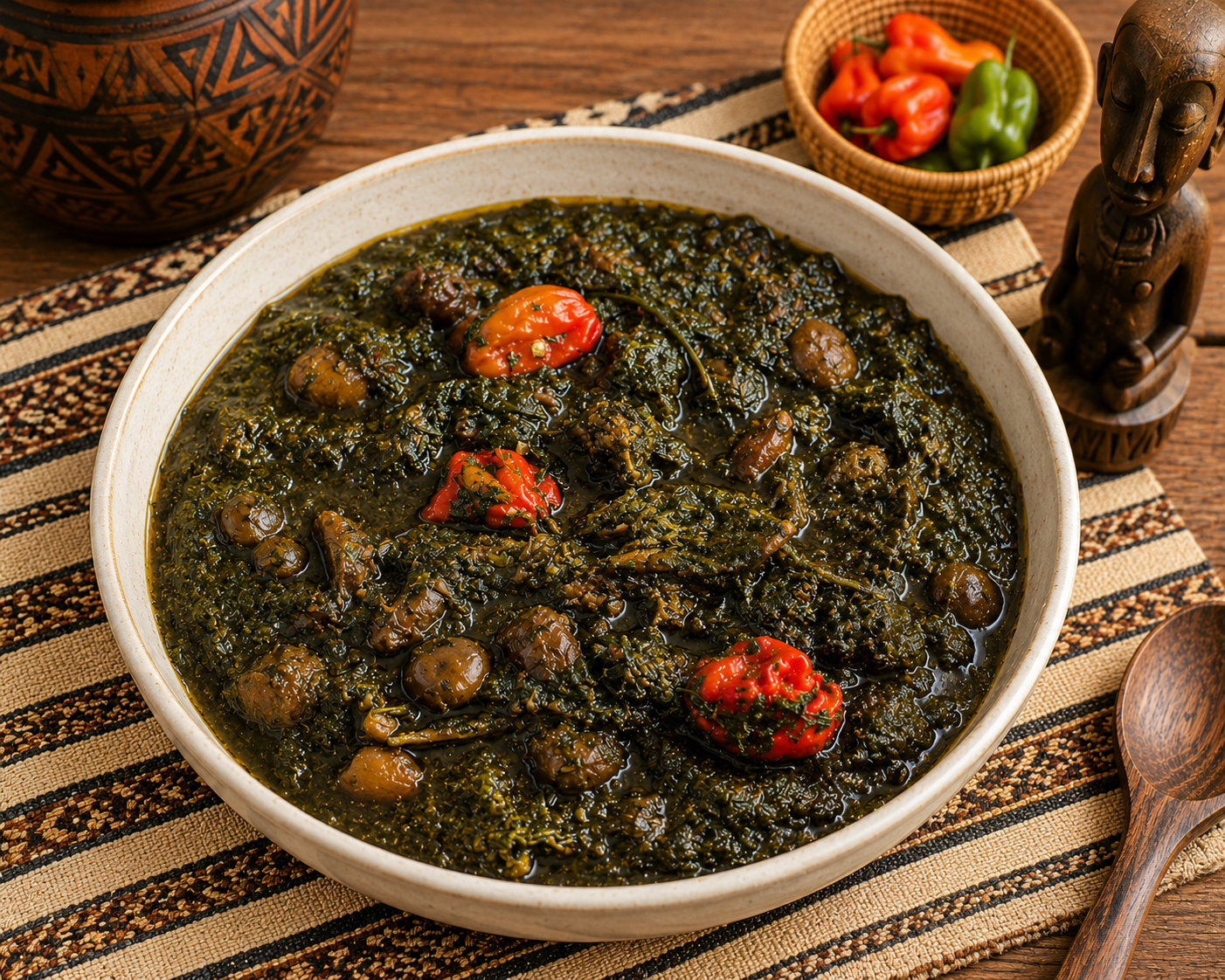
Eru is a legendary traditional dish from Central Africa, extraordinarily rich in both taste and culture. Originating mainly from the forest areas of Cameroon and Nigeria, this dish is named after its essential raw material, eru, which corresponds to the wild leaves of a tropical vine scientifically called Gnetum africanum. Visually, eru appears as a mixture of finely chopped green vegetables, bound by red palm oil and garnished with a profusion of meats, fish, and dried crayfish. What characterizes eru in terms of taste is the perfect harmony of textures and flavors: on one side, the crunchiness of the gnetum leaves, on the other, the melting softness of waterleaf, a local watery vegetable used to soften the preparation, all enhanced by the smoky aroma of crayfish and the creaminess of red oil. This dry stew, without fluid broth, is a nutritional and gastronomic marvel that embodies the absolute mastery of forest plants by local populations.
Prepare this speciality
Choose a detailed recipe, adjust the portions and prepare your ingredients before starting. Our cooking tips and food safety advice complement the steps described in the recipes.
Explore further: Cooking tips · Food hygiene and safety advice.
History and uses
🌳 FOREST ORIGINS AND HISTORY OF THE DISH
The history of eru is rooted in the heart of the equatorial forest of the Congo Basin and the Gulf of Guinea. Gnetum africanum leaves are not conventionally cultivated; they are gathered in the wild by villagers who venture deep into the forest to harvest the vines that climb along giant trees. This age-old gathering makes eru a true living link between the populations and their forest ecosystem. Historically, this dish is the culinary treasure of the Southwest region of Cameroon, particularly associated with the Manyu and Bayangi communities. Over the centuries, the techniques for cutting and cooking these tough leaves have been refined to give birth to the dish we know today. Eru has crossed the borders of its region of origin to conquer all of Cameroon and neighboring countries like Nigeria and Congo, becoming a symbol of national unity and cultural pride for all communities in the sub-region.
🍳 PREPARATION TECHNIQUES AND COOKING RITUALS
The preparation of eru is a meticulous craft that requires long manual preparation. The first step, often carried out collectively by the women of the household, consists of sorting the gnetum leaves, removing the hard stems, then layering them to cut them as finely as possible with a sharp knife. Coarse cutting would spoil the texture of the dish, making it difficult to chew. In parallel, waterleaf is prepared, or failing that, fresh spinach leaves, which will provide the necessary moisture for cooking. The preparation of proteins is just as important: an assortment of beef, tripe, oxtail, and dried beef skin, locally called kanda, is boiled. Smoked fish and a large quantity of dried and ground crayfish are added for the aromatic base. When the meats are tender and the cooking water has almost completely evaporated, the waterleaf is added. Once it has reduced and released its water, the finely chopped eru leaves are gradually incorporated. It is then that raw red palm oil is generously poured, which will bind the ingredients and stew the preparation. No additional water is tolerated; eru must cook only in the juice of the waterleaf and in palm oil, until the gnetum leaves soften while retaining their characteristic slight crunch.
In my books

Continue exploring the continent’s cuisines with Africa at the Table — 54 countries, 54 iconic dishes, by Alioune FALL. This book is in English.
Explore further
🍽️ TABLE COMPANION AND SOCIAL IMPORTANCE
In Cameroonian gastronomy, eru forms an inseparable pair with water fufu, a fermented and water-cooked cassava paste with an elastic and slightly acidic texture. Eating eru without its fufu is considered sacrilege by purists. The tasting ritual is traditionally done by hand: a small ball of warm fufu is taken, a slight well is made in it to accommodate a generous portion of oily and fragrant eru, then the whole is savored in a single melting bite. Socially, eru is a ceremonial and celebratory dish. It is unthinkable to organize a traditional wedding, funeral, or large community celebration in southwestern Cameroon without serving eru. Offering this dish to a passing guest is the highest testimony of respect, esteem, and hospitality one can bestow. It is a dish that brings people together, creates lively discussions around the table, and seals alliances between families.
📦 COMMERCIALIZATION, EXPORT, AND MODERN CHALLENGES
Today, eru has largely moved beyond family kitchens to become a major economic and ecological issue. In large metropolises like Douala or Yaoundé, eru is the most sold dish in popular catering circuits called circuits or tournedos. Faced with the immense demand from the African diaspora in Europe and North America, an export trade of dried and vacuum-packed eru leaves has developed, allowing expatriates to rediscover the flavors of their childhood. However, this dazzling success poses the challenge of preserving forest resources. Uncontrolled intensive harvesting threatens to make the Gnetum africanum vine disappear from some Central African forests. Agroforestry projects and domestication of the plant are currently being carried out by researchers and local associations to encourage the sustainable cultivation of eru, thus ensuring the sustainability of this exceptional culinary heritage for future generations.
📚 SYNONYMS OF ERU AND GNETUM AFRICANUM
Eru is a dish and a plant that travels across many linguistic and cultural borders, earning it various synonyms depending on the region:
Ero: an alternative spelling commonly used in English-speaking countries like Nigeria and some regions of Cameroon. Okok: a very popular name in Beti, Bulu, and Fang languages to designate the plant and its preparations in central and southern Cameroon. Afang: the traditional name given to the plant and a similar very famous soup among the Efik and Ibibio peoples of southeastern Nigeria. Koko: a common denomination in the Democratic Republic of Congo and the Republic of Congo to designate these same stewed forest leaves. Wild vine (or forest vine): a descriptive name sometimes used by French-speaking foresters and botanists to refer to Gnetum africanum.
🔑 LIST OF 5 ESSENTIAL KEYWORDS
Gnetum Cameroon Fufu Forest Tradition Send message
In the kitchen : Eru
Recipes from the site to put your knowledge into practice:
Discover these cuisines at a restaurant
Explore our restaurant and caterer directories. Choose your destination and check the establishment’s menu to confirm which dishes are offered and available.
Continue exploring
Enjoy discovering ingredients and African cuisines? Join our newsletter. The illustrated PDF 10 sauces africaines incontournables is in French and is offered after confirming a subscription to the French or bilingual edition.