Ewedu
Nigeria
Understanding : Ewedu
🍲 ORIGINS AND ANCESTRAL HISTORY OF EWEDU
Ewedu is one of the most iconic pillars of the culinary culture of the Yoruba people, a major linguistic and historical community originating from southwestern Nigeria, also extending across entire parts of Benin and Togo. Much more than a simple vegetable dish, Ewedu is deeply rooted in the cosmogony, traditional medicine, and social organization of this forest and agrarian people. Historically, wild jute leaves, which are the raw material for this soup, were harvested at dawn in the fields and fallow lands surrounding traditional Yoruba cities. In the ancient royal traditions of the city of Ife or Oyo, Ewedu soup held a sacred place during court banquets and coronation rituals. It was renowned for its extremely fluid and slippery texture, a culinary quality sought after and interpreted as a symbol of social fluidity, civil peace, and longevity for the sovereign's reign. For the Yoruba, offering Ewedu to guests is a gesture of warm hospitality that shows a desire to honor the guest while providing an extremely healthy and comforting meal. The transmission of the Ewedu preparation technique, particularly the use of a traditional wooden whisk called ijabe, was a primary teaching passed down from mother to daughter, ensuring the preservation of the authentic texture and culinary heritage through the ages.
🌿 A TREASURE OF ESSENTIAL BENEFITS AND COMPOSITIONS
Botanically and nutritionally, Ewedu is a monochrome soup made from jute leaves, scientifically known as Corchorus olitorius. These plants, which thrive in the humid tropical climate of West Africa, are characterized by thin, serrated leaves of a tender, bright green.
Nutritionally speaking, jute leaves are a true gift from nature, often described as a superfood. They are packed with vital nutrients, including vitamins A, C, E, and B-group vitamins. The high content of vitamin A and beta-carotenes makes them powerful antioxidants, essential for eye health and skin cell regeneration. Furthermore, Ewedu is exceptionally rich in plant-based calcium, highly bioavailable iron, and potassium, making it an excellent choice for combating anemia, strengthening bones, and regulating blood pressure. The most famous characteristic of Ewedu is its richness in mucilage, a soluble fiber highly beneficial for intestinal transit, digestion, and soothing the stomach. Traditional Yoruba healers regularly used Ewedu decoctions to treat gastric ulcers, facilitate childbirth in pregnant women, and relieve chronic constipation.
To prepare a traditional Ewedu soup, very few external ingredients are required. Jute leaves are combined with water, salt, iru (fermented locust beans), and a small amount of dried and ground crayfish to deepen the flavor. Sometimes, a hint of kaun (traditional pottery or potash) is added in tiny amounts to accelerate the tenderizing of the vegetable fibers and amplify the viscous and slippery character of the soup, although this practice is sometimes abandoned today in favor of more natural cooking methods.
🍳 THE STEPS OF THE EWEDU PREPARATION RITUAL
The preparation of Ewedu is a disarmingly simple ritual that nevertheless requires rigorous technical precision to preserve the original green color and achieve the perfect viscosity.
The process begins with the meticulous destemming of the jute leaves. Only the tenderest leaves free from imperfections are selected. They are washed repeatedly with plenty of water to remove any soil or insect residue.
In a small pot, a measured amount of water is brought to a boil. It is crucial not to oversaturate the leaves with water to prevent the soup from becoming too fluid and losing its precious mucilage. When the water boils, the cleaned jute leaves are added, and optionally, a tiny pinch of natural potash is added to tenderize the fibers. It is left to boil over medium heat for only five to ten minutes, until the leaves are soft to the touch.
The next step is what defines the dish's legendary texture. Traditionally, the cook removes the pot from the heat and uses the ijabe, a small broom or round whisk made from dried palm or bamboo branches. With a rapid and vigorous rotating motion of the palms, the cook crushes and whisks the leaves directly in the pot until they are reduced to a smooth, green, and extremely stringy puree. In modern kitchens, the ijabe is sometimes replaced by an electric blender used in very short pulses to avoid overheating the preparation or making it foamy.
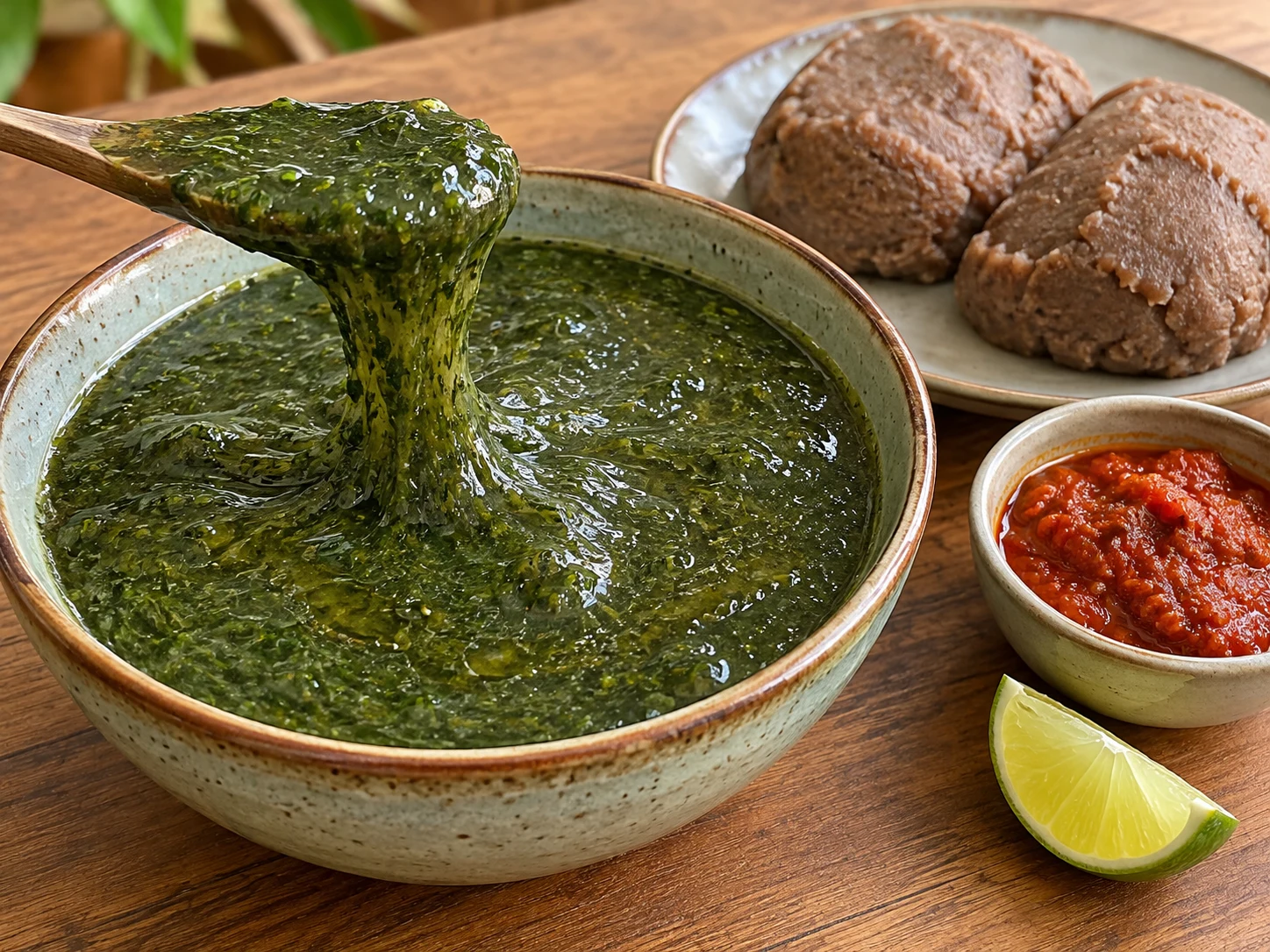
Once the perfect texture is achieved, the pot is returned to very low heat. Pounded iru and ground crayfish are added, along with a pinch of salt. It is gently mixed and allowed to simmer for only two to three minutes to allow the flavors to delicately integrate with the vegetables without destroying the slippery texture. The final soup should display a vibrant green color, perfect creaminess, and flow effortlessly in long silky strands when lifted with a spoon.
🍽️ THE ART OF TASTING AND ITS PLACE IN AFRICAN CUISINE
In the panorama of African culinary art, Ewedu soup holds a singular and crucial place. It perfectly represents the concept of slippery soup, a West African culinary preparation style highly valued for its gastronomic functionality.
Indeed, among the Yoruba, Ewedu is rarely eaten alone. It is almost always part of a magical trinitarian alliance called abula, an absolute classic of street food and traditional restaurants from Lagos to Ibadan. Abula is composed of three distinct elements served in the same bowl: Ewedu (the green slippery soup), gbegiri (a creamy and velvety soup of peeled beans cooked in palm oil, yellow-orange in color), and very spicy and hot red meat stew (obe ata).
The perfect culinary pairing for tasting abula is amala, an elastic dark-colored paste prepared from dried yam flour. The diner takes a ball of warm amala with their fingers and dips it into the abula bowl. The highly viscous and slippery texture of Ewedu then acts as an extraordinary natural lubricant, coating the amala and allowing it to slide effortlessly down the throat while transmitting the explosion of combined flavors of sweet beans, earthy yam, and spicy sauce.
Beyond its native region, Ewedu enjoys immense esteem throughout French-speaking West Africa under other local names. It is an element of national pride in Nigeria that brings communities together around the shared pleasure of a comforting meal. Thanks to the diaspora, Ewedu has traveled to the four corners of the globe. Dried or canned jute leaves are now sold in African grocery stores in Europe, North America, and Asia, allowing expatriate families to recreate the unique sensory experience of traditional abula, maintaining an indestructible link with the traditions of their homeland.
✨ SYNONYMS FOR EWEDU
Ewedu soup and its base leaf have several synonymous appellations across the African continent and in global botanical literature, reflecting its cross-border popularity:
Jute leaf soup: This is the most commonly used descriptive translation in French to name this dish for uninitiated audiences or in international menus.
Lalo or Lalo soup: In several French-speaking West African countries like Senegal, Mali, or Guinea, as well as in the West Indies, the jute leaf and the viscous sauce derived from it are referred to as lalo.
Krain krain or Crain crain: This is the popular name given to the plant and its slimy sauce in Sierra Leone, Liberia, Guinea, and parts of English-speaking Cameroon, evoking the characteristic slippery texture.
Mulukhiyah or Molokheya: In North African and Middle Eastern countries, such as Egypt, Sudan, or Lebanon, the same Corchorus olitorius jute leaf is the base of a legendary national dish called mulukhiyah. Although the Eastern preparation method differs from the West African Yoruba method by the addition of roasted garlic and coriander, the vegetable remains rigorously identical.
🔑 KEYWORDS FOR EWEDU
Ewedu Yoruba Jute leaves Gbegiri Amala Send message
Prepare this speciality
Choose a detailed recipe, adjust the portions and prepare your ingredients before starting. Our cooking tips and food safety advice complement the steps described in the recipes.
Explore further: Cooking tips · Food hygiene and safety advice.
In my books

Continue exploring the continent’s cuisines with Africa at the Table — 54 countries, 54 iconic dishes, by Alioune FALL. This book is in English.
In the kitchen : Ewedu
Recipes from the site to put your knowledge into practice:
Discover these cuisines at a restaurant
Explore our restaurant and caterer directories. Choose your destination and check the establishment’s menu to confirm which dishes are offered and available.
Continue exploring
Enjoy discovering ingredients and African cuisines? Join our newsletter. The illustrated PDF 10 sauces africaines incontournables is in French and is offered after confirming a subscription to the French or bilingual edition.