Ogbono soup
Nigeria
Understanding : Ogbono soup
🍲 HISTORY AND ROOTS OF OGBONO SOUP
Ogbono soup is one of Nigeria's most iconic and popular culinary gems, originating primarily from the Igbo people of the Southeast and the Niger Delta communities, although it has now spread universally throughout West and Central Africa. The term Ogbono specifically refers, in the Igbo language, to the dried seeds of the African wild mango tree. Historically, the collection of these precious seeds in the heart of the tropical rainforest was a seasonal activity of major economic and social importance for rural communities. Ripe fruits would fall to the ground, their pulp consumed or giving way to woody kernels which were then cracked one by one by hand with stones or iron tools to extract the oily kernel hidden inside. These kernels were then sun-dried on large woven trays before being sold in regional markets or carefully stored for the harmattan or lean months. Preparing Ogbono soup was a symbol of self-sufficiency, resilience, and deep harmony with the forest ecosystem. It was also a favorite dish for feeding large family gatherings or celebrating neighborhood alliances, as its unique consistency allowed a large number of guests to be satisfied with a moderate amount of protein by binding them within a rich, nourishing, and exceptionally aromatic sauce.
🌿 A NUTRITIONAL TREASURE AND MEDICINAL BENEFITS
The central and unique component of this soup is the Ogbono seed, from the Irvingia gabonensis tree, commonly known as the African wild mango or Odika. These light beige, oval, and flattened kernels possess exceptional nutritional and medicinal properties that are now attracting the interest of global scientific research.
From a nutritional perspective, Ogbono is a concentrate of energy and vitality. The seeds are extremely rich in healthy fatty acids, particularly monounsaturated and polyunsaturated fatty acids, which play a crucial role in protecting the cardiovascular system and regulating cholesterol levels. They are also a remarkable source of plant proteins, calcium, magnesium, iron, and phosphorus, as well as high-quality water-soluble dietary fiber. These fibers form a dense mucilaginous gel when they come into contact with hot liquid, which gives the soup its characteristic thickening and slippery power. Medicinally, contemporary clinical research has shown that Irvingia gabonensis extracts help regulate blood sugar levels, improve insulin sensitivity, and actively support body weight management by prolonging the feeling of satiety and optimizing lipid metabolism.
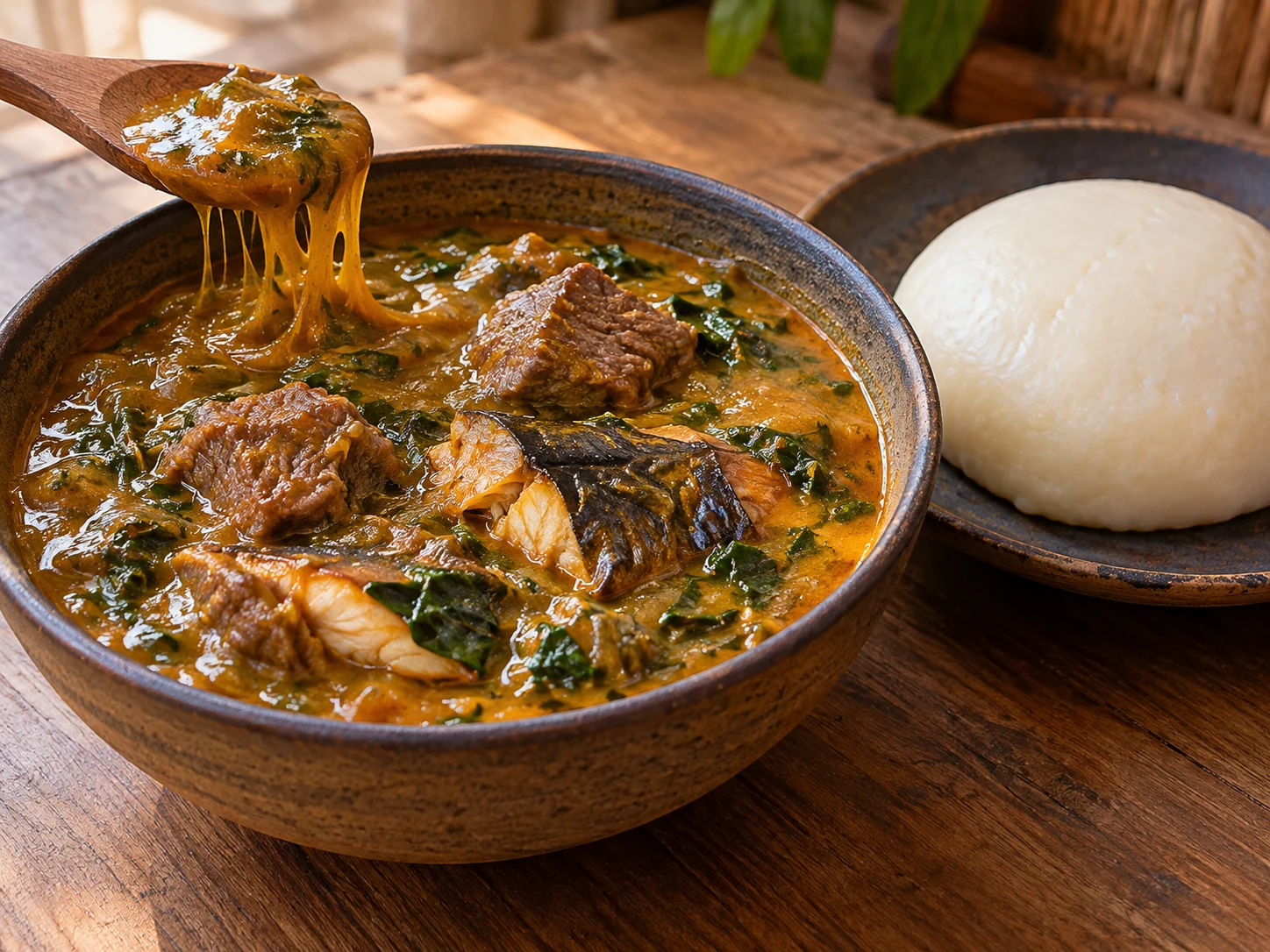
To use these seeds in cooking, they must be ground or milled very finely using a mortar or a dry coffee grinder until a powder with a slightly oily and sandy texture is obtained. This powder, upon contact with warm red palm oil, releases its natural oils and mucilage to create a velvety, dense, and highly stringy sauce that beautifully coats all the other ingredients of the dish.
🍳 OGBONO PREPARATION AND COOKING TECHNIQUE
The making of Ogbono soup is an art of thermal precision. Its aesthetic and physical success depends on how the Ogbono powder is dissolved and cooked to maximize its viscosity without ever burning it.
The first step is to boil and tenderize the selected meats and fish in a large pot. Beef, shaki tripe, gelatinous cow's foot, as well as pre-soaked stockfish and smoked fish are usually combined. These ingredients are seasoned with chili, sliced onions, and salt, and cooked in a measured amount of water to obtain a rich and flavorful, highly reduced broth.
While the meats are cooking, the Ogbono powder is dissolved. The most effective and safest traditional method to avoid lumps is to pour raw red palm oil into a small saucepan and heat it very slightly. Once the oil is warm (but definitely not hot), turn off the heat and incorporate the ground Ogbono powder. Using a wooden spoon, stir vigorously: the Ogbono powder instantly dissolves in the warm oil to form a smooth, shiny, and fluid paste of a beautiful terracotta color.
Once the meats are tender, this dissolved Ogbono preparation is poured directly into the pot containing the hot broth and meats. Stir immediately and vigorously. It is at this precise moment that the magic happens: the sauce instantly thickens and acquires its legendary slippery texture. Dried crayfish powder, fresh Cameroonian chili, and a little salt are then added if necessary.
It is imperative to let the soup simmer over low heat for at least ten to fifteen minutes, stirring regularly to allow the Ogbono seeds to cook completely, which eliminates any earthy aftertaste and releases the full slippery power of the fibers. To perfect the soup, a handful of finely chopped leafy vegetables, such as ugwu (pumpkin) leaves, waterleaf, or pre-washed bitterleaf, are added at the end of cooking. Simmer for another two minutes and turn off the heat. The final soup should be creamy, homogeneous, fragrant, and stretch beautifully into long, golden-green strands.
🍽️ THE PLACE OF OGBONO SOUP IN AFRICAN CUISINE
Within the gastronomic landscape of sub-Saharan Africa, Ogbono soup is a monument of unparalleled popularity. It belongs to the royal category of draw soups, a culinary style extremely popular throughout West and Central Africa for its unique and comforting texture.
In Nigeria, Ogbono transcends all cultural and geographical divisions. Although it is a symbol of Igbo cuisine, it is consumed with the same fervor in the north, south, and west of the country, becoming a true national culinary cement. It is an essential dish in daily life, but it also knows how to dress up with prestige at weddings, Sunday gatherings, and major year-end celebrations.
Ogbono soup is traditionally eaten steaming hot, accompanied by a swallow, this dense starchy paste that serves as a vehicle to bring the sauce to the mouth. It pairs wonderfully with eba (cassava semolina), cassava fufu, pounded yam, or wheat semolina. The ancestral gesture consists of taking a small ball of swallow, making a well in it with the thumb, then dipping it into the Ogbono soup. The exceptional viscosity of the Ogbono instantly coats the starch, allowing it to be swallowed with perfect fluidity while releasing a wave of earthy, marine, smoky, and deliciously spicy flavors.
On a continental scale, Ogbono soup shares a close kinship with indigenous chocolate or dika from Cameroon, and odika bread from Gabon and Congo. Although these countries prepare odika in the form of a grated block to accompany bushmeat or fish stews, the raw material remains rigorously the same, demonstrating the cultural and botanical unity of the African equatorial forest. Carried by the dynamic diaspora, Ogbono has established itself on tables worldwide. Vacuum-packed ground seeds are sold in exotic grocery stores in London, Toronto, Berlin, and Paris, allowing generations born abroad to rediscover the comforting taste of home and celebrate the living heritage of a rich, innovative, and resolutely sharing African cuisine.
✨ SYNONYMS FOR OGBONO SOUP
The Ogbono seed and the soup derived from it have several synonymous appellations depending on linguistic regions, countries, and culinary traditions:
African Wild Mango Soup: This is the most frequent descriptive French translation, mainly used to present the dish to an international audience or in educational and botanical contexts.
Odika Sauce or Odika Soup: In French-speaking Central African countries like Gabon, the Republic of Congo, the Central African Republic, and Cameroon, the ground and pressed seed into a black bread is called odika. The sauce prepared from this bread is thus commonly called odika sauce, although its preparation is darker and denser than classic Nigerian Ogbono.
Draw Soup: This is the generic English term in common use in West Africa to refer to Ogbono soup due to its stringy and viscous texture that facilitates the swallowing of starches.
Irvingia Gabonensis Soup: This is the modern and scientific name of the soup, increasingly used by nutritionists, dietitians, and new African cuisine chefs to scientifically promote the continent's ingredients on the global gastronomic scene.
🔑 OGBONO KEYWORDS
Ogbono Nigeria Irvingia gabonensis Odika Draw soup Send message
Prepare this speciality
Choose a detailed recipe, adjust the portions and prepare your ingredients before starting. Our cooking tips and food safety advice complement the steps described in the recipes.
Explore further: Cooking tips · Food hygiene and safety advice.
In my books

Continue exploring the continent’s cuisines with Africa at the Table — 54 countries, 54 iconic dishes, by Alioune FALL. This book is in English.
In the kitchen : Ogbono soup
Recipes from the site to put your knowledge into practice:
Discover these cuisines at a restaurant
Explore our restaurant and caterer directories. Choose your destination and check the establishment’s menu to confirm which dishes are offered and available.
Continue exploring
Enjoy discovering ingredients and African cuisines? Join our newsletter. The illustrated PDF 10 sauces africaines incontournables is in French and is offered after confirming a subscription to the French or bilingual edition.