Liboké
Central Africa
Understanding : Liboké
🐟 THE ORIGIN AND TRADITIONAL SYMBOLISM OF LIBOKÉ
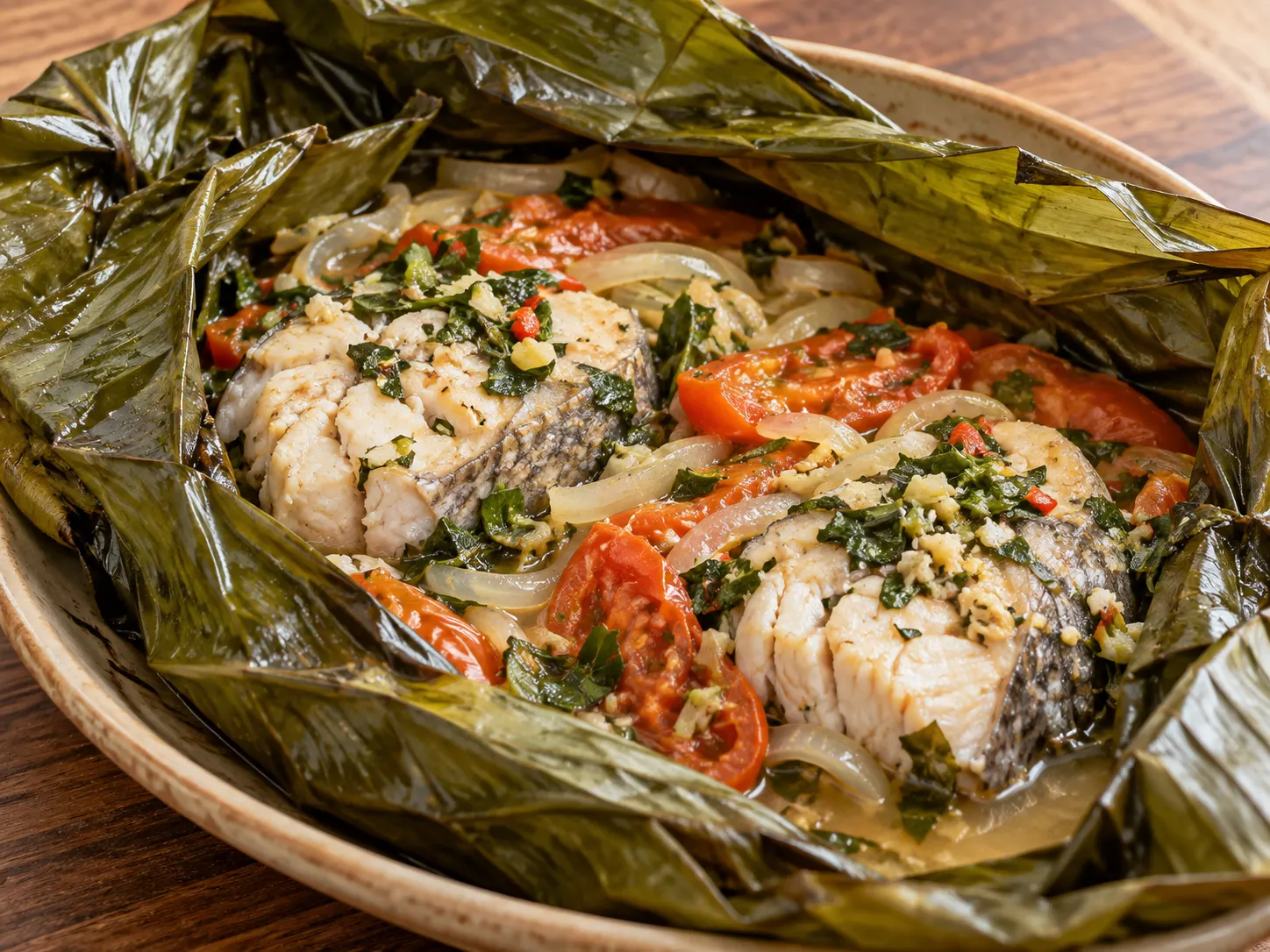
Liboké, whose plural in Lingala is maboké, is an ancestral cooking technique and an emblematic dish from Central Africa, particularly cherished in the Democratic Republic of Congo, the Republic of Congo, and the Central African Republic. Originally, this method met a practical need: to cook food uniformly and hygienically using the abundant resources of tropical nature, long before the introduction of modern metal kitchen utensils. The word refers to both the container, i.e., the papillote made from large plant leaves, and the content, which traditionally consists of fish, meat, or vegetables seasoned deliciously.
Where to find it
Look for the exact food-grade form required by the recipe at markets and specialist shops. Check the product name, ingredients, condition and storage instructions.
Explore further: Cooking tips · Food hygiene and safety advice.
History and uses
In the culinary cosmogony of Central Africa, liboké embodies a symbiotic and respectful relationship with nature. Cooking food in wild leaves harvested in the forest is not just a technical choice; it is a philosophy of temporarily borrowing the earth's aromas to enhance food. This forest cuisine, deeply linked to the Congo Basin and its immense river network, tells the story of fishermen and hunters who prepared their catch directly on the riverbanks, wrapping fresh catches in the surrounding foliage before placing them on embers. Liboké thus symbolizes original purity, rustic simplicity, and the authenticity of a cuisine that rejects artifice to focus on the very essence of the flavors of the earth and water.
🍃 THE SELECTION OF LEAVES AND THE ART OF FOLDING
The absolute secret to the success of an authentic liboké lies in the rigorous selection and handling of the leaves that form the protective wrapper. Unlike modern Western papillotes made of aluminum foil or parchment paper, the leaves used for liboké are not neutral: they play an active role as a condiment, subtly infusing the dish with an impeccable herbaceous, earthy, and slightly smoky aroma. The most sought-after leaves are those of Megaphrynium macrostachyum, locally known as banana leaves or Congolese leaves, although they belong to a distinct botanical family from that of the banana tree. These forest leaves are chosen for their exceptional robustness, their flexibility under heat, and their natural impermeability.
The preparation of the leaves is an artistic ritual that requires great dexterity. Before placing the ingredients in them, each leaf must be meticulously cleaned with a damp cloth to remove forest impurities. They are then quickly passed over a live flame or hot embers. This crucial step, called wilting, modifies the leaf's structure by softening its tough fibers, making it extremely supple and malleable, preventing it from tearing during folding.
Folding is a complex skill learned from childhood from elders. It involves superimposing several layers of leaves, crossing their veins to ensure perfect sealing. The richly marinated pieces of fish or meat are then placed in the center, and the whole is closed to form an airtight pouch, a tightly packed parcel. This parcel is traditionally tied at the top using a flexible liana taken from the central vein of the leaf or a vegetable string. Cooking then takes place either directly on a bed of glowing charcoal embers or by steaming in a large pot containing a little water. The steam trapped inside the papillote inflates the pouch, allowing the food to cook gently in its own juices and in the aromatic sweats of the vegetables, without any added fat.
🍅 CULINARY VARIATIONS AND KEY INGREDIENTS
The most famous and widely consumed liboké worldwide is undoubtedly fish liboké, known in Lingala as liboké ya mbisi. For this royal preparation, freshwater fish caught in the majestic Congo River or its many tributaries are generally used. Captain fish, catfish called ngolo, or bream are particularly appreciated for the firmness of their flesh, which admirably withstands slow steaming.
The seasoning of the fish is a matter of precision and generosity. A dense marinade is prepared, consisting of crushed ripe fresh tomatoes, finely chopped red onions, crushed garlic, grated fresh ginger, cayenne pepper or West Indian chili for heat, and chives or green onions. Sometimes ground wild nutmeg seeds or forest black pepper are added to complexify the aromatic profile. The fish is generously coated with this vegetable mixture before being enclosed in the leaves. During cooking, the vegetables literally melt, creating a divinely fragrant, creamy, and umami-rich cooking juice, without the need to add a single drop of oil.
In my books

Continue exploring the continent’s cuisines with Africa at the Table — 54 countries, 54 iconic dishes, by Alioune FALL. This book is in English.
Explore further
Although fish is the undisputed king of this specialty, liboké comes in a multitude of other savory variations. Chicken liboké, or liboké ya soso, is a highly sought-after festive dish where poultry pieces simmer with onions, garlic, and sometimes peanut paste to add richness and creaminess. There is also wild mushroom liboké, sapelli caterpillar liboké, which is a highly esteemed seasonal delicacy for its nutritional value, or bushmeat or pork liboké. Each variant expresses the richness of the terroir and the creativity of the cook who knows how to adapt her spices according to the chosen protein.
👪 NUTRITIONAL VALUE AND ROLE IN SOCIETY
From a health perspective, liboké is considered by nutritionists to be one of the healthiest and most dietary cooking methods in world gastronomy. Indeed, steaming in airtight leaves preserves all the nutrients, vitamins, and minerals contained in fish or meats, unlike cooking in water where a large part of these beneficial elements dissolves in the discarded cooking broth. Moreover, the complete absence of added oil makes liboké a particularly digestible, light, and low-fat dish, ideal for maintaining good cardiovascular health.
Beyond its undeniable nutritional qualities, liboké holds a major sociological place in Central African cultures. Its preparation, which requires time, patience, and attention, is often a collective activity. The women of the household gather to clean the leaves, pound the condiments, and fold the parcels, thus creating a privileged space for discussion where family stories, educational advice, and ancestral culinary techniques are transmitted.
Serving a hot liboké at a family gathering, a traditional wedding, or to welcome a distinguished guest is a gesture of deep social significance. Opening the steaming vegetable papillote in front of one's guest, allowing a cloud of intensely fragrant steam to escape, is a highly respectful ritual of hospitality and sharing. It is offering the other the fruit of careful work, a gift wrapped by nature itself. For Congolese living abroad, liboké is the dish of nostalgia par excellence. Recreating this dish in exile, sometimes using aluminum foil covered with frozen banana leaves bought in exotic stores, is a strong act of identity resistance, a way of keeping alive the sensory umbilical cord with the distant homeland.
💫 SYNONYMS AND REGIONAL DENOMINATIONS
The liboké technique transcends cultural and linguistic boundaries, which gives it various names and synonyms depending on the countries and communities of Africa:
Maboké: The plural form in Lingala, very frequently used to refer to the dish itself in restaurant menus or during family meals. Liboke: Simplified spelling without accent, commonly used in written publications and on social media. African papillote: French descriptive name used by gastronomes and in international catering circles to explain the cooking concept. Domba: The Cameroonian equivalent of liboké, a traditional method of cooking spiced meats or fish in banana or marantaceae leaves over embers. Ndoba: Term used in some regions of Central Africa to refer to stews cooked by steaming in forest leaves. Ebolo: Lingala term related to the action of wrapping food for cooking in the form of a package. Liboké ya mbisi: Specific name referring exclusively to freshwater fish papillote. Liboké ya soso: Formula specifically referring to the variant prepared with chicken pieces. Liboké ya pondu: Original variant where pounded cassava leaves are steamed in this vegetable pouch.
🔑 KEYWORDS
Congolese gastronomy Steaming Vegetable papillote Megaphrynium macrostachyum Forest cultural heritage
In the kitchen : Liboké
Recipes from the site to put your knowledge into practice:
Discover these cuisines at a restaurant
Explore our restaurant and caterer directories. Choose your destination and check the establishment’s menu to confirm which dishes are offered and available.
Continue exploring
Enjoy discovering ingredients and African cuisines? Join our newsletter. The illustrated PDF 10 sauces africaines incontournables is in French and is offered after confirming a subscription to the French or bilingual edition.