Lasary
Madagascar
Understanding : Lasary
🥗 THE ESSENCE AND PLACE OF LASARY IN INDIAN OCEAN GASTRONOMY
Lasary is much more than a simple side dish or a refreshing starter in Malagasy cuisine: it is the aromatic soul that awakens, balances, and elevates every daily meal. Originating from the Great Island of Madagascar, this traditional condiment is an integral part of the rich tapestry of African and Indian Ocean cuisine. It refers to a vast family of culinary preparations ranging from crunchy raw vegetable salads to sweet and sour marinated condiments, all characterized by a stimulating acidity, a lively vegetable freshness, and often, a spicy warmth that makes the taste buds water.
Where to find it
Look for the exact food-grade form required by the recipe at markets and specialist shops. Check the product name, ingredients, condition and storage instructions.
Explore further: Cooking tips · Food hygiene and safety advice.
History and uses
Historically, lasary bears witness to Madagascar's unique cultural melting pot. Located at the crossroads of maritime routes connecting continental Africa, Southeast Asia, and the Arab-Indian world, the island has successfully fused these diverse influences to create a singular culinary identity. While the use of rice as a staple food comes from Asia, the art of accompanying this rice with flavorful sauces and tangy condiments draws its roots from both African food preservation traditions and the Indian love for achards and chutneys. Lasary is the fruit of this happy encounter. It embodies the ingenuity of Malagasy cooks who, with simple and local ingredients, have managed to design a natural flavor enhancer capable of transforming the most modest meal into an unforgettable sensory experience. Today, it is impossible to imagine a Malagasy table, whether set in the highlands of Imerina or on the sunny coasts, without a bowl of lasary to accompany the main dish.
🥕 EMBLEMATIC VARIETIES AND THEIR INGREDIENTS
The richness of lasary lies in its remarkable diversity, with each region and season dictating the use of specific ingredients to create variations, each more delicious than the last.
The most famous and widely consumed daily variant is undoubtedly lasary voatabia, or tomato lasary. This disarmingly simple condiment features fresh, juicy, and ripe tomatoes, cut into very small, uniform cubes. Finely sliced red or white onions are added, their pungency softened by a prior rinse or by the action of acid. Depending on taste and garden herbs, chopped chives, fragrant fresh cilantro, or grated ginger are added. The whole is bound by a drizzle of neutral vegetable oil and a touch of acidity provided by lime juice or white vinegar, not forgetting a pinch of sea salt.
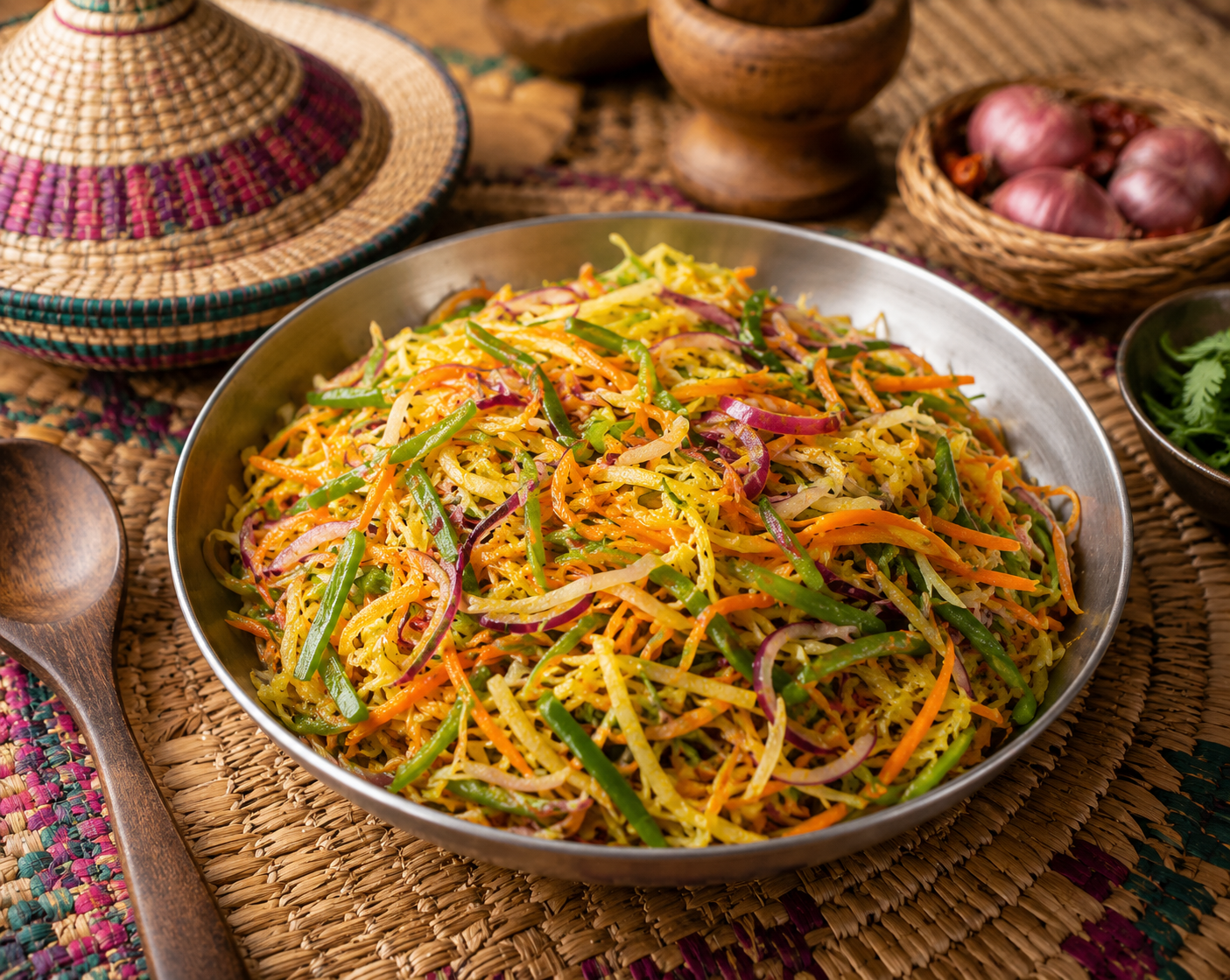
Another major variation is lasary legioma, or vegetable lasary. Unlike the tomato version, this one resembles a warm or cold salad of lightly cooked vegetables. It generally consists of carrots cut into thin sticks or grated, trimmed green beans, and shredded white cabbage. The vegetables are blanched separately in salted boiling water so that they retain their vibrant color and natural crunch. Once cooled, they are mixed with raw onions and seasoned with a vigorous vinaigrette made from oil, vinegar, pepper, and sometimes a hint of mustard.
On the coasts of Madagascar, where tropical fruits abound, lasary manga is prepared, a tangy condiment made from grated or julienned unripe green mangoes. This preparation is often enhanced with hot chili and spices like turmeric, offering a complex flavor profile that is simultaneously sour, salty, and spicy, pairing divinely with wood-fired grilled fish. There is also lasary voatango, a refreshing version made from deseeded and diced cucumbers, ideal for soothing the heat of slow-cooked meat dishes.
👩🍳 THE ART OF PREPARATION AND THE CHEMISTRY OF FLAVORS
The making of a good lasary is a subtle art based on precise cuts and a delicate balance between fat, salt, and acidity. The first secret lies in the calibration of ingredients. Onions and tomatoes must be cut extremely finely and uniformly. This fineness is not only aesthetic: it increases the contact surfaces between the vegetables and the seasoning, thus promoting rapid and homogeneous impregnation of flavors.
Acidity is the chemical engine of lasary. Whether it comes from freshly squeezed lime juice or traditional cane vinegar, acid plays several essential roles. On the one hand, it acts as a cold cooking agent, especially on raw onions, by breaking down their cell membranes to eliminate their aggressive and indigestible pungency, while revealing their natural sweetness. On the other hand, acidity brings a vibrant top note that stimulates taste receptors and facilitates the digestion of main dishes, which are often rich in fats.
In my books

Continue exploring the continent’s cuisines with Africa at the Table — 54 countries, 54 iconic dishes, by Alioune FALL. This book is in English.
Explore further
To bind these lively flavors, the addition of quality fat is essential. A neutral vegetable oil, such as sunflower or peanut oil, is generally used, which acts as a flavor conductor and envelops the ingredients in a veil of sweetness. Finally, red or green chili, called sakay in Madagascar, is the royal condiment that crowns the lasary. It can be incorporated directly as chopped rounds for a diffused spiciness, or served separately as a paste pounded with ginger and garlic so that each guest can adjust their own heat level. Lasary can be consumed immediately after preparation to enjoy the crunch of fresh vegetables, or left to marinate for a few hours in an airtight jar to develop more candied and complex notes, similar to pickles.
🌍 A SOCIAL SYMBOL OF HOSPITALITY AND CONVIVIALITY
Within Malagasy society, the meal is a sacred act structured around vary, steamed white rice, which constitutes the nutritional and spiritual basis of daily life. Rice is considered the body of the meal, but to be complete, it must be accompanied by laoka, meaning side dishes, broths, meats, or vegetables. In this configuration, lasary plays the role of a universal taste mediator. By bringing its touch of acidity, freshness, and spiciness, it breaks the monotony of dry rice and cuts through the richness of traditional laoka such as beef romazava or fatty pork ravitoto.
Enjoying lasary is part of a tradition of family sharing and conviviality. During daily meals as well as large wedding receptions or ancestral ceremonies, lasary is arranged in small colorful bowls distributed on the table. Eating rice topped with lasary is a collective experience that strengthens community bonds and cultivates the joy of being together. It is also an essential element of Malagasy street food. In cities and villages, as night falls, street stalls come alive under the light of kerosene lamps. Customers flock there to enjoy mokary, small rice cakes cooked in special molds, grilled meat skewers called masikita, or simple white bread sandwiches, all generously garnished with crunchy and spicy lasary.
For members of the Malagasy community living abroad, lasary is a crucial vector of cultural identity. Preparing a lasary voatabia or a vegetable lasary during diaspora gatherings is a way to instantly revive the warm atmosphere of Malagasy markets. It is a sensory bridge thrown across the oceans, allowing the generations born in exile to transmit the unique taste of the Great Island and the love of authentic cuisine based on freshness and simplicity.
💫 SYNONYMS AND COMPLEMENTARY DENOMINATIONS
The culinary concept of lasary, which consists of combining fresh or cooked vegetables with a tangy and spicy seasoning to accompany the main dish, is found under different names across Africa and the Indian Ocean islands. These synonymous or related denominations bear witness to the circulation of culinary know-how in this geographical area:
Rougail: The most direct and widely used synonym in the neighboring islands of Reunion and Mauritius, as well as on the east coast of Madagascar, to designate the cold preparation based on tomatoes, onions, and chili that accompanies curries. Kachumbari: The essential East African equivalent, consumed daily in Kenya, Tanzania, Uganda, Rwanda, and Burundi, composed mainly of tomatoes, onions, and lime juice. Achard: An Indo-Persian term used in Madagascar, Reunion, and Mauritius to specifically designate salads of cooked or raw vegetables marinated in oil, vinegar, and turmeric. Chakalaka: Although richer in spices and often cooked with beans, this South African condiment shares with vegetable lasary its role as a spicy and crunchy salad intended to enhance the main dish. Lasari: A phonetic spelling variant sometimes used in international culinary literature or by certain regional communities to designate this national condiment. Salady: A Malagasy word derived from the French salade, sometimes used informally to refer to the freshest and most immediate versions of lasary without prolonged maceration. Sambal: A spicy and tangy condiment from Southeast Asia that shares obvious technical and aromatic similarities with the spiciest lasary of Madagascar.
🔑 KEYWORDS
Malagasy condiment Raw vegetable salad Tangy side dish Culinary heritage Street food
In the kitchen : Lasary
Recipes from the site to put your knowledge into practice:
Discover these cuisines at a restaurant
Explore our restaurant and caterer directories. Choose your destination and check the establishment’s menu to confirm which dishes are offered and available.
Continue exploring
Enjoy discovering ingredients and African cuisines? Join our newsletter. The illustrated PDF 10 sauces africaines incontournables is in French and is offered after confirming a subscription to the French or bilingual edition.