Katogo
Uganda
Understanding : Katogo
🍲 INTRODUCTION AND HISTORICAL ORIGINS OF KATOGO
Katogo is undoubtedly one of the most iconic pillars of East African culinary culture, particularly in Uganda. This dish, born of simplicity and necessity, has endured through the ages to become a true symbol of national unity and conviviality. The word katogo finds its roots in the Luganda language, spoken by the Baganda people who primarily reside in the central region of Uganda. In this rich language, the term literally translates to a mixture or fusion of several ingredients cooked together in a single pot.
Prepare this speciality
Choose a detailed recipe, adjust the portions and prepare your ingredients before starting. Our cooking tips and food safety advice complement the steps described in the recipes.
Explore further: Cooking tips · Food hygiene and safety advice.
History and uses
Originally, during the first decades of its creation, katogo was perceived as a meal for humble people. It was an economical preparation, mainly adopted by families or workers who had limited resources or who had to face long and arduous days of physical labor in the fields. For these people, it was crucial to consume a particularly rich, substantial meal at dawn, capable of providing them with the necessary energy to last until evening. Thus, the tradition of katogo as a national breakfast was born. Unlike Western habits that favor light or sweet foods in the morning, the inhabitants of this region prefer to start their day with a steaming plate of this invigorating stew.
Over time, the social perception of this dish has profoundly changed. Katogo has broken down social class barriers to become a universal comfort food, appreciated in the most remote rural villages as well as in trendy restaurants and large hotels in the capital, Kampala. It is the perfect illustration of how a popular dish, initially dictated by subsistence, can be elevated to the rank of a national gastronomic masterpiece thanks to the passion and loyalty of an entire people.
🍌 VARIATIONS AND SYNONYMS OF THIS TRADITIONAL SPECIALTY
The great strength of katogo lies in its incredible adaptability. While there is a basic recipe, variations are extremely numerous depending on regions, seasons, budgets, and personal preferences. It is this diversity that explains why the dish is referred to by several synonyms or descriptive names across the country. The central element, the true backbone of the dish, remains matooke, which refers to these very unsweet and starch-rich green plantains, typical of the East African highlands.
Among the most common synonyms and variations of katogo are:
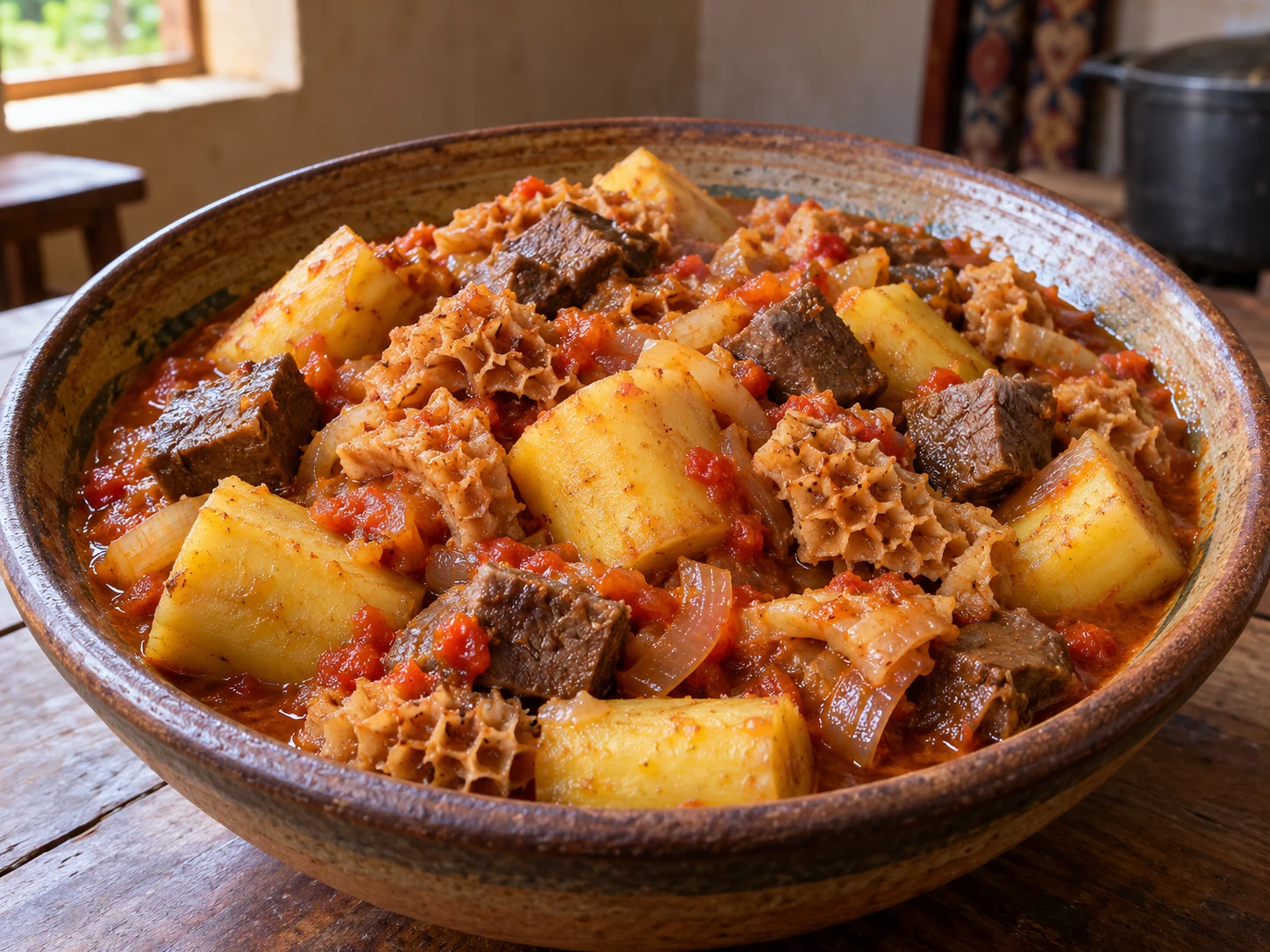
Matooke n'enyama: This term refers to the classic and highly prized combination of green banana and beef. It is the quintessential stew, festive and flavorful, prepared for special occasions or for a rich morning treat. Matooke n'ebijanjaalo: This vegetarian version combines green bananas with stewed red or black beans. It is extremely popular in modest households, school boarding houses, and religious communities, offering an economical yet highly nutritious alternative. Matooke n'ebyenda: This particularly appreciated variant among local connoisseurs combines matooke with beef tripe and offal. The resulting broth has great aromatic depth, renowned for its creamy texture and invigorating properties after a long night. Matooke n'ebinyebwa: Here, green bananas are cooked to be coated with a creamy and thick peanut or groundnut sauce. It is a mild, creamy, and particularly comforting recipe. Although the term katogo remains specifically Ugandan, related culinary preparations are found in neighboring countries such as Rwanda, Burundi, or western Tanzania and Kenya, where green banana also forms the basis of daily diet. However, for any inhabitant of the region, pronouncing the word katogo instantly evokes Ugandan identity, terroir, and savoir-faire.
🍳 DETAILED DESCRIPTION OF THE PREPARATION AND ITS INGREDIENTS
The preparation of katogo is an exercise in patience and aromatic balance. It all begins with the selection of matooke. These green bananas must be firm, fleshy, and absolutely fresh. The most delicate step is peeling. Unlike ripe bananas, the skin of matooke adheres strongly to the flesh and releases a sticky sap that is very difficult to clean. Ugandan cooks often coat their hands with a little cooking oil to prevent this sap from sticking. Once peeled, the bananas are immediately plunged into cold water to prevent them from oxidizing and turning an unappetizing blackish color.
Cooking is traditionally done in a large cast iron or clay pot over a charcoal fire, which gives the dish an inimitable subtle smoky flavor. First, the basic condiments are sautéed in a little fat or traditional ghee: finely chopped onions, crushed garlic, grated fresh ginger, ripe tomatoes, and green peppers. This aromatic base will give the dish its full personality.
In my books

Continue exploring the continent’s cuisines with Africa at the Table — 54 countries, 54 iconic dishes, by Alioune FALL. This book is in English.
Explore further
For the meat version, pieces of beef or tripe are then added and browned to seal in the juices. Spices are incorporated according to taste, such as curry powder, masala, or simply salt and pepper. When the meat begins to tenderize and release its own broth, the drained green bananas are delicately placed on top of the culinary preparation.
One of the secrets of traditional cooking lies in the use of banana leaves to hermetically cover the pot. These leaves trap steam, allowing for slow and even braising. Under the effect of this gentle heat, the green bananas become extremely tender and absorb the flavors of the sauce simmering just below. The starch naturally present in the bananas gradually releases into the cooking liquid, acting as a natural binder that thickens the sauce to give it a rich and velvety consistency. The dish is ready when the matooke can be easily mashed with a fork and the meat is perfectly tender.
🌍 THE UNIQUE PLACE OF KATOGO IN AFRICAN CUISINE
Within the African culinary landscape, katogo occupies a singular and highly symbolic place. Africa is a continent characterized by extraordinary gastronomic diversity, but major common threads unite its different regions. While West Africa is often celebrated for its spicy rice dishes like jollof rice or its preparations of pounded tubers accompanied by thick sauces, East Africa stands out for its unconditional love for green mountain bananas and cereals like millet and corn.
Katogo is a worthy representative of this East African cuisine, focused on local produce and a one-pot cooking philosophy. This single-pot cooking method, found throughout the continent, does not only respond to a logic of simplicity or energy saving. It testifies to a culinary approach where ingredients are not simply combined on a plate, but intimately fuse during cooking to create a synergy of flavors.
Moreover, katogo perfectly illustrates the nutritional genius of African populations. By combining a source of complex carbohydrates like matooke with animal or vegetable proteins like beef, offal, or beans, the dish offers a remarkably balanced nutritional profile. It is a complete meal that sustains the body and warms the spirit. In a continental culture where sharing food is an almost sacred act, katogo embodies this generosity. One never prepares a small portion of katogo; one always cooks a large pot meant to be shared with family, neighbors, or passers-by, thus strengthening social cohesion and a sense of community.
👥 THE SOCIAL ROLE AND CULTURAL EVOLUTION OF CONTEMPORARY KATOGO
In modern Uganda, katogo goes far beyond simple food to become a true social institution. From the first light of dawn, city streets come alive to the rhythm of street vendors and small neighborhood restaurants, commonly called kafunda, where large steaming pots of katogo are set over embers. It is the morning gathering point for an entire population.
This dish has the rare virtue of bringing together people from all walks of life. In these small street restaurants, it is not uncommon to see a senior executive in a suit and tie sitting on a wooden bench next to a laborer or a taxi driver, all sharing the same simple pleasure of enjoying a hot katogo before starting their day. It is a powerful social equalizer that reminds us that, beyond professional or economic differences, everyone shares the same roots and the same taste values.
With rapid urbanization and openness to the world, katogo has also begun its own revolution. Young Ugandan chefs are now appropriating this ancestral recipe to reinvent it and present it in a more contemporary way. Fusion versions of katogo are appearing, incorporating crunchy vegetables, potatoes, or fresh aromatic herbs, or even spices from elsewhere. Some high-end restaurants in Kampala offer it on their weekend brunch menus, attracting a cosmopolitan clientele and tourists curious to discover local cuisine. Nevertheless, for the majority of the population, the traditional version remains unequaled, as it directly touches the emotional memory of childhood and meals prepared by mothers and grandmothers.
✨ CONCLUSION AND RADIANCE OF THIS CULINARY IDEAL
In conclusion, katogo is much more than a simple recipe; it is a culinary poem that tells the story, resilience, and joy of life in East Africa. From humble rural homes to trendy urban tables, this harmonious blend of green matooke bananas and savory stew has won the hearts of millions. It testifies to the unsuspected richness of African gastronomy, a cuisine of the earth, generous, healthy, and deeply human. As the world becomes increasingly interested in global culinary diversity, authentic dishes like katogo amply deserve to shine on the international stage, offering gourmets worldwide a unique culinary journey into the heart of Ugandan traditions.
🔑 KEYWORD LIST
Katogo Matooke Uganda African stew Traditional cuisine
In the kitchen : Katogo
Recipes from the site to put your knowledge into practice:
Discover these cuisines at a restaurant
Explore our restaurant and caterer directories. Choose your destination and check the establishment’s menu to confirm which dishes are offered and available.
Continue exploring
Enjoy discovering ingredients and African cuisines? Join our newsletter. The illustrated PDF 10 sauces africaines incontournables is in French and is offered after confirming a subscription to the French or bilingual edition.