Sukuma wiki
Kenya
Understanding : Sukuma wiki
🌿 ORIGIN AND CULTURAL SIGNIFICANCE OF SUKUMA WIKI
Sukuma wiki is much more than a simple side dish of vegetables in the Horn of Africa and the Great Lakes region. It is a true symbol of resilience, domestic ingenuity, and daily survival for millions of households, primarily in Kenya and Tanzania. To understand the unique place this dish holds in the hearts of East African populations, one must first look at the poetry and pragmatism of its Swahili name. Literally, the term sukuma means to push or to stretch, while wiki refers to the week. Thus, sukuma wiki translates to 'stretch the week' or 'push through to the end of the week'.
Where to find it
Look for the exact food-grade form required by the recipe at markets and specialist shops. Check the product name, ingredients, condition and storage instructions.
Explore further: Cooking tips · Food hygiene and safety advice.
History and uses
This picturesque expression perfectly describes the economic and social reality surrounding this vegetable. Sukuma wiki is affordable, available year-round even during periods of relative drought, and extremely easy to grow in small urban or rural gardens. For modest families whose budget dwindles as the end of the month approaches, this dish is the ideal solution to feed many mouths in a healthy and economical way. It is the meal that bridges the gap between paydays, ensuring that no family goes to bed hungry.
Historically, the cultivation of this vegetable intensified in East Africa during the colonial and post-colonial periods, accompanying the rapid urbanization of cities like Nairobi. Faced with the high cost of urban living and the need to find nutrient-rich yet inexpensive foods, residents adopted and popularized this hardy cabbage. Today, it has transcended its status as a crisis food to become a national pride and an indispensable component of the region's culinary identity.
🥬 BOTANY, INGREDIENTS, AND SYNONYMS OF THIS EMBLEMATIC PLANT
Botanically, sukuma wiki refers to a specific variety of non-heading collard greens belonging to the Brassicaceae family. Unlike Western-style cabbages that form a compact, round head, this plant grows with large, spreading leaves along a sturdy central stem. Its thick, slightly crinkled, and deep dark green leaves are harvested as they grow, allowing the plant to continue producing for several months.
This vegetable is known by several synonyms and descriptive names across the world and different regions of Africa:
Collard greens: This is its most accurate English name, referring to this variety of ornamental and edible cabbage whose leaves do not close. Chou cavalier: This French term is widely used in North America and the English-speaking world, where the vegetable also holds a central place in traditional Southern US cuisine, originally introduced by deported African populations. Non-heading kale: An anatomical description used in some agricultural manuals to distinguish it from classic kales. East African collard greens: A geographical designation that highlights its regional importance compared to other leafy green varieties. Mchicha wa mlima (mountain mchicha): Although the term mchicha generally refers to amaranth leaves in Swahili, some local dialects use variations of this word to describe sukuma wiki when prepared in a similar way. The classic and popular sukuma wiki recipe is characterized by its simplicity. Basic ingredients generally include fresh vegetable leaves, vegetable oil, white or red onions, ripe tomatoes, and salt. However, to enrich the dish's aromatic profile, many families add a pinch of fresh chopped cilantro, cayenne pepper, or a bouillon cube (meat or vegetable), locally known by the brand Royco. In some regional variations, particularly among pastoral communities or in coastal areas, a dash of fresh cow's milk or coconut cream is added at the very end of cooking to soften the natural bitterness of the cabbage leaves.
🍳 PREPARATION AND TRADITIONAL CULINARY TECHNIQUES
The preparation of sukuma wiki requires simple but precise manual skill, often passed down from generation to generation. The first step is to rigorously sort the leaves. Those that are too yellowed or damaged are removed, then a thorough washing with plenty of water is carried out to remove soil, sand, or small insects that like to hide in the leaf folds.
The next step is trimming, which involves separating the tender part of the leaf from its tough, fibrous central vein. To do this, one firmly holds the stem with one hand and slides the other hand along the stem to tear off the leaf with a sharp motion. Once this operation is performed on the entire bunch, the leaves are stacked, tightly rolled into a compact cigar shape, then cut crosswise into extremely thin, almost hair-like strips. This fine chiffonade cut is essential: it allows the leaves to cook quickly while retaining a pleasant texture, without becoming stringy.
In my books

Continue exploring the continent’s cuisines with Africa at the Table — 54 countries, 54 iconic dishes, by Alioune FALL. This book is in English.
Explore further
Traditional cooking is done in a pan or cast-iron pot over a wood or charcoal fire. Vegetable oil is heated first before finely sliced onions are added. When the onions become translucent and begin to brown, crushed tomatoes are added. They are simmered over medium heat, gently crushing them with a wooden spoon until they form a rich, fragrant, and slightly caramelized tomato paste. It is at this point that the sliced sukuma wiki is incorporated.
Unlike the prolonged cooking practices observed for other leaves in Central or West Africa, sukuma wiki is generally stir-fried quickly, for only five to ten minutes. Cooks ensure the mixture is constantly stirred so that all the leaves are coated with the onion-tomato sauce. This brief cooking allows the leaves to preserve their beautiful vibrant green color, their slightly crunchy texture, and, above all, the entirety of their vitamins and minerals that would otherwise be destroyed by excessive and prolonged heat.
🌽 SUKUMA WIKI AND UGALI: A CULINARY AND NUTRITIONAL MARRIAGE
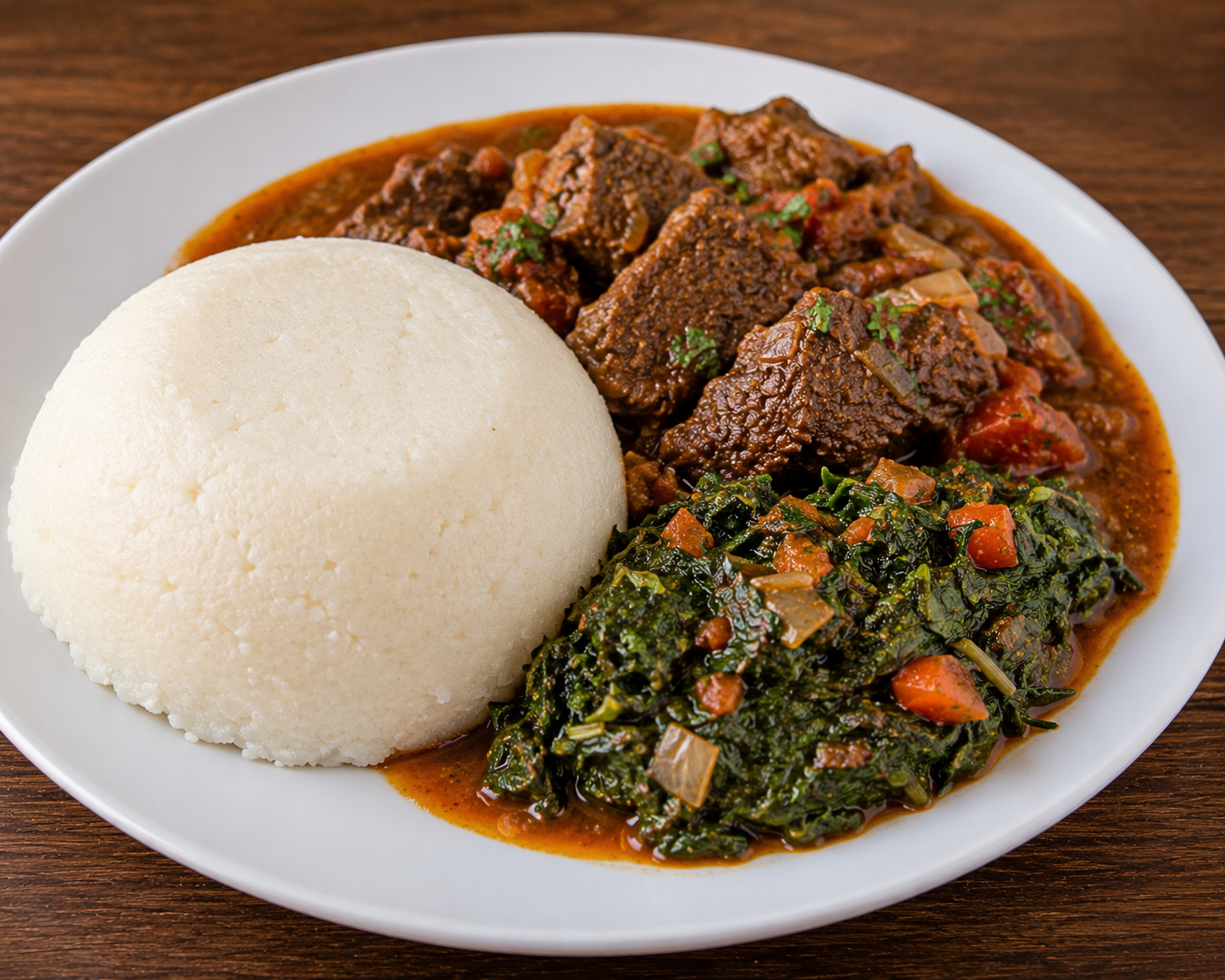
It is impossible to mention sukuma wiki without mentioning its inseparable plate partner: ugali. Ugali is a dense paste of white corn flour cooked in boiling water, which forms the staple carbohydrate of most of East Africa. Together, sukuma wiki and ugali form the quintessential nourishing pair, the daily meal that defines the East African table.
From a nutritional perspective, this combination is remarkably effective. Ugali provides the necessary energy in the form of complex carbohydrates, while sukuma wiki provides a wealth of essential micronutrients. This collard green is indeed exceptionally rich in iron, calcium, dietary fiber, as well as vitamins A, C, and K. For populations who do not have daily or abundant access to animal protein due to economic constraints, sukuma wiki represents a vital source of nutrients to prevent anemia and support children's growth.
The way this meal is consumed is also rooted in tradition. Sukuma wiki and ugali are eaten with the hands. The ritual consists of taking a small ball of warm ugali with the right hand, gently pressing it with the fingers to form a small spoon-shaped hollow, then using this paste spoon to scoop up a generous portion of stir-fried sukuma wiki. It is an act of physical and sensory sharing with food, where each bite brings a perfect balance between the neutral sweetness of the corn paste and the slightly bitter and tangy flavor of the sautéed vegetables.
🌍 THE UNIQUE PLACE OF SUKUMA WIKI IN AFRICAN CUISINE
The African continent has an extremely rich and diverse tradition of consuming leafy greens, but each region has developed its own preferences and preparation methods. While Central and West Africa favor leaves simmered for a long time with palm oil, dried meat, or smoked fish, like Cameroonian ndole or Congolese saka-saka, East Africa stands out for the simplicity and speed of execution of its stir-fried vegetables, of which sukuma wiki is the most worthy representative.
This simplicity also reflects a different relationship with the environment. Sukuma wiki highlights the vegetable in its purest form, without masking its original taste with overly complex or heavy sauces. It is a cuisine that celebrates fresh garden produce. Moreover, this dish shows how an introduced or locally adapted ingredient can become the pillar of a national culinary culture, demonstrating the ability of African societies to integrate external elements to enrich their own heritage.
Today, sukuma wiki is undergoing a period of cultural revaluation and modernization. Long considered a dish for the poor, it is making a strong comeback on the tables of the urban middle class and in the menus of trendy restaurants in Nairobi and Dar es Salaam. Nutritionists now celebrate it as a local superfood, the equal of Western kale, encouraging younger generations to rediscover its health benefits. Furthermore, with the rise of the East African diaspora around the world, sukuma wiki is making its way onto international culinary scenes, offering a tasty and healthy gateway for anyone wishing to explore the unknown delights of East African gastronomy.
🔑 KEYWORDS
Sukuma wiki Ugali Collard greens Kenya East African cuisine
In the kitchen : Sukuma wiki
Recipes from the site to put your knowledge into practice:
Discover these cuisines at a restaurant
Explore our restaurant and caterer directories. Choose your destination and check the establishment’s menu to confirm which dishes are offered and available.
Continue exploring
Enjoy discovering ingredients and African cuisines? Join our newsletter. The illustrated PDF 10 sauces africaines incontournables is in French and is offered after confirming a subscription to the French or bilingual edition.