Mrouzia
Morocco
Understanding : Mrouzia
🍯 MROUZIA: ORIGIN AND IDENTITY
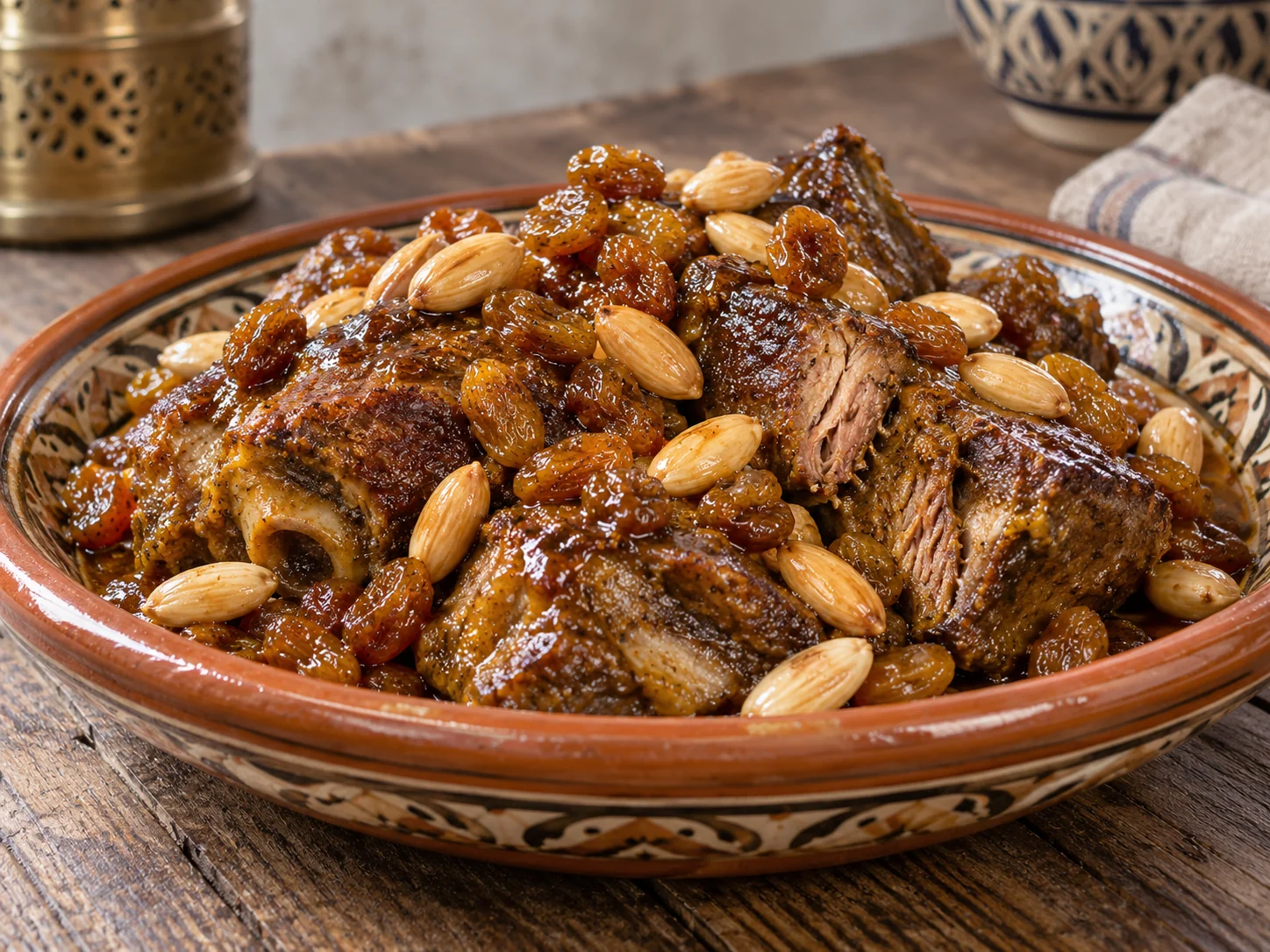
Mrouzia is one of the most iconic dishes of Moroccan cuisine and, more broadly, of the Maghrebi culinary tradition. It is a generous, rich, and fragrant dish, often associated with special occasions, festive meals, and family gatherings. It is recognized by its unique balance of savory, sweet, and spices, a balance that defines its gastronomic nobility. Made primarily with lamb, it is slow-cooked with raisins, honey, almonds, and warm spices such as cinnamon, ginger, saffron, and ras el hanout. This marriage of flavors gives rise to a dish deeply rooted in North African culinary art.
Mrouzia is not just a sweet tagine. It is a prestigious preparation, often served during Eid al-Adha, weddings, large family reunions, or honorary meals. It symbolizes abundance, generosity, and refinement. In the collective memory, it evokes the cuisine of long preparation, where ingredients are left to confit, reduce, and infuse until a nearly festive harmony is achieved. Its identity rests as much on technique as on symbolism: to cook a mrouzia is to celebrate.
Prepare this speciality
Choose a detailed recipe, adjust the portions and prepare your ingredients before starting. Our cooking tips and food safety advice complement the steps described in the recipes.
Explore further: Cooking tips · Food hygiene and safety advice.
History and uses
🌿 A UNIQUE PLACE IN AFRICAN CUISINE
In African cuisine, mrouzia holds a special place because it represents one of the most elegant facets of Maghrebi cuisine. African cuisine is not homogeneous, and mrouzia is a striking proof of this. It shows how much the continent harbors diverse gastronomic traditions, ranging from grain dishes of the Sahel to West African stews, and the refined tagines of North Africa.
Mrouzia belongs to the family of dishes where meat is prepared with dried fruits, honey, and spices. This sweet-savory logic is very present in Maghrebi cuisines, but it also finds echoes in other African cuisines where combinations of ingredients seem to tell the story of trade routes, cultural exchanges, and Arab-Berber, Andalusian, and Mediterranean influences. It is therefore both deeply Moroccan and fully African.
Its importance is significant because it embodies hospitality. In many households, mrouzia is not prepared for an ordinary meal. It is reserved for important guests, religious holidays, or significant events. It then becomes a language of generosity. Offering a mrouzia is to show that one has taken the time, chosen noble ingredients, and wishes to honor those who will share it.
🥘 FLAVORS, TECHNIQUE, AND ART OF PREPARATION
The uniqueness of mrouzia comes from the delicate balance between several taste dimensions. Lamb or mutton brings a deep richness and a melting texture when properly slow-cooked. Raisins provide a natural sweetness. Honey enhances this sweet roundness while giving an appetizing sheen to the sauce. Almonds add crunch or texture depending on how they are prepared. Spices, meanwhile, structure the whole and prevent the dish from becoming too heavy or monotonous.
Among the most used spices, one often finds cinnamon, ginger, saffron, pepper, sometimes turmeric, and especially ras el hanout, a complex blend that varies from merchant to merchant and from region to region. It is precisely this adaptability that makes mrouzia so rich. Each family, each cook, each region can give it a different nuance. Some versions will be sweeter, others more fragrant, and still others more robust.
Slow cooking is essential. It allows the meat to become tender, the sauce to concentrate, and the flavors to merge. Mrouzia requires patience, and this patience is part of its value. In African cuisine, many prestigious dishes rely on this logic of slow transformation. Mrouzia fully fits into this tradition of long preparation, where the fire is allowed to do its work with mastery.
In my books

Continue exploring the continent’s cuisines with Africa at the Table — 54 countries, 54 iconic dishes, by Alioune FALL. This book is in English.
Explore further
🌍 CULTURAL AND SYMBOLIC DIMENSION
Mrouzia is not just a tasty dish; it is also a strong cultural marker. In Moroccan society, it is often associated with the Feast of Sacrifice, as it is a noble way to use lamb or mutton. It transforms a religious and family moment into a memorable culinary experience. It is also served at weddings and other celebrations, where it expresses happiness, prosperity, and social elevation.
This symbolic role goes beyond mere sustenance. Mrouzia tells a particular relationship to the meal, where the act of cooking becomes a social and cultural act. It reflects the importance given to invitation, respect for guests, and the beauty of the table. In many African contexts, food does not just nourish: it connects, it honors, it transmits. Mrouzia perfectly illustrates this function.
It also testifies to the historical circulations that have shaped North Africa. Spices, dried fruits, honey, and cooking methods have traveled over centuries through Saharan, Mediterranean, and Eastern trade routes. Mrouzia is therefore a dish of convergence, where Africa, the Mediterranean, and the Arab-Muslim world meet. This richness of influences gives it a prominent place in African culinary heritage.
🍇 A CUISINE OF MEMORY AND TRANSMISSION
Like many traditional African dishes, mrouzia is transmitted through practice. Recipes are rarely fixed. They live in gestures, advice, and family habits. One learns to balance the honey, to dose the spices, to choose the right meat, to monitor the reduction of the sauce. This knowledge is not only learned from books: it is transmitted in the kitchen, from mother to daughter, from grandmother to grandchild, or among members of the same community.
This transmission gives mrouzia a heritage value. Each version carries the memory of a family and a region. It reminds us that African cuisine is deeply creative and intelligent. It knows how to combine simple or precious ingredients to create a complex, harmonious, and meaningful dish. In a world where life rhythms are becoming faster, mrouzia remains a reminder of the time dedicated to nourishing others well.
It also has a contemporary dimension. Today, chefs, gastronomy enthusiasts, and African cuisine lovers are rediscovering mrouzia and presenting it as an example of the continent's culinary sophistication. It is neither a secondary dish nor a folkloric curiosity. On the contrary, it is a reference in great African cuisine, capable of engaging with haute cuisine while remaining true to its origins.
🧂 SYNONYMS AND RELATED NAMES
Mrouzia is known by several names or similar formulations depending on the context:
tajine mrouzia Moroccan mrouzia sweet and savory raisin tagine lamb tagine with almonds and honey festive mrouzia These expressions do not always refer to exactly the same recipe, but they all point to the same culinary family and the same idea of sweet-savory refinement.
🔑 KEYWORDS
Mrouzia, Moroccan cuisine, sweet and savory tagine, African cuisine, traditional festivals
In the kitchen : Mrouzia
Recipes from the site to put your knowledge into practice:
Discover these cuisines at a restaurant
Explore our restaurant and caterer directories. Choose your destination and check the establishment’s menu to confirm which dishes are offered and available.
Continue exploring
Enjoy discovering ingredients and African cuisines? Join our newsletter. The illustrated PDF 10 sauces africaines incontournables is in French and is offered after confirming a subscription to the French or bilingual edition.