Kalb el louz
Algeria, Maghreb
Understanding : Kalb el louz
🌸 ORIGIN AND IDENTITY
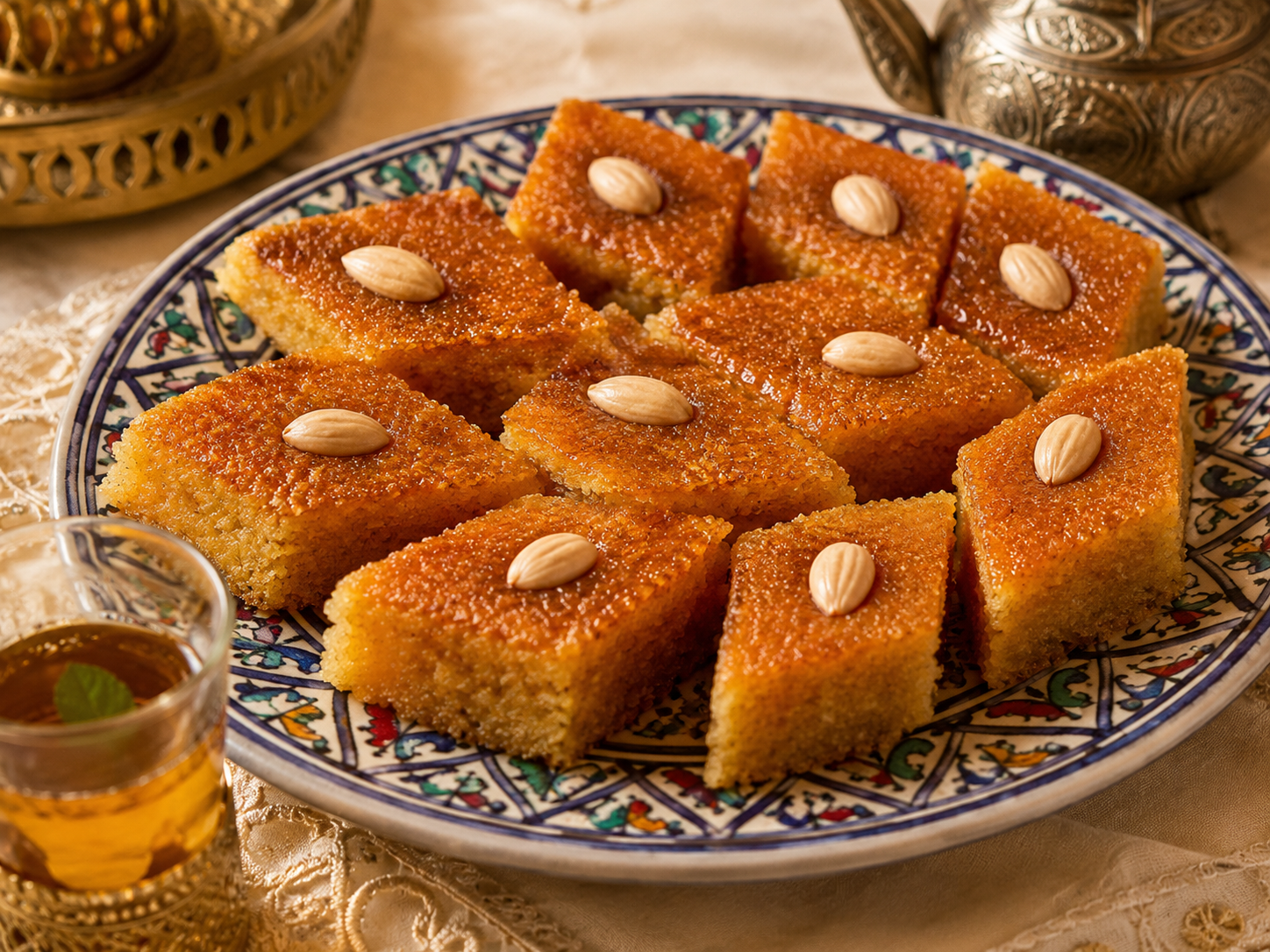
Kalb el louz is one of the most famous pastries in Algeria and throughout the Maghreb. Its name, often translated as “almond heart,” immediately evokes the sweetness, generosity, and refinement of this sweet specialty. It is a semolina cake soaked in syrup, flavored with almond, orange blossom, or sometimes vanilla, and holds a very strong place in the culinary memory of North African families. It is recognizable by its soft, moist, and melt-in-your-mouth texture, as well as its generous shape, often cut into regular diamonds or squares.
Kalb el louz is not just a dessert. It is a symbol of celebration, conviviality, and family transmission. It is often prepared for special occasions, Ramadan evenings, religious holidays, weddings, or important visits. Its presence on a table signifies abundance and respect for guests. In many homes, it is among the sweets carefully prepared, sometimes in advance, so that the cake has time to properly absorb the syrup. This waiting is part of the pleasure and ritual.
Prepare this speciality
Choose a detailed recipe, adjust the portions and prepare your ingredients before starting. Our cooking tips and food safety advice complement the steps described in the recipes.
Explore further: Cooking tips · Food hygiene and safety advice.
History and uses
🌍 ITS PLACE IN AFRICAN CUISINE
In African cuisine, kalb el louz holds a special place because it represents one of the most refined facets of Maghrebi pastry. African cuisine encompasses an immense diversity of traditions, textures, and tastes, and desserts play an important role, even if sometimes less visible than savory dishes. Kalb el louz shows the extent to which North Africa possesses a true sweet culture, where semolina, almonds, honey, sugar, and floral aromas meet in elegant desserts.
This pastry is intimately linked to moments of hospitality. In many Algerian families, kalb el louz is not served just anytime. It is reserved for guests, family gatherings, celebrations, and key moments of the religious year. Its place in African cuisine is therefore not only based on its taste but also on its social function. It expresses generosity, the care taken in welcoming guests, and the desire to offer something noble and warm.
Kalb el louz is also part of a broader culinary history, that of exchanges between North Africa, the Mediterranean, the Arab world, and local traditions. Semolina, which is central to many North African recipes, is here transformed into a sweet pastry. Almonds recall festive products and prestigious ingredients. The flavored syrup unites the whole and gives the cake its recognizable character. This combination makes it a dessert deeply African in its roots, while being open to multiple historical influences.
🍯 FLAVOR, TEXTURE, AND TECHNIQUE
The flavor of kalb el louz relies on a very precise balance between semolina, sugar, almond, and floral fragrance. When the cake is well made, it is tender in the center, slightly grainy due to the semolina, and very moist thanks to the syrup. The top can be lightly golden, sometimes decorated with whole or slivered almonds, but the inside remains the heart of the pleasure: a melt-in-your-mouth dough, saturated with sweetness, without being cloying when the proportions are just right.
The preparation technique is essential. First, the semolina must be mixed with melted butter, smen, or oil, depending on family traditions, to properly coat the grains and achieve a pleasant texture after baking. The mixture is then pressed into a mold, sometimes garnished with a light layer of almonds or a subtle fragrance, then cut into regular portions before or after baking. Once out of the oven, the cake is drizzled with a hot syrup flavored with orange blossom water, sometimes honey or sugar water. It is this sweet bath that gives it its moist texture and shine.
In my books

Continue exploring the continent’s cuisines with Africa at the Table — 54 countries, 54 iconic dishes, by Alioune FALL. This book is in English.
Explore further
The secret of kalb el louz lies in balance. Too much syrup makes it heavy and sticky; not enough leaves it dry. Too much baking hardens it; not enough leaves it fragile. This is why this pastry requires true mastery. In families, it is often said that a good kalb el louz must be melt-in-your-mouth, fragrant, and generous. It should melt gently in the mouth while maintaining some structure. This culinary precision explains why it is so admired.
🌺 CULTURAL AND SYMBOLIC DIMENSION
Kalb el louz is laden with symbols. It first evokes home, transmission, and shared sweetness. Many people associate its taste with childhood, with trays of cakes prepared by mothers or grandmothers, and with long moments spent around tea. It is a pastry that tells the story of the bond between generations. Each family may have its own version, a little more fragrant, a little lighter, a little moister, but the spirit of the dessert remains the same.
Its presence in religious festivals is also important. During Ramadan, it often accompanies evenings and moments of breaking the fast, providing energy and comfort. At weddings or large gatherings, it symbolizes prosperity and attention to guests. Offering kalb el louz is a sign of respect and generosity. It is therefore one of those desserts that nourish not only the body but also social bonds.
In Algerian and Maghrebi culinary heritage, kalb el louz also represents the continuity of ancient know-how. It reminds us that North African pastry is a cuisine of measure, patience, and precision. This dessert is not improvised. It is thought out, prepared, and awaited. It is part of a culture where great importance is given to the beauty of the dish, its fragrance, and its presentation.
🧁 CONTEMPORARY PLACE AND GASTRONOMIC HERITAGE
Today, kalb el louz remains very present in Algerian kitchens and in Maghrebi diaspora communities. It is found in traditional pastry shops, in family homes, on festive tables, and in some modernized versions offered by artisans or chefs. It continues to please because it fulfills a simple and profound desire: that of a rich, fragrant, and memorable dessert.
It is also gaining new visibility thanks to social media, culinary blogs, and pastry chefs who seek to promote traditional African desserts. Some lighten the recipe, others enrich it with almonds, pistachios, or new flavors, but the heart of kalb el louz remains intact. This ability to renew itself without losing its identity is part of its strength.
Kalb el louz is thus much more than a cake. It is an expression of the Maghrebi art of living, a festive sweet, a symbol of memory, and a living culinary heritage. In the great diversity of African cuisine, it holds a prominent place as a semolina dessert that is both humble in its ingredients and noble in its meaning.
🌿 SYNONYMS AND RELATED NAMES
kali el louz kalb el louz almond semolina cake Algerian semolina dessert syrup-soaked Maghrebi pastry
🔑 KEYWORDS
kalb el louz, Algerian pastry, semolina, almonds, African cuisine
In the kitchen : Kalb el louz
Recipes from the site to put your knowledge into practice:
Discover these cuisines at a restaurant
Explore our restaurant and caterer directories. Choose your destination and check the establishment’s menu to confirm which dishes are offered and available.
Continue exploring
Enjoy discovering ingredients and African cuisines? Join our newsletter. The illustrated PDF 10 sauces africaines incontournables is in French and is offered after confirming a subscription to the French or bilingual edition.