Chebakia
Morocco
Understanding : Chebakia
🌼 CHEBAKIA: ORIGIN AND IDENTITY
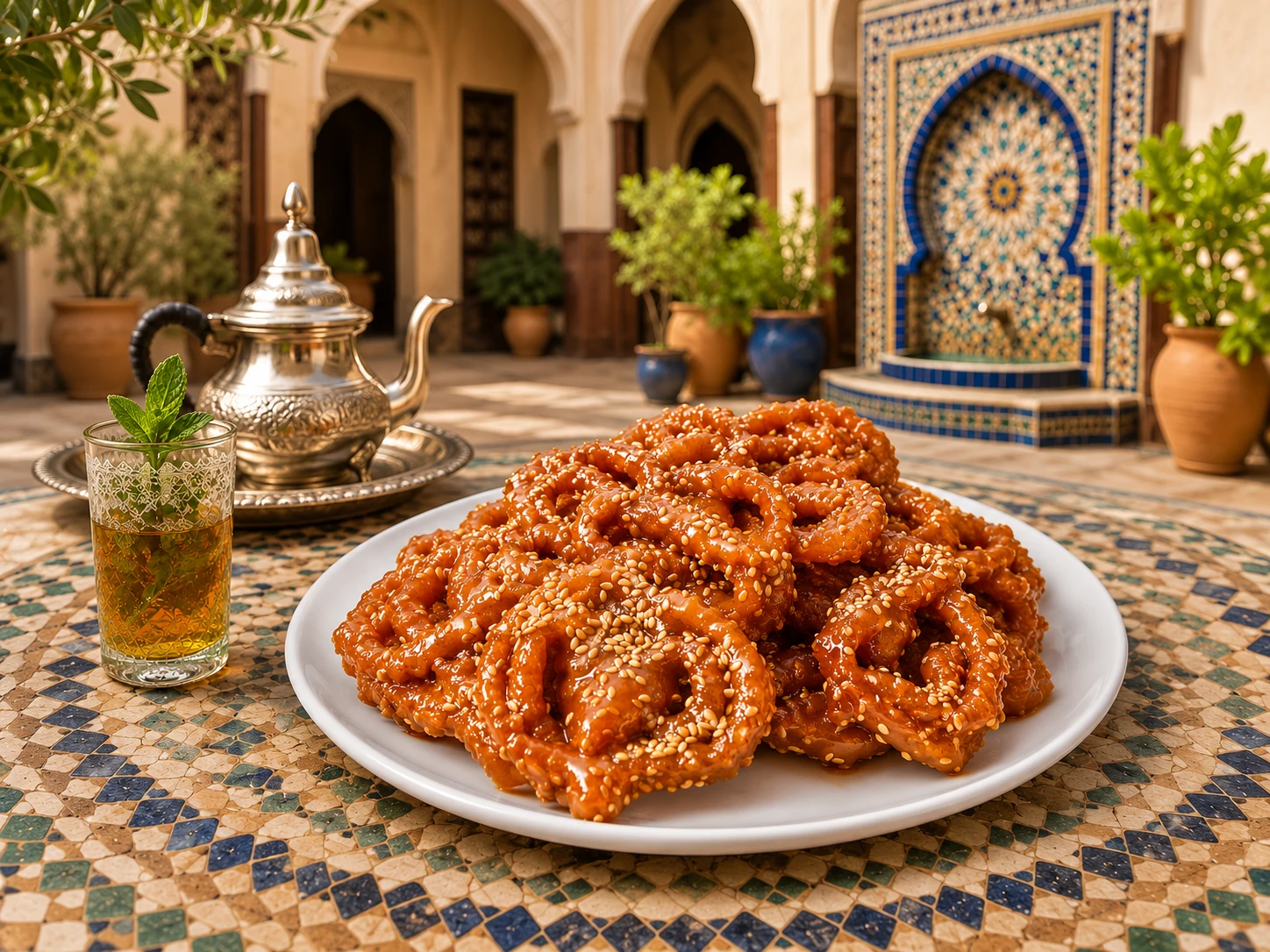
Chebakia is one of the most iconic pastries in Morocco and, more broadly, in the Maghreb. It holds a special place in the culinary memory of North African families, as it is both a festive cake, a symbol of generosity, and a sweet treat intimately linked to the highlights of the religious year. Its recognizable shape, braided or knotted like a flower, then deep-fried and coated in honey, makes it an immediately identifiable delicacy. Chebakia is usually flavored with sesame, anise, fennel, cinnamon, orange blossom water, and sometimes other sweet spices that give it a unique aromatic depth.
Its preparation requires time, precision, and some experience. The dough is worked, cut, and carefully shaped before being fried and then dipped in hot honey, often flavored with orange blossom water. Finally, it is sprinkled with toasted sesame seeds. This succession of steps results in a dessert that is simultaneously crispy, melt-in-your-mouth, and very fragrant. Chebakia is not an improvised pastry: it represents family know-how passed down from generation to generation.
Prepare this speciality
Choose a detailed recipe, adjust the portions and prepare your ingredients before starting. Our cooking tips and food safety advice complement the steps described in the recipes.
Explore further: Cooking tips · Food hygiene and safety advice.
History and uses
🍯 ITS PLACE IN AFRICAN CUISINE
In African cuisine, chebakia holds a very special place because it embodies the richness of Maghrebi pastry. Africa is not limited to its savory dishes; it also has a long tradition of desserts, sweets, and pastries made with honey, semolina, flour, dried fruits, and spices. Chebakia illustrates this sweet dimension of African culinary heritage. It is one of those cakes that are not consumed at any time, but especially during major occasions, religious holidays, and family gatherings.
Its presence is particularly strong during the month of Ramadan, where it often accompanies the breaking of the fast. It is then served with harira, dates, milk, or mint tea. Its energy contribution and high sugar content make it a popular food after a day of fasting. In many families, preparing chebakia during this period is both a culinary and spiritual ritual. It symbolizes abundance, patience, and the joy of sharing.
Chebakia also holds an important place during religious holidays such as Eid, weddings, or important visits. It is often presented on large decorated platters, alongside other Moroccan pastries. It demonstrates a sense of welcome and hospitality, values that are very strong in North African culinary culture. In this context, it is not just a dessert; it is a sign of respect for guests.
🌿 FLAVOR, TEXTURE, AND TECHNIQUE
Chebakia is distinguished by a very balanced combination of flavors and textures. On the outside, it is crispy thanks to the frying and the honey that coats it. Inside, the dough retains a certain suppleness and a delicate texture. The taste is rich, fragrant, sweet without being monotonous, with notes of anise, sesame, cinnamon, and orange blossom. This aromatic complexity is one of the reasons why it is so appreciated.
The preparation technique is essential. The dough must be flexible enough to be shaped, but firm enough to retain its form after cooking. The pieces are often cut into ribbons that are rolled or folded into a rose or diamond shape. Once fried, they are immediately plunged into hot honey so that they soak it up well. Toasted sesame then adds crunch and a slightly nutty note. Every step counts, because a successful chebakia must be well-golden, well-flavored, and perfectly soaked without becoming heavy.
In my books

Continue exploring the continent’s cuisines with Africa at the Table — 54 countries, 54 iconic dishes, by Alioune FALL. This book is in English.
Explore further
There are different variations depending on the regions and families. Some versions are thinner and lighter, others thicker and more generous with honey. Some recipes use more spices, others focus on simplicity. This diversity shows that chebakia is a living, adaptable dessert, deeply linked to local customs.
🌺 CULTURAL AND SYMBOLIC DIMENSION
Chebakia is not just a delicious pastry. It is also a strong cultural marker. For many Moroccan families, it evokes childhood memories, collective preparations at home, and long Ramadan evenings spent in the kitchen. Making chebakia is often an activity shared among several people, where gestures are passed down, repeated, and perfected over the years. This family transmission gives it a very strong emotional value.
Its flower or knot shape sometimes symbolizes elegance and harmony. Its shine due to the honey evokes abundance and blessing. It is a pastry that is fully part of a festive culture, where dessert is not just an end to a meal, but a moment of pleasure, beauty, and generosity. In the Moroccan table, chebakia therefore has an almost ceremonial function.
The dough, spices, honey, and sesame also tell the story of the Maghreb's exchanges with the Mediterranean, Arab, and African worlds. Chebakia is the result of a culture of contact and adaptation. It belongs to a culinary space where local products combine with multiple influences to create a unique dessert.
🧺 CONTEMPORARY PLACE AND GASTRONOMIC HERITAGE
Even today, chebakia remains very present in Moroccan kitchens and in the Maghrebi diaspora. It can be found in artisanal bakeries, family homes, markets, and specialized restaurants. Despite evolving tastes and the arrival of industrial pastries, it retains its prestige and authenticity. It continues to be prepared by hand in many homes, which reinforces its status as a living heritage.
Contemporary pastry chefs sometimes offer modernized versions, lighter, less greasy, or slightly revisited in presentation. But the essence of chebakia remains the same: a carefully shaped dough, fried, dipped in honey, and flavored with seeds and spices. This permanence shows that chebakia has managed to stand the test of time without losing its place or its meaning.
In the panorama of African cuisine, it represents one of the pinnacles of Maghrebi pastry. It testifies to the ability of African cuisines to produce refined, structured, and symbolically rich desserts. Its place is therefore gastronomic, cultural, and emotional.
🌸 SYNONYMS AND RELATED NAMES
chebbakia chebbakya flower-shaped ghriba Moroccan honey pastry Moroccan sesame cake
🔑 KEYWORDS
chebakia, Moroccan pastry, honey, sesame, African cuisine
In the kitchen : Chebakia
Recipes from the site to put your knowledge into practice:
Discover these cuisines at a restaurant
Explore our restaurant and caterer directories. Choose your destination and check the establishment’s menu to confirm which dishes are offered and available.
Continue exploring
Enjoy discovering ingredients and African cuisines? Join our newsletter. The illustrated PDF 10 sauces africaines incontournables is in French and is offered after confirming a subscription to the French or bilingual edition.