Koeksisters
South Africa
Understanding : Koeksisters
🌸 ORIGIN AND IDENTITY
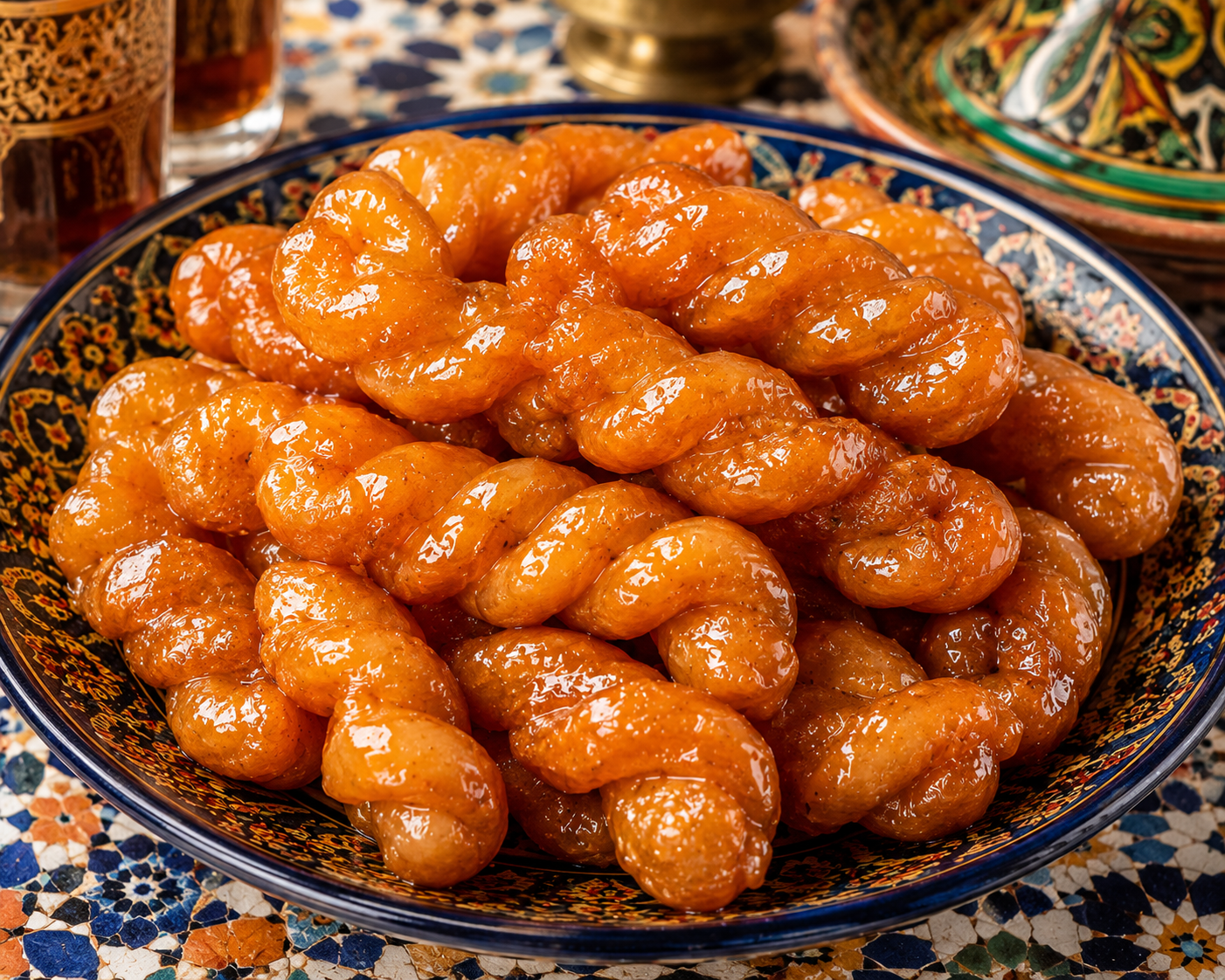
Koeksisters are among the most well-known pastries in South Africa, holding a significant place in the country's culinary imagination. They are small fried dough braids or knots, subsequently dipped in very cold syrup or a sweet glaze that gives them their characteristic shine and texture. The exact etymology of the name remains uncertain according to the Dictionary of South African English; its proposed explanations should not be presented as a proven origin. Koeksisters are among those sweets that tell a story of cultural encounters, local adaptation, and family transmission.
In the contemporary culinary usage described by the sources, koeksister mainly identifies the plaited or twisted pastry, crisp on the outside and soaked in syrup. Koesister identifies the soft, spiced Cape Malay pastry, usually dipped in syrup and coated with coconut. These preparations deserve separate entries. Their spellings nevertheless overlap in historical records: the present distinction should not automatically be projected into the past.
Prepare this speciality
Choose a detailed recipe, adjust the portions and prepare your ingredients before starting. Our cooking tips and food safety advice complement the steps described in the recipes.
Explore further: Cooking tips · Food hygiene and safety advice.
History and uses
🌍 PLACE IN AFRICAN CUISINE
In African cuisine, koeksisters hold a special place because they represent the richness of Southern Africa's sweet traditions. Savory dishes are often discussed as identity markers, but desserts also play an essential role in food culture. Koeksisters demonstrate that African cuisine can produce refined, highly codified pastries deeply linked to social life.
In South Africa, they are often served at family gatherings, community meetings, religious celebrations, or festive events. They accompany tea, coffee, or simply a moment of sharing among loved ones. Their presence on a table signifies abundance, hospitality, and attention to guests. They are often prepared in advance, as they keep well and sometimes even gain flavor after resting.
Koeksisters also reflect South Africa's complex history, marked by migrations, culinary exchanges, and European, Asian, and African influences. South African cuisine has been built upon multiple heritages, and koeksisters are an excellent example. They bear the mark of Dutch tradition, while having been transformed by local contexts, African tastes, and contributions from the Cape Malay community.
🍯 FLAVOR, TEXTURE, AND TECHNIQUE
The main strength of koeksisters lies in the contrast between the dough and the syrup. In the most classic version, the dough is braided or knotted, then fried until golden and crispy. Immediately after cooking, it is plunged into very cold syrup. This thermal shock allows the sugar to penetrate the pastry while retaining its exterior crispness. The result is a bite that is firm, shiny, and intensely sweet.
Koeksisters' taste is seemingly simple but very effective. One finds the sweetness of sugar, sometimes notes of lemon, cinnamon, ginger, or cardamom depending on the variations. The dough itself is neutral, allowing the syrup to play the main role. The pleasure comes as much from the initial crunch as from the sweetness that then spreads in the mouth.
The Cape Malay pastry described above is documented in the Koesister entry. Its soft texture and coconut coating distinguish it from the crisp braid presented here. Variations in flavour within either preparation do not erase this distinction.
The preparation technique requires attention. The dough must be flexible enough to be braided without breaking, but firm enough to hold its shape during frying. The syrup must be prepared in advance and kept cold in the crispy version, as the contrast between hot and cold is essential. A good koeksister should be well-formed, nicely golden, and perfectly coated in sugar, without being heavy or soggy.
In my books

Continue exploring the continent’s cuisines with Africa at the Table — 54 countries, 54 iconic dishes, by Alioune FALL. This book is in English.
Explore further
🧺 CULTURAL AND SYMBOLIC DIMENSION
Koeksisters are not just a dessert. They are a symbol of memory and tradition. In many South African families, their preparation is associated with special occasions, family Sundays, and festive gatherings. They evoke grandmothers' kitchens, generous platters, and moments of conviviality. Their making can become a collective activity, where everyone participates in twisting the dough, frying, or dipping in the syrup.
They also have a very strong identity value. For some communities, they refer to the Afrikaner heritage; for others, particularly in the Cape region, they recall the richness of Cape Malay cuisine, which has profoundly influenced local pastry. This coexistence of origins shows that African cuisine is never uniform: it is made of circulations, adaptations, and shared memories.
Finally, koeksisters illustrate the important place of sugar and frying in certain African pastry traditions. Like other sweets on the continent, they are designed to celebrate, nourish, and bring people together. They bear witness to a dessert art where the simplicity of basic ingredients transforms into a festive and memorable product.
🌺 CONTEMPORARY PLACE AND GASTRONOMIC HERITAGE
Today, koeksisters remain very present in South African gastronomy. They are found in homes, artisanal bakeries, markets, cultural events, and sometimes in modernized versions offered by contemporary pastry chefs. They continue to be appreciated because they embody a familiar, comforting sweetness deeply rooted in local culture.
From a broader perspective, they contribute to the recognition of African culinary heritage in its diversity. They remind us that South Africa possesses a rich, complex sweet tradition open to multiple heritages. Koeksisters are therefore both a popular dessert, an object of memory, and an expression of culinary creativity.
Their lasting popularity also shows that traditional recipes can transcend eras without losing their strength. They remain visible, desired, and shared because they respond to something fundamental: the pleasure of taste, the warmth of welcome, and the beauty of transmitted gestures.
🌿 SYNONYMS AND RELATED NAMES
South African koeksister syrup-braided doughnut Afrikaans pastry koesister Cape Malay sweet
🔑 KEYWORDS
koeksisters, South African pastry, sweet syrup, Cape Malay, African cuisine Send message
In the kitchen : Koeksisters
Recipes from the site to put your knowledge into practice:
Discover these cuisines at a restaurant
Explore our restaurant and caterer directories. Choose your destination and check the establishment’s menu to confirm which dishes are offered and available.
Continue exploring
Enjoy discovering ingredients and African cuisines? Join our newsletter. The illustrated PDF 10 sauces africaines incontournables is in French and is offered after confirming a subscription to the French or bilingual edition.