Briouates
North Africa
Understanding : Briouates
🫔 BRIOUATES AND CULINARY IDENTITY
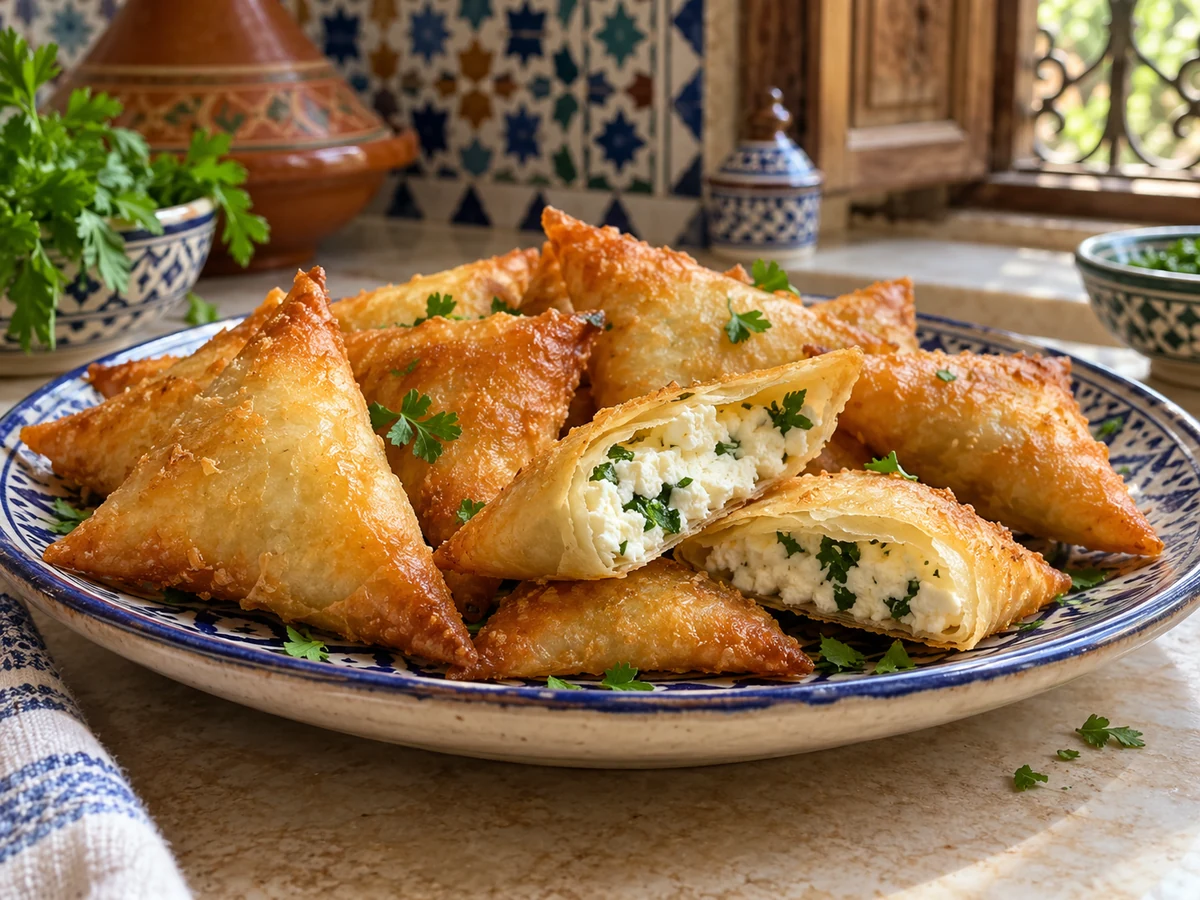
Briouates are small, flaky or crispy pastries, very popular in many homes in North Africa and the Maghreb, and more broadly in the African culinary space influenced by historical, commercial, and cultural exchanges. They come in the form of triangles, rolls, or sometimes cigars, filled with savory or sweet fillings depending on the region and occasion. Their contrasting texture, between a crispy exterior and a melting heart, largely explains their success. They are served as a starter, a side dish, during major celebrations, during Ramadan, at family meals, or on reception tables.
Prepare this speciality
Choose a detailed recipe, adjust the portions and prepare your ingredients before starting. Our cooking tips and food safety advice complement the steps described in the recipes.
Explore further: Cooking tips · Food hygiene and safety advice.
History and uses
In African cuisine, briouates hold a special place because they symbolize both refinement and conviviality. They show how a simple preparation can become an elegant dish when well-shaped and seasoned. Their presence on a table often signals a special moment: they are not just a bite, but a sign of attention paid to guests. They are also very versatile, as they can be filled with meat, fish, cheese, vegetables, dried fruits, almonds, honey, or cream, allowing them to transcend traditions without losing their identity.
🌍 PLACE IN AFRICAN CUISINE
Even if briouates are mainly associated with Morocco, Algeria, Tunisia, and certain areas of the Maghreb, they are fully part of the richness of African cuisine. Africa is not a uniform bloc: it is a set of culinary traditions, cross-influences, and very diverse preparation techniques. Briouates illustrate this circulation of know-how. They bear witness to the contribution of Mediterranean, Arab, Andalusian, Berber, and Sub-Saharan civilizations in the formation of a complex and flavorful cuisine.
In North African homes, briouates often accompany major life events: religious holidays, weddings, births, important visits, family evenings. They are also linked to the art of sharing, which is very present in African cultures. Their individual format facilitates serving and encourages collective tasting. Many can be prepared in advance, frozen, fried at the last minute, or baked for a lighter version. This adaptability makes them a modern as well as a traditional recipe.
Briouates also have strong symbolic value. Their carefully folded shape recalls the meticulous work of cooks, often passed down from generation to generation. Preparing briouates requires patience, precision, and a certain aesthetic sense. It is a cuisine of gesture, memory, and attention. In some families, the recipe is almost a domestic heritage, transmitted orally, with variations specific to each home.
🥟 TEXTURE, FLAVORS, AND TECHNIQUE
The charm of briouates lies in contrast. The outer leaf, often warqa, brick pastry, or an equivalent thin dough, becomes golden and crispy when cooked. The filling, meanwhile, can be soft, spicy, fragrant, or sweet. This contrast is essential: it gives briouates their identity. A good briouate must be well-sealed so as not to open, well-golden to remain appetizing, and sufficiently filled to offer a generous bite without being heavy.
Savory fillings often consist of minced meat, shredded chicken, tuna, eggs, parsley, onions, cheese, spinach, or vegetables. Sweet versions, on the other hand, highlight almonds, honey, cinnamon, orange blossom water, sesame, and sometimes dates or nuts. This duality between savory and sweet perfectly matches certain North African culinary habits, where dishes can play on several taste registers at once.
Cooking can be done by frying, which gives a very crispy and traditional result, or by baking, which offers a lighter version. In both cases, success depends on the quality of the folding, the mastery of cooking, and the balance of the filling. A briouate that is too moist risks tearing, while a filling that is too dry will lose its deliciousness.
In my books

Continue exploring the continent’s cuisines with Africa at the Table — 54 countries, 54 iconic dishes, by Alioune FALL. This book is in English.
Explore further
🕌 CULTURAL AND FESTIVE DIMENSION
Briouates are particularly present during Ramadan, where they often appear on Iftar tables (breaking of the fast). They provide a small, tasty, and nourishing bite before the main dishes. Their place in this context clearly shows their cultural importance: they participate in the ritual of the meal, the generosity of the service, and the festive atmosphere. In this setting, they are often accompanied by soup, fresh juice, mint tea, or traditional pastries.
They also appear during large celebratory meals, where each preparation has its function. Briouates are not always the main dish, but they play a prestigious role. Their finesse gives an impression of controlled abundance. They signal the care taken with the table and the desire to please. In African family contexts, this has great value: cooking is also about honoring guests.
🍯 VARIETIES AND REGIONAL ADAPTATIONS
Depending on the region, briouates change their name, shape, or filling. Some are smaller, others thicker. Some are flavored with cumin, ginger, coriander, or ras el hanout. Others favor the sweetness of honey and almonds. In coastal cities, fish or seafood fillings are more common. In rural areas, simpler versions based on vegetables, herbs, or leftover stewed meat are more often found.
This diversity shows that briouates are not static. They adapt to local resources, seasons, family preferences, and desired levels of refinement. It is a living recipe that evolves with the times. Today, one can even find revisited briouates with contemporary ingredients: curry chicken, grilled vegetables, melted cheese, shrimp, chocolate, or red fruits for dessert versions.
🥗 NUTRITIONAL INTEREST AND MODERATION
Nutritionally, briouates can be quite balanced or richer depending on their cooking method and filling. Baked versions are generally lighter than fried ones. Vegetable, tuna, or chicken fillings provide protein, while almond or dried fruit fillings offer energy and good fats. The presence of fresh herbs, onions, spices, and dried fruits also enhances their taste and nutritional value.
However, briouates are often festive dishes, sometimes rich in oil or sugar. They are therefore best enjoyed in moderation, as part of a varied meal. Their strength is not to be a strict diet food, but a dish of pleasure, tradition, and conviviality.
🍽️ SYNONYMS AND SIMILAR NAMES
Briouates can sometimes be compared to certain names depending on the country, even if the shapes and recipes vary. They can be assimilated, depending on the context, to puff pastries, stuffed triangles, crispy bites, flaky pastries, or Maghrebi samosas. In some uses, they are also referred to as savory pastries or small traditional puff pastries. These synonyms remain approximate, as the briouate has its own identity, linked to its thin dough, its folding, and its culinary heritage.
✨ CONCLUSION
Briouates are much more than a simple recipe. They embody a rich, festive, and refined African culinary tradition, where taste blends with memory, and where technique serves conviviality. Their place in African cuisine is important because they tell the story of exchanges, celebrations, sharing, and domestic know-how. Whether savory or sweet, fried or baked, they remain a symbol of generosity and finesse. They are among those preparations that connect generations and continue to charm with their elegant simplicity and irresistible aroma.
Keywords: briouates, African cuisine, Maghrebi cuisine, traditional pastries, festive recipes
Synonyms: puff pastries, stuffed triangles, crispy bites, savory pastries, traditional crispy pastries
In the kitchen : Briouates
Recipes from the site to put your knowledge into practice:
Discover these cuisines at a restaurant
Explore our restaurant and caterer directories. Choose your destination and check the establishment’s menu to confirm which dishes are offered and available.
Continue exploring
Enjoy discovering ingredients and African cuisines? Join our newsletter. The illustrated PDF 10 sauces africaines incontournables is in French and is offered after confirming a subscription to the French or bilingual edition.