Nyama Choma
Swahili (Kenya)
Understanding : Nyama Choma
INTRODUCTION
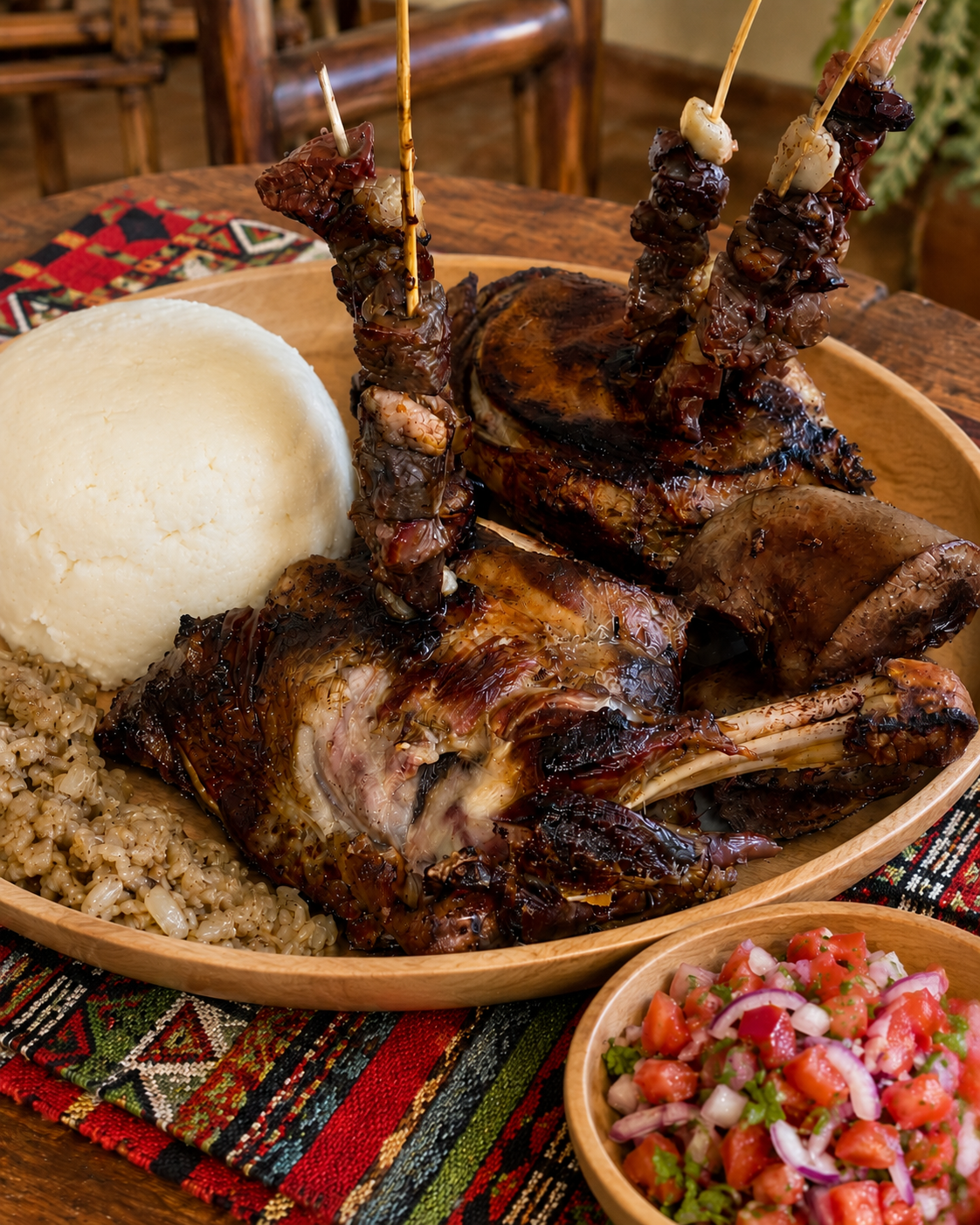
If one had to choose a culinary emblem of East Africa, Nyama Choma (pronounced “nyama choma”) would undoubtedly stand out as a must-have: “grilled meat” in Swahili, Nyama Choma is much more than a simple barbecue. It is the quintessence of conviviality, sharing, celebration, friendship, and festivity, a social institution both rural and urban, a gustatory and sensory experience that unites Kenya, Tanzania, Uganda, Rwanda, Burundi, and resonates throughout Africa and the diaspora. The intoxicating smell of grilling over charcoal, golden crispness, secret seasonings, accompaniments of fresh vegetables, kachumbari (spicy salad), ugali, or bananas, nyama choma invites a journey into the heart of East African terroirs and pastoral and urban traditions. Behind a simple name unfolds a rich culinary universe, where each tribe, each region, each family has its “touch,” its know-how, its marinade recipes, its cooking rituals, its secrets of cooking and sharing. The place of Nyama Choma in African cuisine is monumental: a heritage of celebration and gathering, a wedding or mourning dish, street food or gourmet dish, it is an identity marker, a mirror of contemporary social transformation. This detailed description recounts the history, technique, symbolism, diversity, and economic and cultural role of Nyama Choma, while exploring its adaptations and challenges in modern Africa and the diaspora.
1. ORIGINS, HISTORY, AND SYMBOLISM OF NYAMA CHOMA
1.1. Pastoral roots and the importance of meat The tradition of grilling over embers is ancient in Africa: pastoral populations (Maasai, Samburu, Barabaig, Kikuyu, Luo, Baganda, etc.) consumed zebu, goat, sheep, beef, and sometimes game meat, roasted over the flame, often simply seasoned with salt and wild herbs. Barbecue, initially a survival technique (easy food to share, preserve, transport) also became a ritual: the collective cooking and consumption of consecrated livestock (marriage, sacrifice, hunting communities, birth of a child, harvest festival). 1.2. Evolution and urbanization The “nyama choma” concept became an urban institution starting from the colonial period and especially in Kenya in the 1970s-80s with the proliferation of restaurants run by migrant ex-pastoralists. This unifying dish became democratized and went beyond the scope of celebrations or special occasions: it is now accessible in every neighborhood bar, every family highway restaurant, every company barbecue, every student lunch.
2. INGREDIENTS, PREPARATION, AND CULINARY SECRETS
2.1. The queen meats • Goat (mbuzi): Kenyan star, renowned for its firm flesh and delicately wild taste, best for “parties.” • Beef (ng’ombe): more common in the Great Lakes region, around Lake Victoria, in cities (Nairobi, Dar es Salaam). • Mutton, lamb: more sporadic, depending on the season. • Chicken, fish (tilapia, Nile perch): often offered in lake regions or as a modern variation. • Game: although regulated (legality, species protection), there is bush Nyama Choma (antelopes, bushbuck, warthog, etc.) served during special celebrations. 2.2. Cuts and marinade Traditionally, the meat is cut into large pieces, keeping the bone, the fat (“nyama choma best eaten with bone”), simply salted or rubbed with garlic, lime juice, grated ginger, chili. Some families, street vendors, or famous restaurateurs incorporate a more complex marinade: • Marinade with beer, lemon, soy sauce, vinegar, yogurt • Local spices: cardamom, coriander, cumin, nutmeg, wild rosemary, savanna herbs • Fresh chilies, garlic, onion, peanut or sunflower oil But the philosophy remains “simple”: the primary quality of nyama choma is the meat and the embers, not an overabundance of condiments. 2.3. Cooking Cooking over wood or charcoal fire is essential: • The pieces are skewered, placed on grills or wrapped in green branches, cooked slowly over low heat to retain the juice. • They are turned regularly, sometimes coated with melted fat or spiced butter, watched with an expert eye. • The meat should come out “pink in the center,” with a golden and crispy crust. • Cutting is done by hand, on a wooden board, with a machete or a large knife, in front of the guests themselves.
3. THE GREAT ACCOMPANIMENTS OF NYAMA CHOMA
3.1. Ugali Corn flour paste (or cassava/sorghum/millet), ugali, bland and compact, is the perfect counterpoint to fatty and salty meat. A ball is made in the palm, which serves as a “spoon” to pick up pieces of meat and sauce. 3.2. Kachumbari An essential fresh salad, typical of Kenya and Tanzania: diced tomatoes, thinly sliced red onion, fresh coriander, finely chopped chili, lemon juice. It refreshes, balances, and “cuts the fat.” 3.3. Plantain, potatoes, chapati, rice Depending on the region, the meat can be served with fried bananas (“matoke” or “plantain”), homemade fries, pilaf rice, or flatbread (chapati, Indian heritage). 3.4. Sauces and pickles “Nyama choma joints” often offer achar (an Afro-Indian pickle with vinegar, carrots, mango, spices), spiced salt, local pili-pili sauce, or melted garlic butter. 3.5. Drinks Local beer (Tusker, Serengeti, Nile Special) classically accompanies nyama choma, sometimes palm or banana wine.
4. MOMENTS, RITUALS, AND COLLECTIVE IDENTITY
4.1. Marker of celebration Nyama choma is shared at weddings, funerals, work meetings, sports victories, student gatherings, Sunday get-togethers with friends. The cost, and even the preparation, are shared; it is a sign of economic solidarity: people “contribute,” they go to the butcher together, they wait, they chat, they eat standing or sitting in a circle. 4.2. Symbol of hospitality and masculinity In many East African societies, the man who “offers” nyama choma demonstrates his generosity, his status (family, company), his rank. To barbecue for friends, in-laws, or a passing guest is to sacrifice something precious, announce a celebration, and strengthen the group. 4.3. Place in daily and urban life In every city (Nairobi, Dar es Salaam, Kampala, Kigali, etc.), hundreds of “nyama choma joints” dot the streets, from popular suburbs to chic neighborhoods: a barbecue, a bench, a large pot of kachumbari, sometimes a group of musicians. On Sundays, in the evening, on patron saint days, in fan zones (football), nyama choma animates the social fabric, abolishes social differences, “everyone helps themselves with their fingers.”
5. VALORIZATION OF RURAL ECONOMY, SECTORS, AND TOURISM
5.1. Meat sector and barbecue professions • The institution of nyama choma contributes to the valorization of the beef, goat, and sheep sectors: breeders, cattle dealers, transporters, butchers, charcoal merchants, restaurateurs, condiment vendors, musicians, and waiters. • The “kings of nyama choma” (famous cooks) are adored, publicized, and recognized trainers. 5.2. Gastronomic tourism Many tourist circuits include a nyama choma evening, presented as “the authentic African experience.” In festivals (Nairobi Nyama Choma Festival, Dar Barbecue Fest, etc.), grilling competitions, international culinary events, the recipe becomes “exportable.”
6. NUTRITIONAL VALUE AND HEALTH
Grilled meat provides: • High biological value proteins • Iron, zinc, B vitamins (especially B12) • Lipids: important if neither too fatty nor charred Fresh accompaniments (kachumbari, lemon, ugali) balance acidity, facilitate digestion, and correct excess fat. However, be careful: risk of excess red meat, saturated fat intake, and high-temperature cooking products (moderation recommended by dietitians). The valorization of lean meats, varied cuts, and vegetables makes the dish healthier.
7. MODERNITY, FUSION, DIASPORA
7.1. Nyama choma fusion Young chefs are embracing it: • Lamb skewers with niter kibbeh (Ethiopia x Kenya) • Nyama choma burgers, wraps, pizzas, empanadas stuffed with grilled meat • Creative marinades (Cajun, soy sauce, mustard, honey, Euro-African aromatics) • Warm salads, steamed baos, nyama choma tacos for global street food 7.2. Diaspora and digital “Afro barbecue parties” are fashionable in Paris, London, Atlanta, Johannesburg, Rome, with online sales of spices, grills, and video recipes. Social networks are overflowing with photo contests and shared recipes.
8. LIMITS, CHALLENGES, AND FUTURE
• Meat sources: industrialization, cold chain issues, access to healthy meat, respect for resources (anti-poaching efforts, sustainable farming). • Health: growing awareness of the link between red meat and pathologies; promotion of variety (white meat, fish) and new accompaniments. • Environment: need to reconcile barbecue and forest resource management (responsible charcoal production, eco-friendly alternatives). • Transmission: globalization tends to standardize recipes; necessity to document and celebrate local diversity.
CONCLUSION Nyama Choma is not “just grilled meat”: it is the soul of celebration, the memory of peoples, the warmth of friendship, and the living expression of African barbecue genius. An epic of controlled flame, shared in a circle, the crispness of the meat and the tenderness of the gesture, it conveys, as much as the greatest African classics, the cultural depth and the capacity for innovation of the continent’s communities. To cook, savor, and transmit nyama choma is to protect an institution of African living together, to always and again inscribe fire cooking as an act of love, identity, solidarity, and creativity. Nyama choma remains, for the present and the future, a bridge between rural, urban, and global Africa.
Prepare this speciality
Choose a detailed recipe, adjust the portions and prepare your ingredients before starting. Our cooking tips and food safety advice complement the steps described in the recipes.
Explore further: Cooking tips · Food hygiene and safety advice.
In my books

Continue exploring the continent’s cuisines with Africa at the Table — 54 countries, 54 iconic dishes, by Alioune FALL. This book is in English.
In the kitchen : Nyama Choma
Recipes from the site to put your knowledge into practice:
Discover these cuisines at a restaurant
Explore our restaurant and caterer directories. Choose your destination and check the establishment’s menu to confirm which dishes are offered and available.
Continue exploring
Enjoy discovering ingredients and African cuisines? Join our newsletter. The illustrated PDF 10 sauces africaines incontournables is in French and is offered after confirming a subscription to the French or bilingual edition.