Plantain
Asia/Africa/South America
Understanding : Plantain
INTRODUCTION
Plantain (Musa paradisiaca) is one of the undisputed pillars of African cuisine. Nicknamed "the cooks' banana," plantain shapes the tables and economies of tropical Africa, from the Gulf of Guinea to the Great Lakes, from the Ivorian forest to the Congolese savanna, and even to the urban markets of African diasporas. While it resembles sweet banana, it differs in its texture, uses, and its social and gastronomic identity. Beyond its versatility, plantain embodies the agricultural resilience, conviviality, celebration, popular creativity, and feminine ingenuity that characterize the continent's cuisine. Its presence in recipes, rituals, markets, during festive or solidarity moments, makes it a true cultural marker and a key resource for food security. This text traces the history, botany, cultivation, processing, culinary diversity, nutritional value, social symbolism, modernity, and challenges of plantain in African cuisine, while illustrating its centrality in the living heritage of Black Africa.
Where to find it
Look for it at a market or African grocery shop, fresh or frozen depending on the recipe. Ask the seller about the variety, ripeness and preparation instructions.
Explore further: Cooking tips · Food hygiene and safety advice.
History and uses
1. ORIGIN, TRANSMISSION, AND SPREAD OF PLANTAIN
1.1. Provenance and Distribution Plantain originated in Southeast Asia, domesticated around Papua New Guinea approximately 7,000 years ago. Its introduction to Africa is believed to be ancient: Arabs, then Portuguese, but undoubtedly also through Austronesian migrations from Madagascar, introduced it along the coasts of the Gulf of Guinea, from Congo, to Cameroon, Nigeria, Ghana, up to Benin and Togo, and later in Sanaga, the Great Lakes, Central Africa, and even East and South Africa (Mozambique, Angola, Gabon, etc.). Quickly acclimatized, plantain thrives in the equatorial/humid climate. It became the basis of peasant diets in dense or intermediate forest regions, then established itself in cities during the urbanization of Africa in the 20th century. Its spread now covers the entire sub-Saharan continent, as well as the Caribbean, Latin America, South Asia, and the African diaspora due to migrations and the success of "world food." 1.2. Botanical Diversity Plantain belongs to the Musaceae family. It is a triploid hybrid (AAB), resulting from the cross between Musa acuminata and Musa balbisiana. There is a great diversity of cultivars: French plantain, false-horn, horn plantains, etc. Plantain is most often distinguished by its stages of maturity: • Green – starchy, firm • Yellow – sweeter, softer • Ripe-black – very sweet, melting texture
2. CULTIVATION AND SOCIO-ECONOMIC IMPORTANCE
2.1. Plantain Cultivation Plantain is cultivated in peasant plantations, family fields, agroforestry associations (under the canopy of fruit trees, cocoa, oil palms...). Technically undemanding, it grows in deep, drained, warm, and humid soils, with little need for inputs or irrigation. The plantain cycle is approximately 9 to 12 months until fruiting. Bunches are harvested at full maturity. Its high yield (10 to 40 kg/bunch, 12 to 24 t/ha/year) ensures a major food supply for producing countries (Nigeria, Ghana, Cameroon, Ivory Coast, DR Congo, Uganda...), which are among the largest global exporters. 2.2. Sectors, Markets, and Processing Plantain structures rural and urban markets: • Sold fresh or ripened at the market, on heads, in trucks, in batches or "hands." • Artisanal processing: chips, flour, fritters, alloco, fufu, placali, plantain couscous, wine, flour... • Urban agri-food industry for chips, snacks, gluten-free flour, pastries, "ready to cook." • Growing international trade towards African and Creole diasporas (France, Belgium, Canada, USA...). Plantain is the economic support for many female vendors and processors, rural families, and a source of employment in the downstream and African agri-food industry.
3. PLACE IN AFRICAN CUISINE: AN INFINITE RICHNESS
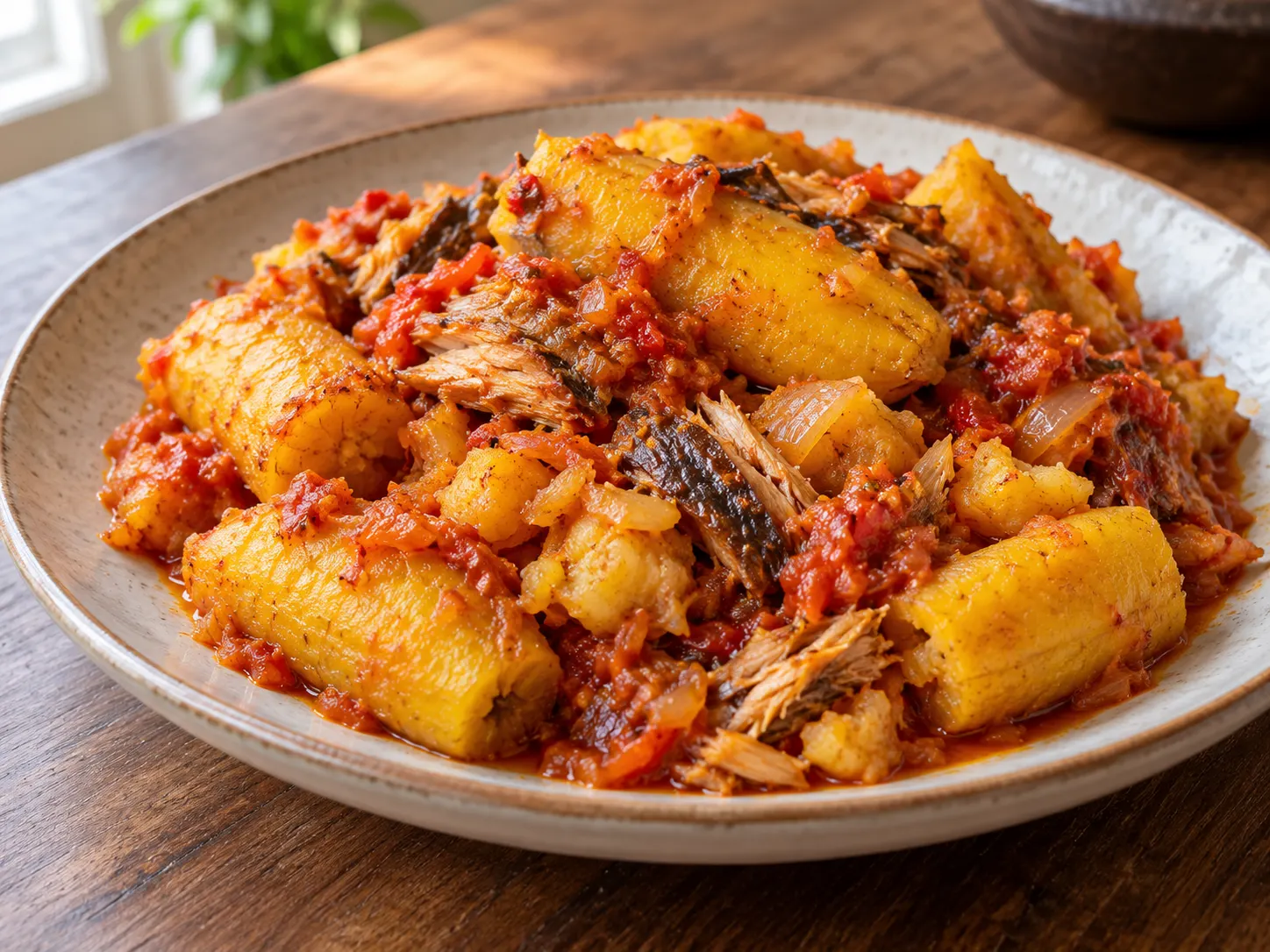
3.1. Boiled or Steamed Plantain • Green or yellow plantain, peeled, cut into pieces, cooked in salted water. Served as a side dish or main course. • Steamed, with or without skin, in quarters or slices. • Particularly prized with rich sauces (peanut – mafé –, palm nut sauce, leafy vegetable, smoked fish...). 3.2. Fried Dishes: Alloco, Dodo, Kelewele... • Alloco (Ivory Coast, Burkina Faso, Mali): ripe plantain cut into slices/sticks, fried in palm or peanut oil, soft inside, crispy outside; iconic dish of "maquis" (street food stalls), snack, festive appetizer, queen of street food. • Dodo (Nigeria, Benin): Ivorian analogue, served as a side dish with rice, beans, sauces, or alone. • Kelewele (Ghana): spicy (ginger, garlic, chili, clove, nutmeg) and fried ripe plantain, sold on the street or at popular festivals. • Plantain fritters: mashed/ripe banana paste, sugar, flour, fried, often for breakfast or dessert. 3.3. Chips, Crackers, Snacks • Thinly sliced plantain, dry-fried or in oil, salted or spiced, sold in bags at the market or as an urban appetizer, a crispy "healthy" alternative to industrial snacks. 3.4. Purées, Porridges, Fufu, Placali • Plantain fufu (Ghana, Ivory Coast, Cameroon, Uganda, Congo...): plantain (often a mixture of plantain and yam, cassava or taro), cooked then pounded extensively in a mortar until a smooth and elastic texture, formed into balls or sticks. Accompanies all sauces and stews, a central element of the "hand-eating" meal. • Placali (Ivory Coast: fermented plantain puree sometimes mixed with cassava). • Plantain ugali (Uganda, Rwanda): paste obtained by cooking/crushing green plantain, the base of "matoke." 3.5. Soup, Stews, and Simmered Dishes • Peasant soups with plantain, peanuts, vegetables, fish or meat. • Cameroonian Ndolé: stew of bitter leaves and peanuts often served with boiled or fried plantain. • Dishes en papillote, plantain paste cooked in leaves (Uganda, DR Congo). 3.6. Pastries, Desserts, and Fusion Cuisine • Plantain cake, galette, crepe or flan (sometimes with coconut, almond, honey, chocolate or spices). • Iced or grilled as dessert, flambéed or honey-cooked banana, plantain compote. • Integrated into Afro-urban "gastro-fusion": plantain burger, tacos, "sweet plantain" tortilla.
In my books

Continue exploring the continent’s cuisines with Africa at the Table — 54 countries, 54 iconic dishes, by Alioune FALL. This book is in English.
Explore further
4. SOCIAL, SYMBOLIC, AND CULTURAL PLACE
4.1. Plantain, Food of Celebration and Sharing • Symbol of abundance: it graces weddings, baptisms, funerals, village festivals. • Offered as dowry, banquet, chieftaincy basket, a sign of wealth and hospitality. • Serves as a first food or weaning food for children (porridge), a healthy and nourishing element, recommended for babies and convalescents. • Shared "by hand," a convivial dish, plantain connects family, friends, and social classes in the same bowl. 4.2. Transmission, Feminine, Heritage • "The alloco hand" or "the fufu hand" distinguishes a good cook. • Mother-daughter transmission of peeling, cutting, frying, pounding, steaming methods. • Heritage objects: mortar, pestle, serving tray, pounding pot. 4.3. Diasporic Identity Food In the African diaspora, plantain becomes a memory of home, a taste of childhood, a pivot of the "Afro brunch," a marker of African identity in the city (Afro restaurants, food trucks, brunches, Pan-African and Antillean festivals).
5. NUTRITIONAL VALUE AND HEALTH ASPECTS
• Complex starch, especially in green plantain: provides lasting satiety, long-lasting energy, slow absorption. • Soluble and insoluble fibers: bowel regulator, good for digestion. • Rich in potassium, magnesium, vitamin A, B6, C, iron, and certain antioxidants. • Gluten-free: usable by celiac individuals, adds body to dough, puree, replaces wheat flour. • Ripe plantain provides more fast sugars, ideal as a snack, for sports recovery, or a healthy dessert. • Be mindful of oil cooking: prefer gentle frying, absorb excess oil, alternate with steaming, boiling, or baking for a healthier version.
6. MODERNITY, INNOVATION, CHALLENGES
6.1. Agri-food Industry and Culinary Creativity • Plantain flour for gluten-free bread, crepes, pastries, infant food, muesli. • "Organic" plantain chips, colorful, sweet, spicy varieties, exported worldwide. • Sweets, spreads, sauces made from ripe plantain, cocktails, fermented drinks (wine, drinking purees). 6.2. Fusion Cuisine and Global Gastronomy • Plantain in burgers/buns, tacos, Afro sushi, croquettes, waffles, trendy bakeries, poke bowls, vegan desserts. • Emergence of Afro-fusion chefs, plantain's influence in major European, American, and Asian cities. 6.3. Agricultural and Sovereignty Challenges • Vulnerability to diseases (Bactrocera, sigatoka, fusarium), need for cultivated diversity, agroecology, agronomic research. • Marketing challenge: seasonal fluctuations, significant post-harvest losses, need for processing channels, "zero-waste." • Nutritional education to accompany the rise of fried plantain products, promote diversification.
CONCLUSION Plantain, a bittersweet root, the backbone of African cuisines, connects land, celebration, and memory. A dish for banquets and everyday life, it is a tool for solidarity, emancipation, and innovation – from the village to the global gastronomic table. Preserving, transmitting, and reinventing plantain means defending the generosity, intelligence, and vitality of all African cuisine.
In the kitchen : Plantain
Three recipes from the site to put your knowledge into practice:
Discover these cuisines at a restaurant
Explore our restaurant and caterer directories. Choose your destination and check the establishment’s menu to confirm which dishes are offered and available.
Continue exploring
Enjoy discovering ingredients and African cuisines? Join our newsletter. The illustrated PDF 10 sauces africaines incontournables is in French and is offered after confirming a subscription to the French or bilingual edition.