Attiéké
Lagoon communities of Côte d’Ivoire
History meets tasting
Historical and cultural context
Recognised by UNESCO in 2024, this Ivorian skill is transmitted through family observation.
Sensory guide
Slightly tangy cassava granules, soft and small; fermentation changes the taste.
Skill to observe
Follow cassava transformation: fermentation, granulation, then steaming.
Indicative sensory descriptions: variety, fermentation, cooking and accompaniments change the result. Catalogue illustrations, not a shared botanical scale.
UNESCO · 02086 · 2024Understanding : Attiéké
INTRODUCTION
Attiéké, often called "Ivorian couscous," is undoubtedly one of the most iconic food products of Côte d'Ivoire and, more broadly, West Africa. Composed of white grains with a light and fluffy texture, this cassava-based dish symbolizes the creativity and vitality of African culinary culture. Behind every plate of attiéké lies the history, ingenuity, and resilience of the people who shaped it – the Ébrié, Alladian, Avikam, and other Ivorian lagoon groups. More than just a dish, attiéké has become a staple at festive tables, popular markets, family gatherings, and daily meals across West Africa and the diaspora. Simple to the eye, refined to the palate, it accompanies a wide range of meats, fish, shellfish, vegetables, and sauces, bridging tradition and modernity.
Where to find it
Look for fresh, frozen or dehydrated attiéké in African grocery shops. Follow the instructions for the product you buy: fresh attiéké and the dried version require different preparation.
Explore further: Cooking tips · Food hygiene and safety advice.
Search Amazon.fr — affiliate link →
Check availability and delivery on Amazon.fr. Compare ingredients, packaging and sellers.
As an Amazon Associate I earn from qualifying purchases.
History and uses
HISTORY AND ORIGINS
Cassava: a nourishing root Originally from South America, cassava, or yuca (Manihot esculenta), was imported by Portuguese navigators to the west coast of Africa as early as the 16th century. This tuberous plant, with its many varieties, quickly adapted to the African climate and soils, becoming today one of the main staple foods, with over 800 million consumers worldwide. Cassava has high energy value but must be carefully processed to eliminate the hydrocyanic acid (toxic) present in many so-called "bitter" varieties. Due to its ease of cultivation, drought resistance, and high yield, cassava has become a survival resource during food crises.
The birth of attiéké It was in the lagoon region of Côte d'Ivoire, more precisely among the Ébrié, Alladian, and Avikam people, that the specific technique for obtaining attiéké was born: fermentation, grating, pressing, and granulation of cassava. This tradition, passed down from generation to generation by women, differs profoundly from other African cassava processing methods (gari, foufou, tapioca, placali) due to the fineness of its grain and its slightly acidic flavor. The word "attiéké" is said to come from the Ébrié term "attiéké," which means "granular food." Gradually, the recipe spread throughout the country, and then beyond, driven by urban growth, migration, and sub-regional trade.
Traditional attiéké production The making of artisanal attiéké is a meticulous craft, often carried out communally or by families, primarily by women.
PREPARATION STEPS
Peeling and washing Fresh cassava tubers are washed, meticulously peeled, and cut into large pieces. Grating The pieces are grated by hand on traditional metal graters until a moist, fine, and homogeneous paste is obtained. Fermentation This paste is placed in a bag or net, then left to ferment for 1 to 3 days in a warm or ambient environment. This process gives attiéké its characteristic acidic aroma. Pressing After fermentation, the paste is vigorously pressed to remove as much water as possible and a good portion of the toxic matter. Formerly, this pressing was done between stones; today, manual presses are used. Granulation The pressed paste is then rubbed between the hands or sieved with cassava flour (mafé) to form regular grains, neither too fine nor too thick; the finest are reserved for young children. Steaming The formed grains are then steamed in large pots with perforated bottoms (or couscous steamers) for ten to twenty minutes. The final result: a soft, slightly moist attiéké, ready to be enjoyed. Fluffing and drying After cooking, it is fluffed with the fingers to prevent clumping and allow for good preservation, then partially dried in the sun when produced for sale.
MODERNIZATION
Today, production has become industrialized. Packaged attiéké is available fresh, frozen, or dehydrated, to meet the growing demand from the diaspora and urban supermarkets. Some women's cooperatives are internationally recognized for the quality of their exported attiéké. Attiéké's place in African cuisine and society A pillar of Ivorian gastronomy A national dish par excellence, attiéké is omnipresent: at ceremonies (baptisms, weddings, funerals), at neighborhood feasts, in markets, at picnics, in maquis (small popular restaurants), or as street "fast food." Its accessibility, its mildness on the palate, and its nourishing character make it a universal dish, suitable for the poor and the rich, the child and the elderly.
In my books

Continue exploring the continent’s cuisines with Africa at the Table — 54 countries, 54 iconic dishes, by Alioune FALL. This book is in English.
Explore further
SOCIAL AND ECONOMIC ROLE
The production of attiéké is women's business: it structures rural life, strengthens community solidarity, enables children's education, and supports financial autonomy. Selling attiéké at the market is a stable source of income for many. Working in associations (GVC groups), creating cooperatives, modernizing tools, and obtaining protected designations are real levers for local development. A dish of exchange and sharing Offering attiéké during a visit, a bereavement, or a celebration is a gesture of welcome and respect. Families regularly send attiéké to their relatives in the city or abroad, as a token of affection.
CULINARY USES, VARIATIONS AND ACCOMPANIMENTS
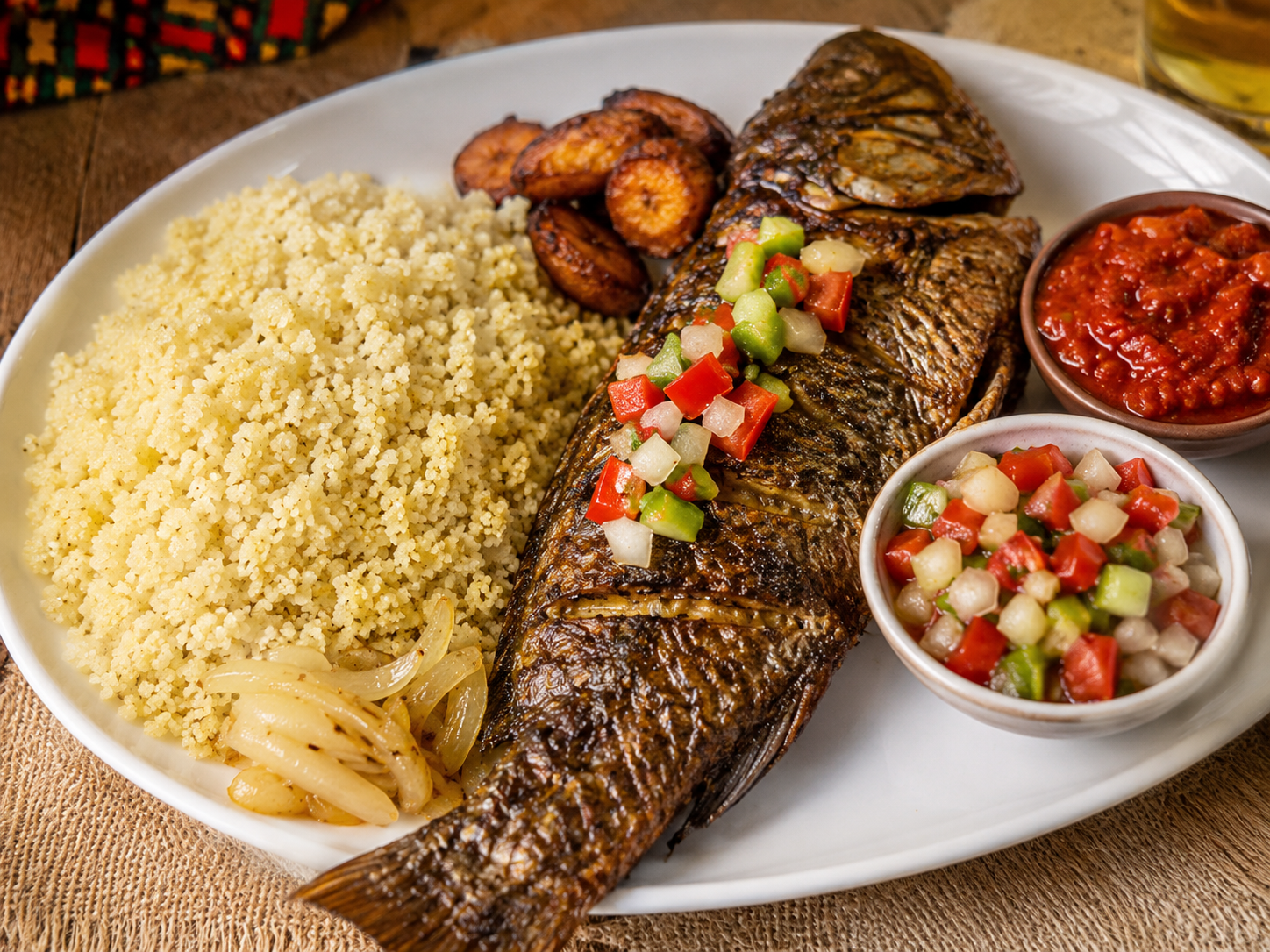
Plain attiéké As is, attiéké is eaten hot or warm, often accompanied by a spicy sauce, onion rings, fresh tomatoes, cucumber, and a drizzle of oil. Attiéké with fish (grilled fish attiéké) This is the most popular combination: a fish (carp, captain, tilapia) grilled over a wood fire or in the oven, served with a mountain of attiéké, raw vegetables, and spicy sauces (pili-pili, shito, or simply a zest of lemon and a little chili oil). Attiéké with meat or chicken Attiéké readily accompanies grilled chicken, beef or lamb skewers, kédjénou (Ivorian chicken stew), rabbit, or any slow-cooked dish. Attiéké salad An urban and light version, where cold attiéké is mixed with crunchy vegetables, shrimp or shredded chicken, seasoned with a lemon vinaigrette – a dish popular with young people and expatriates. Attiéké Express ("Garba") An excellent popular Ivorian dish, served quickly in neighborhoods: a portion of attiéké, fried or grilled tuna, onion rings, fresh chili, sometimes a hard-boiled egg or a quick tomato sauce. A symbol of a quick and efficient student meal.
OTHER REGIONAL VARIATIONS
In rural areas, some enhance attiéké with bitter leaves, palm nut sauce, or mix it with other cereals (millet, corn) depending on local availability.
NUTRITIONAL VALUE
Nutritional profile (per 100g of cooked attiéké) 110 to 130 kcal 27 g carbohydrates (mainly starches) 1 to 2 g protein 0.5 g fat Fiber, B vitamins, iron, magnesium, potassium Attiéké is gluten-free, very digestible, suitable for children, the elderly, or those with allergies. Its fermentation increases the bioavailability of certain nutrients and improves digestibility, limiting the risk of gastric complications. Its moderate glycemic index classifies it among the starches recommended in a balanced diet, especially when accompanied by vegetables, proteins, and vegetable oils.
SYMBOLISM AND MODERNITY
Diaspora and globalization Wherever the Ivorian diaspora has settled, attiéké has followed. It is now found in supermarkets in Paris, Brussels, London, Montreal, New York. It has become an identity marker and a link between generations, cultures, and dispersed families. Modernization and innovation Young African chefs are reinventing attiéké: as maki, burgers, pancakes, revisited desserts, or as a garnish for mixed dishes (smoked fish, tapas, meal soups). This culinary revival values ancestral know-how while anchoring it in contemporary cuisine.
CONCLUSION
Attiéké is not just a starch or a side dish: it is the memory of a territory, proof of women's know-how, an expression of affection, and the invisible thread connecting clans, neighborhoods, and nations. A pivot of African gastronomy as well as a promise of economic and social future, it celebrates the diversity, strength, and creativity of the African continent. Enjoying a plate of attiéké is not only savoring Côte d'Ivoire but also tasting a festive, generous, and ever-innovative Africa.
In the kitchen : Attiéké
Three recipes from the site to put your knowledge into practice:
Discover these cuisines at a restaurant
Explore our restaurant and caterer directories. Choose your destination and check the establishment’s menu to confirm which dishes are offered and available.
Continue exploring
Enjoy discovering ingredients and African cuisines? Join our newsletter. The illustrated PDF 10 sauces africaines incontournables is in French and is offered after confirming a subscription to the French or bilingual edition.